


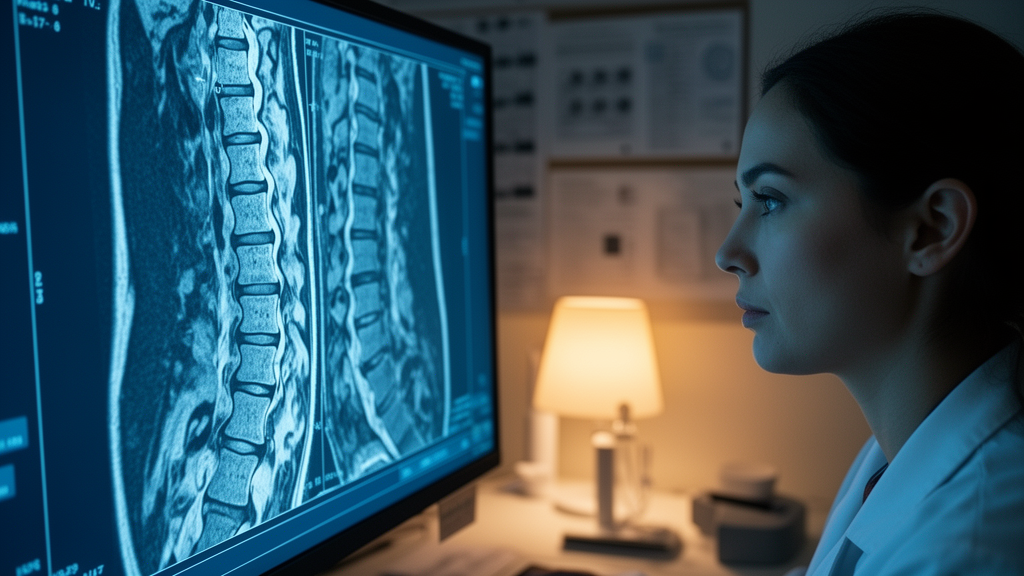
Every year, millions of people undergo chest or abdominal CT scans for reasons that have nothing to do with their spine. Yet hidden inside those images, radiologists now believe, lies a largely untapped trove of diagnostic information: evidence of vertebral compression fractures that often go undiagnosed, silently accelerating osteoporosis and raising the risk of future breaks. A team of engineers and clinicians at the American University of Beirut has now built an end-to-end deep learning pipeline that mines these routine scans automatically, flagging both fractures and Schmorl’s nodes — disc herniations into the vertebral endplates — without any additional imaging, radiation, or cost to the patient.
The clinical motivation is stark. Osteoporotic vertebral compression fractures are among the most common skeletal injuries in older adults, yet they frequently escape detection because patients are rarely evaluated for bone health when they come in for unrelated imaging. Many fractures are asymptomatic or produce only vague symptoms, and dedicated osteoporosis screening remains underutilized due to cost, access barriers, and the logistical burden of separate appointments. Opportunistic screening — extracting diagnostic value from imaging already acquired for other purposes — has emerged as a pragmatic way to close this care gap, and the Beirut team’s system is among the first to combine fracture detection, severity grading, and Schmorl’s node identification in a single deployed workflow.
Technically, the pipeline operates in two stages, both built on the YOLOv11 architecture, a recent generation of the You Only Look Once family of real-time computer vision models. The first stage is a segmentation model, based on the YOLOv11l-seg variant, that was trained on three public datasets — CTSpine1K, VerSe2019, and VerSe2020 — totaling nearly 1,500 CT volumes with expert-labeled vertebrae. After harmonization through isotropic resampling and standardized anatomical labeling, the model learned to localize, segment, and individually label every vertebra from C1 down to S1. Unlike U-Net-style semantic segmentation networks, YOLOv11 natively handles detection, segmentation, and classification in a single pass, which the researchers say was critical for the speed demanded by live clinical deployment.
The segmentation results are striking. When at least one end of the spine was visible in the scan, the model achieved 96 percent Top-1 accuracy in assigning the correct anatomical label to each vertebra, and even when both spinal extremities were absent from the field of view, accuracy only dropped to 86 percent. Top-3 accuracy — meaning the correct label appeared among the model’s three highest-ranked predictions — reached a perfect 100 percent in both conditions. The mean Intersection over Union, a standard measure of how closely predicted segmentation masks match ground truth, averaged 0.94, indicating near-perfect spatial overlap.
Once each vertebra is isolated and cropped, it flows into a multi-stage classification pipeline trained on a retrospectively curated institutional dataset of 5,000 CT scans from the American University of Beirut Medical Center, collected between 2016 and 2020 from patients aged 65 and older who underwent abdominal, pelvic, or lumbar imaging for non-spinal reasons. Two experienced radiologists annotated every vertebra using a custom-built DICOM labeling tool, applying the Genant semi-quantitative grading method — the clinical gold standard that classifies fractures as mild, moderate, or severe based on the degree of vertebral height loss. An initial consensus phase on 500 scans calibrated the annotators before the remaining scans were divided between them.
The classification cascade itself is elegantly layered. A primary classifier first assigns each vertebra to one of three categories: normal, fractured, or unknown — the latter serving as a safety valve for cases obscured by motion artifacts, surgical hardware, or severe degenerative change, which are automatically routed to a radiologist for mandatory review. Vertebrae flagged as fractured then pass to a severity grader, while all confidently classified vertebrae are additionally screened for Schmorl’s nodes by a separate binary detector. The outputs are aggregated per vertebra as multi-label results, allowing clinicians to see, for example, both a moderate fracture and a co-occurring Schmorl’s node on the same vertebral body.
Performance on held-out test data was strong across the board. The primary fracture classifier reached 92.7 percent vertebra-level accuracy, with 92.6 percent sensitivity, 95.8 percent specificity, and an F1-score of 91.6 percent for fractured vertebrae — figures that match or exceed most published approaches, including a commercially deployed algorithm from Zebra Medical that achieved only 68 percent sensitivity in a real-world evaluation. Schmorl’s node detection achieved 91.9 percent accuracy with an F1-score of 93.5 percent for the Schmorl class, which the authors believe is the first reported benchmark for automated Schmorl’s node detection from CT. Severity grading proved harder, at 85.0 percent overall accuracy, with the moderate category the weakest link — a limitation the team attributes largely to the opportunistic nature of the scans, which were not acquired with bone-optimized protocols and therefore carry reduced vertebral resolution.
End-to-end evaluation of the full pipeline, from raw CT input through segmentation, classification, and web-based visualization, showed an overall success rate of 85 percent — defined as cases where every vertebra was correctly segmented and classified — and 90 percent multi-label consistency with radiologist consensus. To make the system interpretable rather than a black box, the researchers applied Eigen-CAM, a gradient-free technique that computes principal components of the final convolutional feature maps to produce spatial heatmaps. These visualizations revealed clinically meaningful patterns: normal vertebrae produced compact central activations, mild fractures shifted attention toward the superior endplate, moderate fractures spread diffusely across the vertebral body, severe fractures concentrated sharply at the site of collapse, and Schmorl’s nodes appeared as focused circular hotspots at the endplate — mirroring the very progression described by the Genant grading system.
Perhaps the most distinctive feature is what happens after deployment. The system is live at AUBMC, integrated into routine radiology workflows through a React-based web platform where radiologists can review every per-vertebra prediction, view confidence scores, and override results with a single click. Every correction is logged and stored alongside the original model output, creating a continuously growing pool of expert-validated annotations. These feed scheduled retraining cycles — with strict separation between training and evaluation data to prevent leakage, and systematic benchmarking before and after each retraining to verify genuine improvement — meaning the model steadily adapts to the institution’s real data distribution over time.
The team deliberately trained and tested on messy, heterogeneous, real-world imaging rather than pristine curated datasets, incorporating variability in scanner vendors, reconstruction kernels, slice thickness, contrast administration, and patient positioning. That choice makes the reported numbers a more honest reflection of clinical performance, and it positions the pipeline as a practical blueprint for bringing AI-assisted vertebral screening into everyday radiology. Looking ahead, the researchers plan to extend the system to MRI and DEXA imaging, fuse clinical data for personalized fracture risk assessment, and use large language models to automate structured reporting — steps that could transform a routine chest scan into a comprehensive, opportunistic bone health checkup for millions of older adults.
Subject of Research: Deep learning detection of vertebral fractures and Schmorl's nodes from routine CT scans
Article Title: End-to-end deep learning pipeline for opportunistic vertebral fracture and Schmorl’s node detection from routine CT scans
Article References: Hasan, H., El-Hajj Fuleihan, G., Natout, M., Mohanna, A., Tajeddine, R., Rafeh, W., Saleh, F., El Alam, R., Chahine, R., Khoury, N., & Chehab, A. (2026). End-to-end deep learning pipeline for opportunistic vertebral fracture and Schmorl’s node detection from routine CT scans. Frontiers in Musculoskeletal Disorders, 4, Article 1718482. https://doi.org/10.3389/fmscd.2026.1718482
Image Credits: AI Generated
DOI: 10.3389/fmscd.2026.1718482
Keywords: deep learning, vertebral fracture, opportunistic screening, osteoporosis, CT imaging, YOLOv11, Schmorl's nodes, medical AI, End-to-end, deep, learning, pipeline
Cite Scienmag News
Ophelia Keating. (October 16, 2026). AI Turns Routine CT Scans Into a Silent Spine Screening Machine. Scienmag. https://scienmag.com/ai-turns-routine-ct-scans-into-a-silent-spine-screening-machine/
Ophelia Keating. "AI Turns Routine CT Scans Into a Silent Spine Screening Machine." Scienmag, 16 October 2026, https://scienmag.com/ai-turns-routine-ct-scans-into-a-silent-spine-screening-machine/. Accessed 16 October 2026.
Ophelia Keating. "AI Turns Routine CT Scans Into a Silent Spine Screening Machine." Scienmag. October 16, 2026. https://scienmag.com/ai-turns-routine-ct-scans-into-a-silent-spine-screening-machine/


