


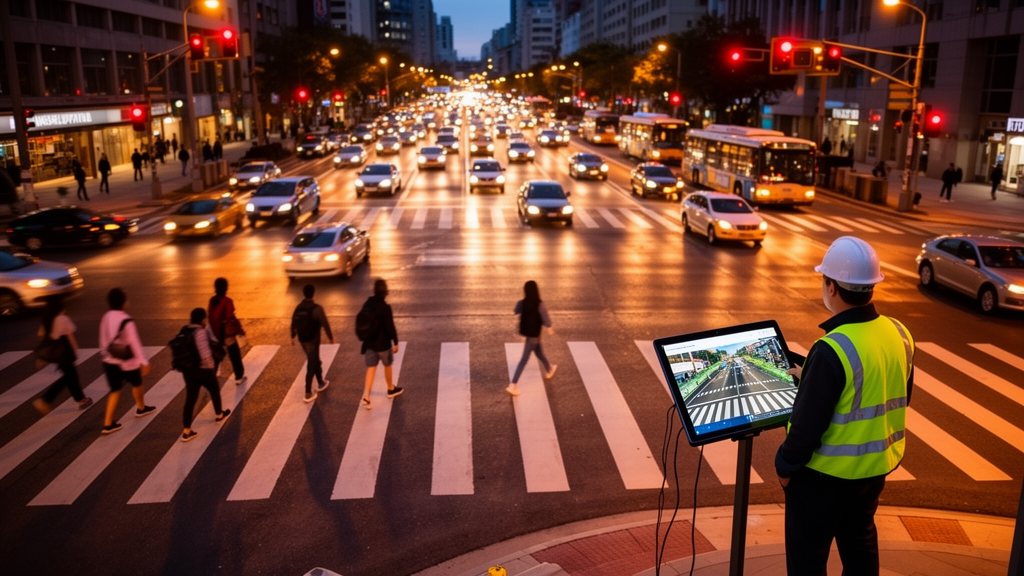
Every day, at thousands of intersections around the world, a quiet and deadly negotiation takes place. A driver wants to turn left. A pedestrian wants to cross. The traffic signal, for all its blinking authority, was never really designed to referee this encounter. Now a team of researchers at Columbia University has taught an artificial intelligence to do exactly that — and the results suggest our cities’ most dangerous crosswalks could become dramatically safer without grinding traffic to a halt.
The study, published in Frontiers in Future Transportation, introduces PedSLight, a reinforcement learning framework that puts pedestrian safety directly inside the brain of the traffic light. Led by Yongjie Fu, Zhangjing Cheng, Bowen Fang, and Xuan Di, the work tackles one of the most stubborn dilemmas in urban traffic engineering: the permissive left turn. Under this common signal arrangement, drivers turning left must yield to oncoming traffic while simultaneously watching for pedestrians crossing legally in their path. It is a geometry tailor-made for conflict, and it accounts for a substantial share of severe pedestrian-vehicle crashes at signalized intersections.
What makes PedSLight genuinely different from previous attempts at safety-aware signal control is where the safety information lives. Conventional approaches bolt pedestrian protection onto the signal through structural fixes — protected-only left-turn phases, all-red intervals, or rule-based constraints. These work, but they are blunt instruments. PedSLight instead embeds a measure of pedestrian conflict risk directly into the optimization objective itself, the mathematical reward the learning agent is trying to maximize. The AI doesn’t just avoid unsafe configurations because a rule forbids them; it actively learns that conflicts are costly and seeks timing plans that minimize them, while still keeping traffic moving.
The safety metric at the heart of the system is time-to-collision, or TTC, a classic concept in traffic safety research dating back to Hayward’s near-miss formulations in 1972. TTC estimates the remaining time before two agents on constant-speed trajectories would collide. The researchers use a threshold-based version: for every left-turn vehicle and every pedestrian in a geometrically conflicting stream, the controller projects each agent’s arrival time at the conflict boundary — the edge of the crosswalk region where their paths intersect. If the two arrival times fall within a predefined TTC threshold, a potential conflict event is recorded. The cycle-level safety cost is simply the total count of such near-conflict events accumulated over the entire signal cycle.
This conflict count is then combined with a waiting-time efficiency signal in a weighted reward, and the whole thing is trained using Proximal Policy Optimization, or PPO, one of the most stable and widely used deep reinforcement learning algorithms. The weighting parameter controls the relative emphasis on safety, giving traffic engineers explicit, tunable control over the efficiency-safety trade-off. Importantly, the authors are candid that this is not a hard safety guarantee — the reward penalizes expected conflict exposure but cannot promise every action is conflict-free. For real-world deployment, they argue, the learned policy should sit beneath a runtime-assurance layer that verifies minimum greens, clearance intervals, and mutually exclusive movements before anything is executed.
The decision structure is also carefully engineered. Rather than updating signal phases every few seconds — a practice that can produce rapid, destabilizing phase switching — PedSLight makes its decisions at cycle boundaries. Each signal cycle lasts 100 seconds, and at the start of every cycle the controller selects continuous allocation ratios that determine how green time is split between protected and permissive left-turn phases for the north-south and east-west directional groups. The action remains fixed for the entire cycle. This design ensures phase stability while still allowing the AI to adaptively adjust left-turn protection intensity as traffic conditions evolve.
The controller’s perception is equally sophisticated. The system observes a direction-aware traffic state tensor built from a Discrete Traffic State Encoding: twelve movement groups spanning four approaches, each containing pedestrian, through, and left-turn streams; ten non-uniform distance bins along the longitudinal space, with finer resolution near the intersection to better capture pedestrian-vehicle interaction dynamics; and two feature channels carrying binary occupancy and average speed. The geometry-awareness extends to the safety computation itself — pedestrian candidates are filtered by movement direction consistent with the turning conflict and by their spatial location on the turn-in side of the intersection, reflecting the actual geometry of permissive-left-turn encounters.
Simulated in the microscopic traffic simulator SUMO, at a four-leg intersection and then extended to a three-intersection arterial corridor, PedSLight was benchmarked against actuated and fixed-time controllers under multiple demand levels. At the single intersection, the results revealed a nuanced picture. Under low-to-medium demand, the actuated controller achieved the lowest travel time, and PedSLight was slightly inferior when efficiency dominated. But as the safety emphasis increased in the evaluation scoring, PedSLight improved its relative ranking and achieved competitive or superior overall scores. Under medium-to-high demand, the advantage became clearer: PedSLight ranked near the top even when efficiency dominated, and its position remained stable as safety emphasis grew. Fixed-time controllers, by contrast, showed strong sensitivity to their preset signal splits, with travel times climbing steeply as protected-turn allocation increased.
The corridor results were even more striking. In the three-intersection setting, where each intersection is controlled by an independent PPO agent observing only local states, fixed-time control proved highly fragile. Moderate increases in protected-turn allocation led to severe efficiency degradation, with average travel times reaching 146.87 and 212.56 seconds — three to five times higher than the remaining configurations — as congestion propagated through the corridor. The learned multi-agent policy, meanwhile, attained the lowest average travel time of 42.52 seconds and the lowest TTC-based safety cost of 1.662 among all evaluated controllers. Crucially, PedSLight was the only policy that simultaneously improved both metrics, whereas fixed-timing strategies exhibited a pronounced trade-off between them.
The implications reach well beyond the simulation. Pedestrian-intensive intersections with permissive left turns — the kind found in dense urban cores from New York to Tokyo — are precisely where the efficiency-safety dilemma bites hardest. The framework enables explicit trade-off control through stable cycle-boundary updates and supports simulation-based evaluation before any real-world deployment. The authors note that corridor training remains sensitive to reward scaling and multi-agent update stability, and future work will expand to larger networks with cooperative multi-agent training, allowing neighboring controllers to share information and jointly optimize network-wide efficiency and pedestrian safety. But the core message is already clear: the traffic light can learn to watch for pedestrians, not just cars — and the cities that deploy such systems first may finally resolve the deadly negotiation at their crosswalks.
Subject of Research: PedSLight: pedestrian and safety-aware reinforcement learning for mixed pedestrian-vehicle signal control
Article Title: PedSLight: pedestrian and safety-aware reinforcement learning for mixed pedestrian-vehicle signal control
Article References: PedSLight: pedestrian and safety-aware reinforcement learning for mixed pedestrian-vehicle signal control. (n.d.). https://doi.org/10.3389/ffutr.2026.1953597
Image Credits: AI Generated
DOI: 10.3389/ffutr.2026.1953597
Keywords: PedSLight, pedestrian, safety-aware, reinforcement, learning, mixed, pedestrian-vehicle, signal, control, scientific research
Cite Scienmag News
Cassandra Pierce. (October 16, 2026). PedSLight: pedestrian and safety-aware reinforcement learning for mixed pedestrian-vehicle signal control. Scienmag. https://scienmag.com/pedslight-pedestrian-and-safety-aware-reinforcement-learning-for-mixed-pedestrian-vehicle-signal-control/
Cassandra Pierce. "PedSLight: pedestrian and safety-aware reinforcement learning for mixed pedestrian-vehicle signal control." Scienmag, 16 October 2026, https://scienmag.com/pedslight-pedestrian-and-safety-aware-reinforcement-learning-for-mixed-pedestrian-vehicle-signal-control/. Accessed 16 October 2026.
Cassandra Pierce. "PedSLight: pedestrian and safety-aware reinforcement learning for mixed pedestrian-vehicle signal control." Scienmag. October 16, 2026. https://scienmag.com/pedslight-pedestrian-and-safety-aware-reinforcement-learning-for-mixed-pedestrian-vehicle-signal-control/


