


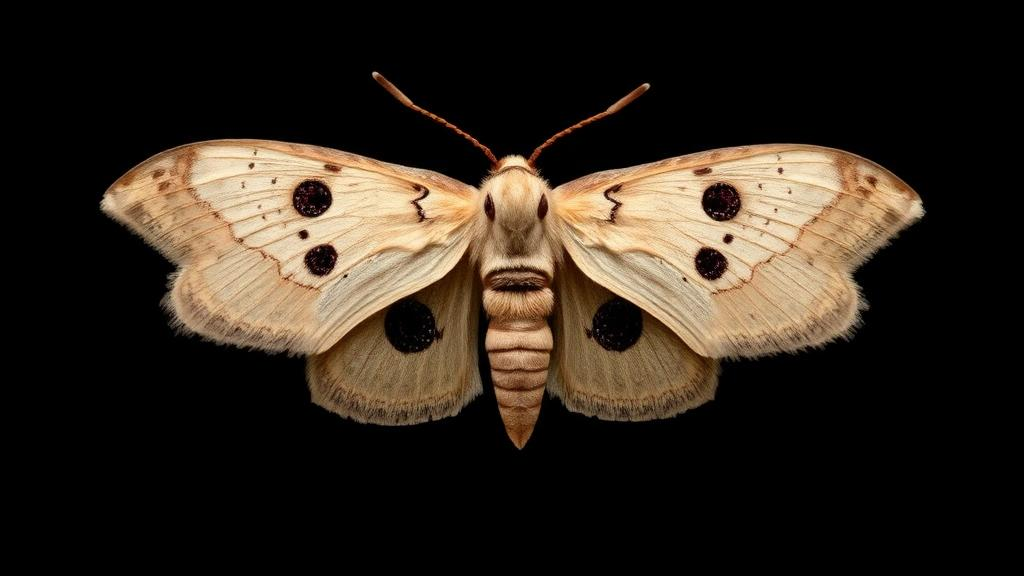
On the small volcanic island of Lanyu, off the southeastern coast of Taiwan, entomologists have uncovered two moth genera never before recorded on the island, including one species entirely new to science. The discovery, published in the Deutsche Entomologische Zeitschrift, adds two genera of the leafroller moth tribe Olethreutini to Taiwan’s fauna and formally names the new species Xenolepis syamanlamurani Lu, Hsu & Hsu, sp. nov. The findings push Taiwan’s tally of olethreutine genera to 37 and its species count to 104, and they hint that the island’s insect fauna is more closely tied to Southeast Asia than to the main island of Taiwan itself.
Olethreutini is a large tribe within the tortricid moth subfamily Olethreutinae, a group that includes many economically significant pests. The tribe encompasses more than one hundred genera and over one thousand species worldwide. Despite its size, the tribe remains difficult to define cleanly: no single convincing synapomorphy, or shared derived character, has been identified that unites all of its members. Some traits, such as a tibial pencil with a modified anal fold structure on the hindwing and a sacculus bearing one or two spine clusters, appear only in this tribe, yet not all members possess them. This ambiguity makes every new record and description a meaningful contribution to understanding the group’s diversity and evolutionary relationships.
The story of Olethreutini in Taiwan began with a checklist compiled by Kawabe and colleagues in 1992, which recorded 30 genera and 59 species. Two decades later, Heppner’s 2012 catalogue added one genus and 12 species, though it omitted taxa treated by Bae in his 1993 review of the genus Lobesia, which had added two new and three newly recorded species, as well as Kawabe’s 1993 description of Apotomis fuscomaculata. Most recently, Sun and Li provided a comprehensive new checklist in 2024, raising the count to 35 genera and 102 species. The new study, conducted by researchers rearing larvae collected during field trips to Lanyu Island, now brings those numbers to 37 genera and 104 species.
The first newly recorded genus, Metendothenia Diakonoff, 1973, is represented on Lanyu by the species Metendothenia mesarotra (Meyrick, 1911), originally described from the Solomon Islands. The researchers reared this moth from two host plants on the island: Drypetes littoralis and Putranjiva formosana, both members of the family Putranjivaceae. Previously documented larval hosts included Mischocarpus sundaicus (Sapindaceae) in the Oriental region and Putranjiva matsumurae in Japan, indicating that this species feeds on a range of unrelated plants. The genus itself is characterized by a suite of features: males bear a groove on the inner side of the hind-tibia housing a tibial pencil, the hindwing carries an anal lobe, the valva is often asymmetrical with more setae on the left one, the phallus is slender and usually armed with minute ventral spines, the sacculus is complex and sometimes bears a setose expanded process, the ostium bursae is dilated posteriorly, and the corpus bursae carries a scobinate signum.
Metendothenia currently includes 18 species distributed across the Holarctic, Afrotropical, Oriental and Australasian regions, though the genus is acknowledged to require further revision. The Lanyu population of M. mesarotra shows no differences from populations in Japan, where immature stages were previously described from Okinawa. The species is most similar to M. organica, known only from a single female collected in Sri Lanka; the two share a similar wing pattern but can be separated by the length of the antrum, which is shorter than one quarter of the ductus bursae in M. organica but longer than one third in M. mesarotra. The new Taiwanese record fills a distributional gap between Indonesia and Japan, and the authors suggest the species may prove to be widely distributed across the islands lying between Lanyu and Java.
The second newly recorded genus, Xenolepis Diakonoff, 1973, yielded the study’s headline discovery: an undescribed species now named Xenolepis syamanlamurani. The genus is diagnosed by male genitalia characters including a conical uncus, small socii, a narrow gnathos, a moderately long and weakly sclerotized tuba analis, a slender valva covered with apically bifurcate spines bent medially, a short sacculus bearing a tuft of short setae and a group of slender setae projecting beyond it, spines at the ventral base of the cucullus, and a curved phallus lacking cornuti. Seven species had been described prior to this study, mainly distributed in the Oriental and Australasian regions.
Xenolepis syamanlamurani was reared from larvae found on young leaves of Rourea minor (Connaraceae), a host plant family newly documented for the genus. Most previously reared specimens of Xenolepis came from Syzygium species in the family Myrtaceae, so the new record implies the genus is probably not host specific. The larvae tie leaves together to form a shelter in which they feed and eventually pupate, and the study provides the first images ever published of the immature stages of Xenolepis. The species belongs to the second of two species groups proposed within the genus, characterized by forewings with bright orange blotches and dark brown patches and hindwings lacking a deep cleft. Based on COI barcode data, Brown and Miller suggested this second group may actually represent a distinct new genus, a question that will require further revision.
The new species is very similar in wing pattern to X. apicula and X. cultrata, both described from Thailand in 2022. Adults of X. syamanlamurani can be distinguished from those two congeners by the connected basal patch and median fascia of the forewing, whereas the two Thai species show these markings separated. In the male genitalia, X. syamanlamurani and X. cultrata share a relatively straight cucullus compared with the curved cucullus of X. apicula, but the new species differs from X. cultrata in that the dorsal margin of the cucullus is slightly curved at the apical third rather than straight, and the ratio of valva length to sacculus length is 5:1 rather than 4:1. Males have antennae measuring 2.20 to 2.88 millimeters and forewings 3.42 to 4.28 millimeters long; females are similar but slightly larger in forewing length, at 3.78 to 4.34 millimeters, and lack the hair pencil on the hindwing anal margin seen in males.
The specific name syamanlamurani honors Dr. Syaman Lamuran (En-Tzu Tung), a friend of the authors who has made numerous contributions to research on the traditional ecological knowledge of the Tao people, Taiwan’s indigenous inhabitants of Lanyu Island, and whose assistance during field trips made the work possible. The type series, reared from larvae collected at Qiwei and Chungai bridge on Lanyu at elevations of 50 to 200 meters, will be deposited in the National Museum of Natural Science in Taichung, Taiwan, and The Natural History Museum in London. The holotype male was collected on 16 April 2023 and emerged as an adult on 1 May 2023.
Both genera are known in Taiwan only from Lanyu Island and the Hengchun Peninsula at the island’s southern tip. This pattern echoes a broader biogeographic affinity: several lepidopteran species on Lanyu are more closely allied with the fauna of the Philippines and Sundaland than with that of main island Taiwan. Hasora mixta, a skipper mainly distributed in Sundaland, has a subspecies endemic to Lanyu, and Macroglossum ungues, a hawkmoth ranging from Indonesia to the Philippines, has a Taiwanese subspecies representing its northernmost population. The authors suggest it is worth investigating whether Xenolepis occurs on main island Taiwan, and whether these two olethreutine genera are present in the Philippines. For now, the tiny island’s moths continue to reveal connections across the seas of Southeast Asia, one leaf-tying larva at a time.
Subject of Research: Discovery of two newly recorded olethreutine moth genera on Lanyu Island, Taiwan, with description of the new species Xenolepis syamanlamurani
Article Title: Two newly recorded genera of the tribe Olethreutini ( Lepidoptera , Tortricidae ) from Lanyu Island, Taiwan, with a description of a new species
Article References: Lu, Y.-Y., Hsu, Y.-M., Lin, H.-Y., & Hsu, Y.-F. (2026). Two newly recorded genera of the tribe Olethreutini (Lepidoptera, Tortricidae) from Lanyu Island, Taiwan, with a description of a new species. Deutsche Entomologische Zeitschrift, 73(2), 289-298. https://doi.org/10.3897/dez.73.191917
Image Credits: AI Generated
Keywords: Tortricidae, Olethreutini, Lanyu Island, Taiwan, new species, Metendothenia, Xenolepis, entomology, Lepidoptera, biogeography, newly, recorded
Cite Scienmag News
Drew Townsend. (October 16, 2026). Two New Moth Genera Recorded from Taiwan’s Lanyu Island, One New Species Described. Scienmag. https://scienmag.com/two-new-moth-genera-recorded-from-taiwans-lanyu-island-one-new-species-described/
Drew Townsend. "Two New Moth Genera Recorded from Taiwan’s Lanyu Island, One New Species Described." Scienmag, 16 October 2026, https://scienmag.com/two-new-moth-genera-recorded-from-taiwans-lanyu-island-one-new-species-described/. Accessed 16 October 2026.
Drew Townsend. "Two New Moth Genera Recorded from Taiwan’s Lanyu Island, One New Species Described." Scienmag. October 16, 2026. https://scienmag.com/two-new-moth-genera-recorded-from-taiwans-lanyu-island-one-new-species-described/

