


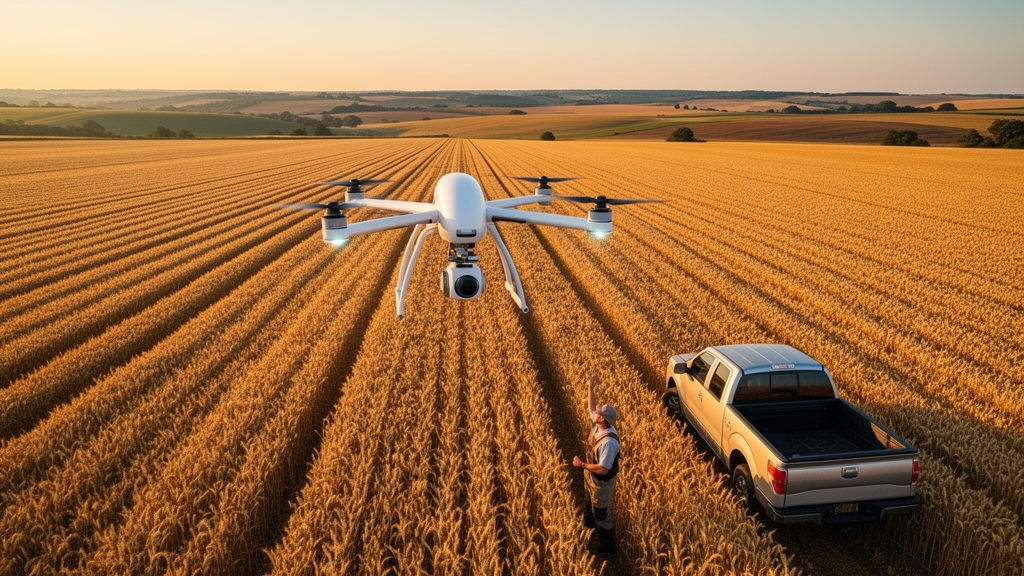
Deep learning has transformed the way researchers monitor crops from the air, but it has always come with an expensive catch: someone has to label the images. Now, a team at the Leibniz Centre for Agricultural Landscape Research in Germany has shown that a neural network can teach itself to read drone imagery of four very different summer crops, and then predict their yields with competitive accuracy, all without a single label during the crucial learning stage. The study, published in Artificial Intelligence in Agriculture, could reshape how precision agriculture handles the small, diversified fields that dominate much of the world’s farmland.
The experiment took place at patchCROP, a 70-hectare landscape laboratory in Brandenburg established in 2020. The site consists of 30 small fields, each roughly half a hectare, deliberately arranged to combine different crop rotations, soil qualities, and management practices, including conventional and reduced pesticide use, with and without flower strips at field edges. This patchwork of conditions is exactly the kind of environment where conventional supervised models struggle, because researchers typically need a separate model for every crop type and management context, and labeled data are scarce.
Stefan Stiller, Kathrin Grahmann, and Masahiro Ryo focused on four summer crops grown during the 2020 season: lupine, maize, soybean, and sunflower, spread across 14 fields. A senseFly eBee X drone flew at 84 meters, capturing high-resolution RGB images with a ground sampling distance of 2.22 centimeters. Flights were timed to specific phenological stages on the BBCH scale, between flowering and fruit development, when canopy structure is strongly developed and consistently observable in ordinary color imagery. Combine harvesters then recorded georeferenced yield points along standardized paths, between 100 and 300 raw points per field, which the team meticulously cleaned by removing errors at harvest path ends, points affected by speed changes or turns, and values adjusted to standard moisture content.
The technical heart of the study is self-supervised learning, specifically the VICReg algorithm, which stands for Variance-Invariance-Covariance Regularization. Unlike contrastive frameworks such as SimCLR, which require large datasets to construct reliable negative pairs, non-contrastive approaches like VICReg learn by enforcing consistency between augmented views of the same image. The model applies transformations such as flips, rotations, random cropping, and color jittering to create two views of each patch, then trains its embeddings to be similar across views while a variance term ensures the features remain diverse and a covariance term reduces redundancy among feature dimensions. The authors lowered the variance and invariance weights from the original setting of 25 to 1.25, adapting the loss balance to the moderate global variability and strong local heterogeneity of agricultural drone imagery.
For pre-training, the researchers applied a sliding window algorithm across the full images of all 14 fields, extracting patches of 224 by 224 pixels, roughly 5 by 5 meters on the ground, with a stride of about 1.3 meters. This generated 15,304 unlabeled samples covering every crop type. The model learned to encode plant morphology, canopy texture, color gradients, and field characteristics into high-dimensional numerical vectors called representations, which summarize the visual content of an image in a way that can be reused across tasks. Only afterward did the team attach a simple prediction head and fine-tune it, crop by crop, on small labeled datasets of 302 to 1023 yield-labeled image patches centered on harvester yield points, while freezing the pre-trained convolutional backbone.
The results were revealing. When the researchers projected the learned embeddings into two dimensions using UMAP, images of the same crop type formed visible clusters without any labels, and a k-nearest neighbor classifier confirmed the model could distinguish crop types with an average accuracy of 0.71, ranging from 0.62 for soybean to 0.82 for sunflower. Remarkably, the embeddings also clustered by management practice with an average accuracy of 0.80, suggesting the model had picked up on visual signatures of conventional versus reduced pesticide use and flower strips. Some confusion remained between sunflower and maize, and between lupine and soybean, reflecting overlap in the embedding space.
For yield prediction, the self-supervised approach with the modern ConvNeXt Tiny architecture achieved a statistically significant improvement in Pearson’s correlation over conventional supervised training, with a mean field-level correlation of 0.34 versus 0.28 across the 14 fields. The best self-supervised models predicted with higher mean performance for maize, soybean, and sunflower, and marginally lower for lupine. With the lightweight ResNet18 architecture, no significant superiority emerged. The authors stress that the best performing model depended on crop type, architecture, and evaluation metric, so the results do not show overwhelming support for the hypothesis that self-supervised models always outperform supervised ones.
Yet a quieter finding may be more important than the headline numbers. When models were transferred from validation to held-out test data within each field, the self-supervised versions showed significantly smaller performance drops: a decline of 0.08 in correlation for ResNet18 versus 0.24 for supervised training, and 0.06 versus 0.11 for ConvNeXt Tiny. This suggests the representations learned without labels are more robust and transferable under the heterogeneous conditions of real agriculture, where data rarely satisfy the assumption of identical distributions between training and test sets. Prior work has shown that self-supervised learning enhances robustness to input corruptions and data imbalance, and the new results align with that picture.
The implications reach beyond a single experimental site. Conventional supervised yield prediction typically requires a multitude of crop-specific models, as seen in separate studies for winter wheat, barley, and soybean, each tailored to particular conditions. By decoupling representation learning from the yield signal, self-supervised training captures a broader spectrum of morphological and field texture patterns, including rare visual signatures that skewed yield distributions would otherwise suppress. A single pre-trained model can then serve multiple downstream tasks through comparatively lightweight fine-tuning, reducing both annotation effort and computational requirements in diversified small-field agriculture.
The authors acknowledge limitations: the evaluation covered a single site and one growing season, so conclusions about inter-site or inter-annual transferability remain open, and the spatial cross-validation design did not fully exceed the semivariogram range of spatial autocorrelation. Future work could combine self-supervised learning with multitemporal, multispectral, and physics-informed modeling, and test the approach across multiple regions, soil types, and years. As vision foundation models advance in agriculture and ecology, the study points toward unified agricultural models that could serve crop classification, yield prediction, and stress detection within a single framework, bringing data-efficient artificial intelligence to the diversified farms where it is needed most.
Subject of Research: Self-supervised learning enables label-free crop yield prediction across diversified cropping systems
Article Title: Self-supervised learning for crop yield prediction across diversified cropping systems
Article References: Stiller, S., Grahmann, K., & Ryo, M. (2026). Self-supervised learning for crop yield prediction across diversified cropping systems. Artificial Intelligence in Agriculture. https://doi.org/10.1016/j.aiia.2026.10.002
Image Credits: AI Generated
DOI: 10.1016/j.aiia.2026.10.002
Keywords: self-supervised learning, crop yield prediction, VICReg, drone imagery, precision agriculture, diversified cropping systems, Self-supervised, learning, crop, yield, prediction, across
Cite Scienmag News
Alan Morgan. (October 16, 2026). Self-supervised AI learns to predict crop yields without labels. Scienmag. https://scienmag.com/self-supervised-ai-learns-to-predict-crop-yields-without-labels/
Alan Morgan. "Self-supervised AI learns to predict crop yields without labels." Scienmag, 16 October 2026, https://scienmag.com/self-supervised-ai-learns-to-predict-crop-yields-without-labels/. Accessed 16 October 2026.
Alan Morgan. "Self-supervised AI learns to predict crop yields without labels." Scienmag. October 16, 2026. https://scienmag.com/self-supervised-ai-learns-to-predict-crop-yields-without-labels/


