


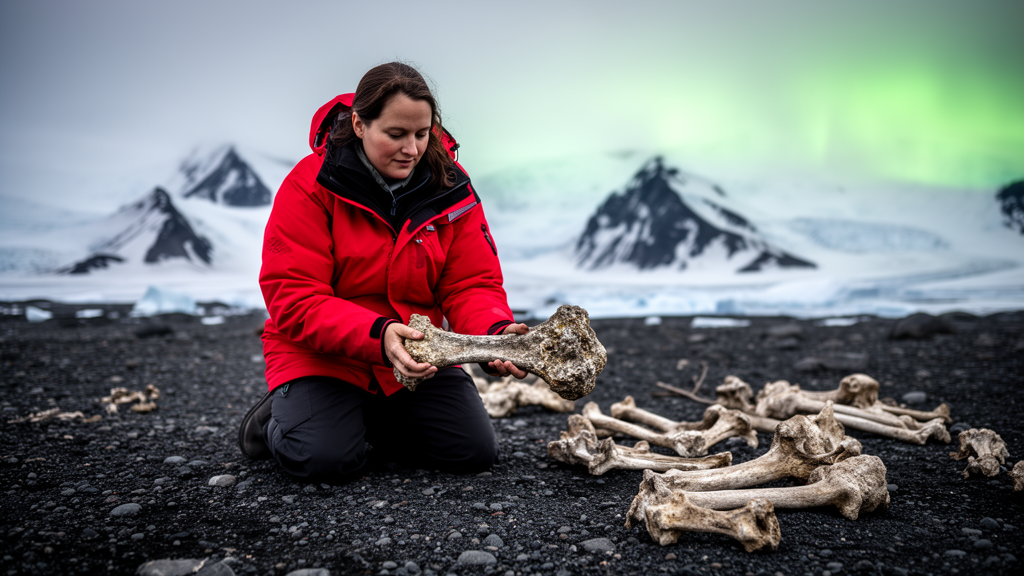
Deep in the frozen sediments of Seymour Island, off the northeastern tip of the Antarctic Peninsula, lies one of the richest penguin fossil records on Earth. Now, a team of researchers has shown that these 50-million-year-old bones do more than document the evolution of ancient penguins—they also act as tiny geochemical archives of Antarctica’s climate history. By scanning Eocene penguin fossils with micro-X-ray fluorescence (µ-XRF), scientists have uncovered elemental fingerprints that trace how weathering, sediment dynamics, and burial chemistry shifted as the continent slid from greenhouse warmth toward the chill that eventually birthed its great ice sheets.
The study, published in the journal Fossil Record, focused on fossils collected during Chinese–Chilean Antarctic research expeditions in 2020 and 2024. Three fossil specimens—catalogued as CUGB P2003, P2004, and P2005—span three distinct stratigraphic intervals of the Eocene succession on Seymour Island, ranging from about 55.3 to 37.7 million years ago. Two modern comparative specimens, a chinstrap penguin collected near Great Wall Station on King George Island and an emperor penguin from near Zhongshan Station on Penguin Island, provided a biological baseline for distinguishing diagenetic alteration from original bone chemistry.
The analytical centerpiece was a Bruker M6 Jetstream mobile XRF scanner housed at the Micro-X-ray Fluorescence Imaging Laboratory of the China University of Geosciences in Beijing. The instrument fired a rhodium-target X-ray beam, focused to a spot smaller than 50 micrometers, across the bone surfaces while a silicon drift detector recorded the fluorescence signals. Scanning proceeded in ambient air rather than in a vacuum chamber, a choice that spared the large, fragile fossils from pressure-induced stress while still delivering reliable elemental detection. Each pixel was sampled for 10 milliseconds at a 50-micrometer step size, and the full mapping field—covering 2,651 by 1,968 pixels—took nearly 19 hours to acquire.
The spectra revealed eleven primary elements in the bones: calcium, iron, strontium, manganese, phosphorus, potassium, titanium, silicon, sulfur, aluminum, and zinc. Calcium and phosphorus, the building blocks of bone bioapatite, showed strong, broadly continuous signals in both fossil and modern bones, with slightly higher intensities at the dense midshafts than at the articular ends. But the story of interest lay in the elements that should not be there at all—silicon, potassium, and titanium, which are hallmarks of terrestrial weathering rather than of living bone tissue.
The standout result came from the oldest specimen, CUGB P2004, recovered from the Telm 2 subunit of the La Meseta Formation and dated to 55.3–54.1 million years ago, in the lower Ypresian stage of the early Eocene. This fossil showed the highest mean µ-XRF values for silicon, potassium, and titanium of any sample, with titanium signals roughly double those of the two younger fossils and far exceeding the near-background levels measured in the modern bones. These elements formed continuous, high-intensity enrichments across most of the bone surfaces, and their spatial patterns tracked one another closely.
Titanium is the key to interpreting this pattern. Because titanium is highly immobile and nearly insoluble under typical surface weathering conditions, it survives transport and early diagenesis largely unaltered, making it one of the most reliable geochemical tracers of terrestrial input. Its stable +4 oxidation state and biological inertness further bolster its credentials as a proxy for continental weathering fluxes. The elevated titanium, silicon, and potassium signals in the early Eocene bones therefore point to a surge of weathering-derived material washing into the depositional basin—consistent with paleoclimatic reconstructions indicating warm, humid conditions in Antarctica during the Early Eocene Climatic Optimum, when intensified chemical weathering on adjacent landmasses would have flushed clays and silts into nearshore marine environments.
Depositional energy added a second layer of control. The lower La Meseta Formation, where CUGB P2004 was found, consists of fine-grained sediments laid down in low-energy, mid- to outer-shelf settings. Under such quiet conditions, bones would have lingered in prolonged contact with porewater circulating through silicon- and potassium-bearing detrital and authigenic phases, allowing clay- and silt-derived material to infiltrate bone porosity and coat bone surfaces. By contrast, the younger specimens—CUGB P2005 from Telm 5, dated to 49.1–45.8 million years ago, and CUGB P2003, assigned to the giant penguin Palaeeudyptes sp. from the Submeseta Formation at 41.2–37.7 million years ago—were deposited in higher-energy, nearshore environments dominated by coarser sediments, stronger currents, and glacial debris. Their bones show markedly lower and more patchy silicon, potassium, and titanium signals, consistent with episodic reworking and rapid burial that shortened bone–porewater interaction times.
Redox chemistry left its own signature. Iron and manganese were elevated in all three fossil specimens relative to both modern bones and background levels, and their heat maps displayed irregular, patchy distributions across the bone surfaces. Such heterogeneity is exactly what repeated cycles of local reduction and oxidation during burial would produce: under reducing conditions, ferrous iron and divalent manganese stay mobile in porewater, while under oxidizing conditions they precipitate as oxyhydroxides within bone pores and on bone surfaces. Sulfur told a complementary story—nearly absent in CUGB P2004 but strongly enriched in localized zones of CUGB P2005, where sulfur hotspots partially overlap with iron-enriched areas. That spatial association suggests the precipitation of iron sulfides in reducing microenvironments, plausibly driven by sulfate-reducing bacteria converting sulfate to sulfide, which then reacts with dissolved iron. The authors note that while µ-XRF cannot directly identify specific mineral phases, the observed iron–manganese enrichment and iron–sulfur colocalization fit models in which microbial and abiotic redox processes jointly govern secondary mineral formation in fossil bone.
Strontium and aluminum behaved more subtly. Strontium showed localized hotspots in the joint regions of the two younger fossils but remained uniformly low in CUGB P2004, and its mean values generally sat below background levels. Aluminum, despite being mobilized during intense weathering, stayed near background in all bones—partly because the low-energy aluminum Kα signal is attenuated under non-vacuum scanning conditions, and partly because aluminum tends to remain locked in detrital or authigenic aluminosilicates in the surrounding matrix rather than entering the bone apatite lattice. Zinc and aluminum values fell below background across the fossils, indicating that those measurements largely reflect analytical noise rather than genuine enrichment.
Taken together, the elemental patterns demonstrate that Eocene penguin bones preserve an integrated record of weathering intensity, evolving sediment dynamics, and redox conditions during the transition from extreme greenhouse warmth to subsequent cooling—a transition that culminated in major Antarctic glaciation at the Eocene–Oligocene boundary. The study is the first to reveal patterns of elemental variation across a sedimentary sequence using vertebrate fossils, forging a novel link between vertebrate fossil geochemistry and paleoenvironmental change on the Antarctic Peninsula. As the climate cooled from the middle to late Eocene, weathering intensity declined, terrestrial input to the basin waned, and the bones recorded the shift. For researchers probing how polar environments respond to extreme greenhouse warming—past, present, and future—these fossilized penguins may prove to be among the most eloquent witnesses of all.
Subject of Research: Geochemical analysis of Eocene penguin fossils as proxies for Antarctic weathering and paleoclimate change
Article Title: Eocene penguin fossils as archives of Antarctic weathering and climate change: insights from micro-X-ray fluorescence elemental mapping
Article References: Xia, B., Wu, H., & Li, Q. (2026). Eocene penguin fossils as archives of Antarctic weathering and climate change: insights from micro-X-ray fluorescence elemental mapping. Fossil Record, 29(2), 575-587. https://doi.org/10.3897/fr.29.192319
Image Credits: AI Generated
DOI: 10.3897/fr.29.192319
Keywords: penguins, Eocene, Antarctica, Seymour Island, micro-X-ray fluorescence, paleoclimate, weathering, diagenesis, fossil geochemistry, La Meseta Formation, Antarctic Peninsula, greenhouse–coolhouse transition
Cite Scienmag News
Gavin Prescott. (October 16, 2026). Ancient Penguin Bones Turned Stone-Like Archives Reveal Antarctica’s Greenhouse Past. Scienmag. https://scienmag.com/ancient-penguin-bones-turned-stone-like-archives-reveal-antarcticas-greenhouse-past/
Gavin Prescott. "Ancient Penguin Bones Turned Stone-Like Archives Reveal Antarctica’s Greenhouse Past." Scienmag, 16 October 2026, https://scienmag.com/ancient-penguin-bones-turned-stone-like-archives-reveal-antarcticas-greenhouse-past/. Accessed 16 October 2026.
Gavin Prescott. "Ancient Penguin Bones Turned Stone-Like Archives Reveal Antarctica’s Greenhouse Past." Scienmag. October 16, 2026. https://scienmag.com/ancient-penguin-bones-turned-stone-like-archives-reveal-antarcticas-greenhouse-past/


