


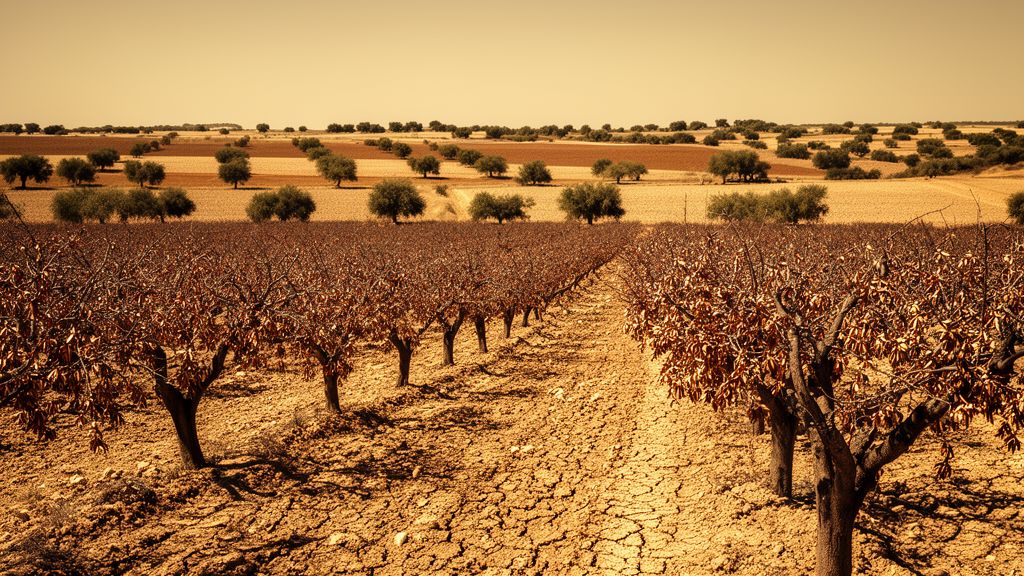
A bacterial invader that has already devastated olive groves in southern Italy is now rewriting the rules of plant disease management on the other side of the Mediterranean. In the almond orchards of Alicante, Spain, researchers have found that the damage inflicted by Xylella fastidiosa does not depend on the pathogen alone. Instead, the severity of defoliation and branch dieback emerges from a dangerous interplay between infection, drought stress, shrub encroachment and the composition of wild vegetation at the forest–agriculture boundary. The findings, published in the journal NeoBiota, challenge one of the most widely held assumptions in disease ecology: that greater plant diversity buffers crops against invading pathogens.
Xylella fastidiosa is a xylem-limited bacterium transmitted by sap-feeding insects such as Philaenus spumarius and Neophilaenus campestris. Once inside a host, it multiplies within the water-conducting vessels, physically occluding them and triggering hydraulic failure that manifests as leaf scorch, defoliation and progressive branch death. Since its first European detection in Apulian olive trees in 2013, the pathogen has spread across France, Portugal and Spain, where the Alicante demarcated area has become a stronghold of the X. fastidiosa subspecies multiplex sequence type ST6, the strain behind almond leaf scorch disease. Its extraordinary host range, encompassing hundreds of plant species, combined with its dependence on generalist insect vectors, makes it a paradigm of a polyphagous invader capable of exploiting both cultivated and natural ecosystems.
To understand what drives the impact of this invader, a research team surveyed 19 almond orchards embedded within a semi-arid Mediterranean mosaic of limestone hills, pine forests and cultivated land. The region receives a meagre 290 to 460 millimetres of annual precipitation under a mean temperature of roughly 18 degrees Celsius, conditions that already push vegetation to its physiological limits. Within each orchard, six almond trees were visually assessed for canopy defoliation and the proportion of dead branches on a continuous 0 to 100 percent scale, following protocols adapted from the International Co-operative Programme on Forests. Adjacent natural vegetation was surveyed along parallel 50-metre transects starting at the orchard edge, where every woody and herbaceous individual was recorded, its distance from the crop measured and its health evaluated through leaf discoloration and dead branch percentages.
Molecular diagnostics formed the backbone of the study. Plant material from almond trees and selected wild species was collected according to European and Mediterranean Plant Protection Organisation standard PM7/24, which prescribes sampling xylem-rich tissues to maximise detection probability. DNA was extracted using the CTAB method and screened with a duplex quantitative PCR protocol that simultaneously targets two independent genomic regions of the bacterium, combining the Harper and Ouyang assays. A sample was deemed positive only when both protocols amplified, with cycle quantification values at or below 35 considered positive, above 38 negative and intermediate values re-tested as inconclusive. The results confirmed the presence of X. fastidiosa in 36 of 114 sampled almond trees, allowing the team to classify 11 orchards as infected and 8 as uninfected at the time of sampling. Notably, two orchards with a clean surveillance history tested positive during the survey, while two previously classified as infected showed no detection, underscoring the temporal variability of bacterial loads and the insufficiency of visual symptoms alone for reliable inference of infection status.
The phytosanitary contrast between infected and uninfected trees was stark. Mean defoliation reached 53.9 percent in infected trees against 30.2 percent in uninfected ones, while dead branch proportions climbed to 37.0 percent versus 25.6 percent, differences that were statistically significant. In the adjacent vegetation, 353 individuals belonging to 22 species were sampled, of which 40, or 11.4 percent, tested positive for the pathogen. The highest incidence occurred in Ulex parviflorus at 37.5 percent, followed by Rhamnus alaternus, Cistus albidus and Salvia rosmarinus. Crucially, 87.5 percent of all positive wild-plant samples came from areas surrounding infected orchards, and the cycle quantification values in those plants were markedly lower, ranging from 16.3 to 38.0, indicating far higher bacterial concentrations than in vegetation near uninfected orchards, where values clustered between 32.7 and 36.3. Lower quantification cycles translate into greater inoculum availability, which in turn raises the probability that xylem-feeding vectors acquire the bacterium while feeding.
The statistical analysis employed generalised linear mixed models within a multi-model inference framework, screening predictors for collinearity, standardising them and selecting models through an all-subsets approach based on the corrected Akaike Information Criterion. Akaike weights ranked predictor importance and coefficients were estimated as weighted averages across models within four criterion units of the best fit. The models revealed that defoliation in almond trees increased significantly with X. fastidiosa infection, higher shrub cover within the orchard, greater abundance of potential host species in the adjacent vegetation and higher long-term variability in potential evapotranspiration, a proxy for drought-related climatic stress. Defoliation decreased with increasing landscape contagion, meaning that more fragmented landscapes, where the contagion index is lower, suffered greater damage. Dead branch percentages rose with infection and shrub cover but fell with higher annual mean potential evapotranspiration. Significant interactions between infection and several environmental variables, including evapotranspiration range, shrub cover, host abundance and the Compound Topographic Index, a measure of soil water retention, all pointed in the same direction: infected orchards exhibited exacerbated symptoms under elevated drought variability, denser shrub cover, higher host abundance and lower soil water availability.
Perhaps the most provocative result concerns plant diversity. Contrary to the dilution hypothesis, which posits that richer communities reduce pathogen transmission, overall Shannon diversity of the adjacent vegetation showed no buffering effect on almond health. Instead, the abundance of potential X. fastidiosa host plants in the surrounding wild vegetation was positively associated with defoliation in infected orchards, suggesting an indirect facilitation of disease dynamics. For a generalist pathogen with such a broad host range, a denser assemblage of competent hosts likely increases landscape-level inoculum and provides continuous habitat for insect vectors, amplifying pressure on the focal crop. Interestingly, the direct detection of the bacterium in adjacent vegetation was not linked to almond damage, implying that the role of wild hosts as vector reservoirs may matter more than their role as direct pathogen reservoirs in this system. The authors propose that vector persistence, rather than pathogen spillover per se, could be the critical mechanism linking wild host abundance to crop decline, although transmission processes were not directly assessed.
In the natural vegetation itself, the story was different. Leaf discoloration and branch dieback in wild plants were governed primarily by abiotic stress gradients rather than by pathogen presence. Discoloration increased with higher plant diversity, greater distance from orchard edges, higher host species abundance, higher temperatures and lower precipitation, while dead branch rates rose with distance from the crop. The positive effect of distance may reflect denser, less-managed semi-natural communities where competition for scarce water intensifies under Mediterranean conditions. Higher diversity itself may amplify competition during drought, increasing susceptibility to abiotic stress rather than to infection. This contrast between managed and natural systems underscores a differential vulnerability: almond orchards suffer most where infection synergises with drought and landscape fragmentation, whereas wild communities decline mainly under climatic pressure.
The management implications are far-reaching. The authors advocate a shift from reactive eradication towards integrated, landscape-level strategies that explicitly incorporate landscape configuration, vegetation structure and climate context into phytosanitary decision-making. Surveillance should prioritise orchards embedded in drought-prone, fragmented landscapes with high shrub cover and abundant alternative hosts. Strategic management of key reservoir species such as Ulex parviflorus and Cistus spp., together with the reduction of dense shrub cover within and immediately adjacent to orchards, may limit vector habitat suitability without compromising broader biodiversity values. Drought adaptation, through optimised irrigation, soil management that improves water retention and drought-resilient rootstocks, should be regarded as a central pillar of pathogen management under climate change, potentially weakening the interaction between abiotic stress and invasion impact. Above all, the findings caution against promoting plant diversity per se as a disease buffer when the invader is a polyphagous generalist; host identity and density, not diversity metrics alone, are the variables most directly tied to invasion dynamics and vector ecology.
The study is not without limitations. Its single-season design cannot capture the seasonal and inter-annual fluctuations of bacterial titres, and the visual symptoms recorded can also be induced by other undiagnosed biotic or abiotic stressors. Transect-based measures of host abundance serve as proxies for reservoir size, and future work integrating vector population densities, movement patterns and transmission assays will be needed to forge the causal links suggested here. Nevertheless, by combining field surveys, molecular diagnostics and landscape analysis within a coherent invasion-biology framework, the research delivers a robust foundation for risk assessment in Mediterranean agroecosystems and offers a template for confronting other invasive, polyphagous pathogens in an era of accelerating global change.
Subject of Research: Landscape and environmental drivers of plant health decline during an active invasion of Xylella fastidiosa Wells et al. in Mediterranean agroecosystems
Article Title: Landscape and environmental drivers of plant health decline during an active invasion of Xylella fastidiosa Wells et al. in Mediterranean agroecosystems
Article References: Landscape and environmental drivers of plant health decline during an active invasion of Xylella fastidiosa Wells et al. in Mediterranean agroecosystems. (n.d.). https://doi.org/10.3897/neobiota.109.190448
Image Credits: AI Generated
DOI: 10.3897/neobiota.109.190448
Keywords: Xylella fastidiosa, plant pathology, invasive species, almond orchards, Mediterranean ecosystems, drought stress, landscape ecology, NeoBiota, Landscape, environmental, drivers, plant
Cite Scienmag News
Gavin Prescott. (October 16, 2026). Drought and Fragmented Landscapes Amplify Xylella Damage in Spanish Almond Orchards. Scienmag. https://scienmag.com/drought-and-fragmented-landscapes-amplify-xylella-damage-in-spanish-almond-orchards/
Gavin Prescott. "Drought and Fragmented Landscapes Amplify Xylella Damage in Spanish Almond Orchards." Scienmag, 16 October 2026, https://scienmag.com/drought-and-fragmented-landscapes-amplify-xylella-damage-in-spanish-almond-orchards/. Accessed 16 October 2026.
Gavin Prescott. "Drought and Fragmented Landscapes Amplify Xylella Damage in Spanish Almond Orchards." Scienmag. October 16, 2026. https://scienmag.com/drought-and-fragmented-landscapes-amplify-xylella-damage-in-spanish-almond-orchards/


