


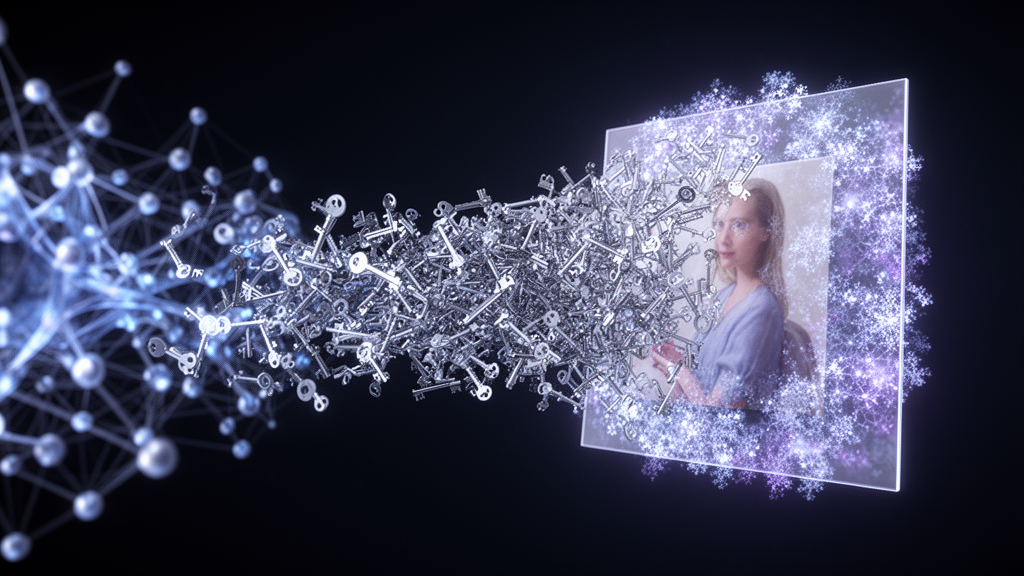
Researchers at Vellore Institute of Technology in India have unveiled a new image encryption scheme that combines a custom-built four-dimensional chaotic map with a deep neural network that grows a tiny secret seed into a full-sized encryption key. The system, described in Frontiers in Artificial Intelligence, scrambles and disguises digital images so thoroughly that even an attacker who can feed chosen images into the algorithm and study the outputs comes away with nothing useful. Because the entire process is reversible, the original picture can be recovered pixel-perfectly, with zero mean squared error between the plaintext and the decrypted result.
Image encryption has long relied on two complementary operations. Confusion, or permutation, shuffles the positions of pixels so the picture becomes spatially meaningless, while diffusion alters the actual intensity values of the pixels so that even a single changed input ripples across the whole encrypted output. Chaotic maps, mathematical functions that are exquisitely sensitive to their initial conditions, are the workhorses of both stages: feed in a secret starting value and the function spews out a sequence that looks random but can be regenerated exactly by anyone holding the same key. The weakness of many published schemes is that the key material used for diffusion is either derived from the same sequences used for scrambling or produced by simple, predictable rules, leaving an opening for chosen-plaintext and known-plaintext attacks in which an adversary encrypts specially crafted images to expose the underlying key stream.
The new work attacks both vulnerabilities at once. For confusion, the team introduced what they call the 4D Non-monotonic Sinusoidal Chaotic Map, or NSCM. A conventional monotonic function generates sequences that steadily rise or fall, which is useless for cryptography because the output is predictable. The researchers folded a sinusoidal term into the monotonic recurrence, converting the non-random ascending or descending sequence into a genuinely random, non-monotonic one. The map produces four coupled random sequences from three initial values and one control parameter, all specified to fifteen decimal places. According to the authors’ analysis, the sequences yield positive Lyapunov exponents of 0.85 and 0.69 above control parameter thresholds of 3.6 and 3.7 respectively, and bifurcation diagrams show the system descending into full chaos as the parameter climbs past roughly 3.5. A 0-1 test returned 0.84 for one sequence, further confirming chaotic behavior.
Randomness was also verified against the official benchmark. The team ran their sequences through the full NIST statistical test suite, the standard battery used by the US National Institute of Standards and Technology to certify pseudorandom number generators for cryptographic use. All fifteen tests passed, including the frequency, runs, approximate entropy, discrete Fourier transform, and cumulative sums tests, with p-values ranging from 0.0108 to 0.9999. That matters because the statistical quality of the random sequences directly determines how flat and uninformative the encrypted image appears.
The more unconventional half of the scheme is the diffusion key. Instead of expanding a key image by interpolation or pseudo-random number generation, both of which carry known weaknesses, the researchers harvest sixteen elements from the fourth sequence of the NSCM and arrange them into a 4 by 4 matrix. This tiny matrix is then fed through a six-layer convolutional neural network built from transposed convolution layers, which progressively upsample the input: 4 by 4 becomes 8 by 8, then 16, 32, 64, 128, and finally 256 by 256, matching the size of the plaintext image. Each layer applies transposed convolution to enlarge the spatial dimensions, a rectified linear unit to inject non-linearity, and batch normalization to stabilize the values. The final output is normalized to the 0-to-255 intensity range and reshaped into a key map that looks like pure noise, with essentially no correlation between neighboring pixels.
Crucially, the network never needs training. Because it performs no classification, regression, or feature learning, there is no backpropagation and no dataset; it operates purely as a deterministic forward mapping with fixed parameters. Those parameters, including kernel sizes, strides, and the number of filters, are not fixed by the algorithm but chosen by the user and known only to sender and receiver, so the architecture itself becomes part of the secret key. This design sidesteps the time cost that plagues learning-based encryption schemes while still reaping the non-linear complexity that neural layers provide.
Encryption proceeds in three rounds of confusion followed by one of diffusion. The 256 by 256 plaintext is first divided into 1,024 blocks of 8 by 8 pixels, and the blocks themselves are shuffled using a permutation derived from the first NSCM sequence. Two further pixel-wise shuffles follow, driven by the second and third sequences. Finally, the thrice-scrambled image is XORed bit by bit with the neural key map to produce the ciphertext. Decryption simply reverses the pipeline: XOR with the key map, then undo the permutations in reverse order using the de-scrambling indices.
The experimental results are strong across the standard battery of cryptanalytic metrics. Information entropy of the encrypted images reached 7.9974 on an 8-bit scale whose theoretical maximum is 8, indicating near-perfect randomness. Correlation coefficients between adjacent pixels, which hover near 1 in natural images, collapsed to values within a few thousandths of zero in the ciphertext. The number of pixels change rate and unified average changing intensity, the two canonical measures of resistance to differential attacks, came in above 99.5 percent and above 33 percent respectively for every test image, matching or approaching the ideal thresholds. Histograms of encrypted images were flat and image-independent, denying attackers any statistical fingerprint of the original content.
Robustness testing pushed the scheme further. When encrypted images were cropped by 25, 50, or even 75 percent, simulating an occlusion attack, the decrypted pictures remained recognizable, with peak signal-to-noise ratios declining gracefully from about 15.8 to 11.0 decibels. Salt-and-pepper noise injected into up to half of the ciphertext still allowed recovery of the plaintext. Against chosen-plaintext attacks, the team encrypted all-black and all-white images, the classic probe for exposing permutation-only ciphers, and found the difference between the two ciphertexts revealed no patterns; pixel correlation in the encrypted all-black image was a negligible 0.00113, and XORing two ciphertexts did not leak the key stream.
Perhaps the most striking figure is the key space. The three initial values and control parameter, each precise to ten to the minus fifteen, contribute roughly 2 to the power 199 possible keys, while the sixteen-element input vector at ten to the minus four precision adds another 2 to the power 212, for a combined space of about 2 to the power 411, vastly exceeding the 2 to the power 100 lower limit generally considered safe against brute force. If the input vector were specified to fifteen decimal places, the space would balloon to 2 to the power 996. Key sensitivity is equally fierce: perturbing a key by one part in ten to the fifteen renders decryption impossible. And the whole operation is fast, encrypting a 256 by 256 grayscale image in about 2.0 seconds on an ordinary Intel Core i5 machine with 8 gigabytes of RAM, quicker than several competing schemes the authors compared against. With medical imaging, satellite data, and the Internet of Things all demanding lightweight yet attack-proof visual security, a scheme that marries chaos theory to the geometry of transposed convolutions offers a compelling template for the next generation of lossless image ciphers.
Subject of Research: Deep network-guided key map generation and a 4D non-monotonic sinusoidal chaotic map for lossless image encryption
Article Title: Deep network-guided key map generation for lossless image encryption
Article References: Deep network-guided key map generation for lossless image encryption. (n.d.). https://doi.org/10.3389/frai.2026.1913975
Image Credits: AI Generated
DOI: 10.3389/frai.2026.1913975
Keywords: image encryption, chaotic map, deep learning, convolutional neural network, cryptography, diffusion, confusion, XOR, key space, NIST randomness tests, differential attack, lossless decryption
Cite Scienmag News
Blake Davidson. (October 16, 2026). Neural Network Forges Chaotic Keys to Lock Images Against Hackers. Scienmag. https://scienmag.com/neural-network-forges-chaotic-keys-to-lock-images-against-hackers/
Blake Davidson. "Neural Network Forges Chaotic Keys to Lock Images Against Hackers." Scienmag, 16 October 2026, https://scienmag.com/neural-network-forges-chaotic-keys-to-lock-images-against-hackers/. Accessed 16 October 2026.
Blake Davidson. "Neural Network Forges Chaotic Keys to Lock Images Against Hackers." Scienmag. October 16, 2026. https://scienmag.com/neural-network-forges-chaotic-keys-to-lock-images-against-hackers/


