


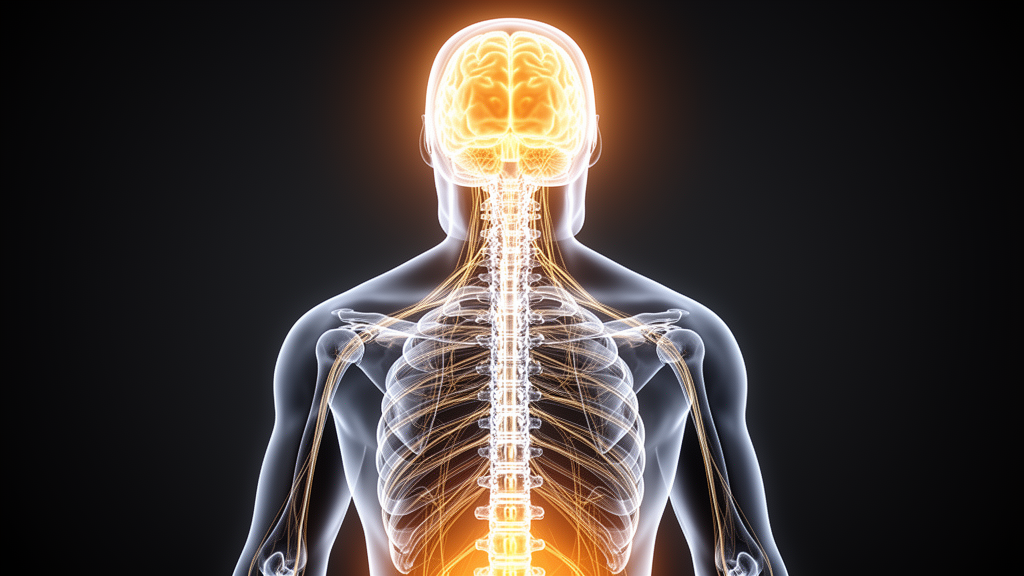
Chronic non-specific low back pain is one of the most stubborn and disabling health problems on the planet, and in roughly ninety percent of cases no structural damage in the spine can explain the suffering. A new Hypothesis and Theory article published in Frontiers in Pain Research argues that the missing piece may lie in something stranger than discs and vertebrae: the brain’s internal representation of the back itself. The paper, authored by Zhifei Xie of Palmer College of Chiropractic Florida, proposes a testable framework that links distorted body representation, altered motor control of trunk muscles, and abnormal pain processing into a single, measurable model that could finally be tested within the same group of patients.
The core insight is that three large bodies of research have grown up largely in isolation. One line of work shows that people with chronic low back pain often perceive their back differently, reporting a diminished sense of connection to it or uncertainty about its size and position. A second documents changes in the motor cortex’s control of trunk muscles, including shifted and enlarged cortical maps of the deep abdominal muscle transversus abdominis in people with recurrent pain. A third reveals altered pain processing, from heightened sensitivity to pressure at sites far from the back to less efficient endogenous pain modulation. What has never been done, the author notes, is measuring all three domains concurrently in the same well-characterized cohort, leaving open whether they covary, which comes first, and whether any of them explains the others.
To organize these threads, the framework borrows from predictive coding, a computational theory of the brain formalized by Karl Friston. Under this view, the brain constantly predicts incoming sensory signals and updates its internal models when prediction errors accumulate. Movement, in the related active-inference account, is not commanded top-down but emerges as the body fulfills proprioceptive predictions. Applied to back pain, the hypothesis is that persistent nociceptive input or altered sensorimotor processing could disrupt the updating of predictions about trunk state, allowing mismatches between predicted and actual bodily signals to persist. That persistent mismatch could then couple distorted trunk-state estimation to changes in motor regulation, bodily perception, and pain processing in a mutually reinforcing loop.
The focal candidate mechanism is the body schema, the action-oriented, largely unconscious representation that supports movement planning and online control. Crucially, the author is careful about measurement. No existing instrument directly measures the body schema; researchers rely on proxies such as the left/right judgment task, which is interpreted as indexing implicit motor imagery; the lumbar two-point discrimination threshold, a behavioral index of tactile-spatial acuity; and the Fremantle Back Awareness Questionnaire, a self-report measure of conscious back-perception disturbance. Each captures a different phenomenon, and their reliability, measurement error, and construct structure in low back pain remain incompletely established.
The empirical evidence is suggestive but uneven. Studies have found higher lumbar two-point discrimination thresholds in people with chronic low back pain, sometimes linked to greater gray-matter volume in the back region of primary somatosensory cortex and altered S1-thalamic connectivity. Elevated thresholds appear most clearly in subgroups with predominant central-sensitization features, hinting that these disturbances may characterize only part of the population. Laterality-judgment findings are heterogeneous, with some studies showing slower or less accurate trunk judgments and others finding preserved performance with altered brain responses. Self-reported back-perception disturbance, meanwhile, is consistently higher in patients and correlates with pain, disability, catastrophizing, and psychological distress.
On the motor side, transcranial magnetic stimulation studies reveal a complex picture. Some abnormalities appear in remote muscles such as the hand, suggesting a generalized change in motor-system state rather than a trunk-specific one. Trunk-muscle mapping studies have shown shifted cortical representations of transversus abdominis associated with delayed anticipatory muscle activation, and reduced map volume with loss of spatial separation between deep back muscles. A recent systematic review and meta-analysis of thirty-three studies found low to moderate certainty evidence for lower paraspinal corticospinal excitability, but concluded that findings must be interpreted separately by target muscle and outcome rather than collapsed into a single corticomotor abnormality.
Pain processing forms the third domain, operationalized through pressure pain thresholds, temporal summation of pain, and conditioned pain modulation. Meta-analytic evidence indicates less efficient conditioned pain modulation in chronic low back pain, while facilitated temporal summation appears in both acute and chronic presentations. The framework insists these psychophysical measures be kept distinct from related but non-interchangeable concepts such as nociplastic pain criteria, central sensitization, and Central Sensitization Inventory symptom burden. Notably, a recent multivariate imaging study found preserved mechanoreceptive somatotopy in the somatosensory and motor cortices of patients despite their greater self-reported back-perception disturbance, arguing against simple cortical map degradation as a necessary explanation and sharpening the question of what, exactly, is altered.
Because the directional architecture remains untested, the framework lays out four competing models: a body-representation-led account in which miscalibrated trunk-state estimation organizes the other domains; a pain-processing-led account in which altered pain sensitivity drives perceptual and motor changes; a motor-system-led account in which altered movement changes the sensory evidence available for updating body models; and a shared-upstream account in which threat learning, attention, affective state, or systemic influences generate parallel variation without direct causation among the domains. Fear and avoidance could occupy different positions in each, acting as upstream drivers, mediators, or consequences. Once reciprocal feedback develops, different initiating architectures may produce increasingly similar cross-sectional patterns, which is why the author treats mutual reinforcement as a maintenance process rather than a fifth initiating model.
To make the framework falsifiable, the paper specifies a construct-validity prerequisite and four predictions. First, body-representation measures should add reproducible explanatory information about corticomotor and pain-processing outcomes beyond pain intensity, disability, psychological variables, and nociplastic features. Second, those cross-domain associations should be stronger when independently assessed nociplastic features converge. Third, interventions designed to recalibrate trunk-state estimation should produce change in a valid target indicator that then predicts or mediates change in motor regulation and pain processing, beyond expectancy and general treatment effects. Fourth, longitudinal cohorts should test whether early change in body-representation measures predicts later motor or pain outcomes, comparing all four architectures in formal model comparison.
The clinical stakes are considerable. If a valid indicator of trunk-state estimation could be selectively changed and that change shown to precede improvements in motor control and pain, it would offer a precisely specified sensorimotor entry point for rehabilitation, distinguishable from placebo, belief change, or task practice. Existing evidence offers only partial precedent: a mediation analysis of education and graded sensorimotor retraining found the largest indirect effects through back beliefs, catastrophizing, and self-efficacy, with a smaller effect through back self-perception and no support for tactile acuity as a mediator. The author is candid that the incremental value of the broader body-representation domain and the mechanistic independence of the narrower body-schema component remain open empirical questions. What the framework delivers is a rigorous roadmap, converting a diffuse family of observations into specific, disconfirmable predictions that could reshape how chronic back pain is understood and treated.
Subject of Research: Altered body representation, corticomotor function, and pain processing in chronic non-specific low back pain
Article Title: Altered body representation in chronic non-specific low back pain: a testable framework linking body-schema-related disturbance, corticomotor alterations, and altered pain processing
Article References: Xie, Z. (2026). Altered body representation in chronic non-specific low back pain: a testable framework linking body-schema-related disturbance, corticomotor alterations, and altered pain processing. Frontiers in Pain Research, 7, Article 1899538. https://doi.org/10.3389/fpain.2026.1899538
Image Credits: AI Generated
DOI: 10.3389/fpain.2026.1899538
Keywords: chronic low back pain, body schema, body representation, predictive coding, corticomotor control, pain processing, somatosensory cortex, nociplastic pain, central sensitization, transcranial magnetic stimulation, motor imagery, sensorimotor integration
Cite Scienmag News
Cassandra Pierce. (October 16, 2026). The Brain’s Hidden Map of Your Back May Hold Clues to Chronic Pain. Scienmag. https://scienmag.com/the-brains-hidden-map-of-your-back-may-hold-clues-to-chronic-pain/
Cassandra Pierce. "The Brain’s Hidden Map of Your Back May Hold Clues to Chronic Pain." Scienmag, 16 October 2026, https://scienmag.com/the-brains-hidden-map-of-your-back-may-hold-clues-to-chronic-pain/. Accessed 16 October 2026.
Cassandra Pierce. "The Brain’s Hidden Map of Your Back May Hold Clues to Chronic Pain." Scienmag. October 16, 2026. https://scienmag.com/the-brains-hidden-map-of-your-back-may-hold-clues-to-chronic-pain/


