


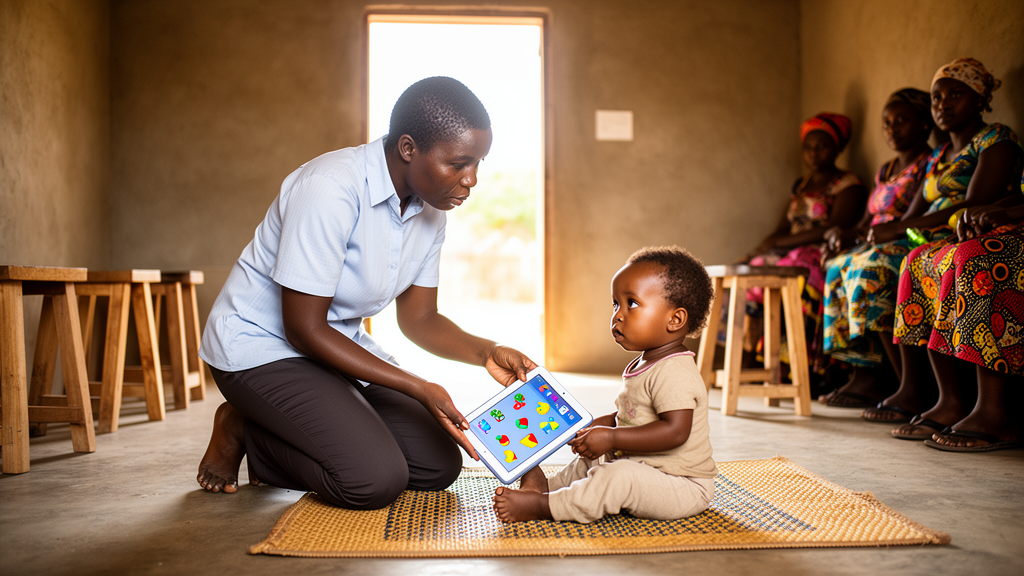
Tablet-based tests of executive function—the brain skills that let children hold rules in mind, stop impulsive responses, and shift between tasks—have become a staple of developmental psychology across the life span. A new study from Kenya now delivers a sobering reality check: when researchers administered a well-established computerized battery of these tests to 3-year-olds in two independent cohorts, most children could not even pass the training items designed to confirm they understood the instructions, and among those who did, performance was often at or below chance. The findings, published in Frontiers in Developmental Psychology, raise urgent questions about the validity of tablet-based executive function scores in the youngest and most vulnerable children in low- and middle-income country settings.
The research team, led by Michael T. Willoughby of RTI International and Amanda C. Wylie, with collaborators spanning the University of Nairobi, Kenyatta National Hospital, the Kenya Medical Research Institute, Seattle Children’s Research Institute, and the University of Washington, drew on two prospective cohort studies. The first, Tunza Mwana, enrolled 350 mother-child dyads in rural Migori County, half of them involving children prenatally exposed to HIV; 64 children attempted the executive function assessment at their age-3 visit. The second, the ABC study, followed 400 dyads in Nairobi’s Dandora area, near the city’s main dumpsite where open waste burning is routine; 161 children attempted the same battery. Both studies used identical tablets, a common approach to assessor training, and some cross-over in assessors, making the replication unusually clean.
The battery itself, known as Tangerine EF Touch, is a tablet-based set of tasks previously used with preschool-aged children in Kenya with strong psychometric properties, including longitudinal measurement invariance, retest reliability, and criterion and predictive validity. The assessment begins with orientation tasks that make no executive function demands—children simply pop blue bubbles that appear at random positions on the screen, a measure of processing speed and engagement. Then come the real tests: inhibitory control tasks such as Animal Go/No-Go, in which children touch a button for every animal except cats; Mango-Banana, a spatial conflict task requiring children to touch the matching fruit even when it appears on the opposite side of the screen; and Silly Sounds, a Stroop-like task in which children must touch the animal that does not make the sound they hear. Working memory is probed by Pick the Picture, a self-ordered pointing task, and Animal Location, a Corsi-like visual-spatial task in a 3×3 grid. Cognitive flexibility is measured by Something’s the Same, an item selection task requiring children to match pictures on color, shape, or size.
The structure of each task follows a careful protocol. An assessor introduces the task with a standardized script, demonstrates a correct response, and then presents untimed training items—roughly two to seven, depending on the task—that make minimal executive function demands. If a child fails the training items after up to two attempts, the tablet itself, not the assessor, automatically discontinues the task. This gating mechanism is meant to ensure that test scores reflect genuine executive function skill rather than misunderstanding. In theory, only children who demonstrate comprehension proceed to the timed test items, where responses must occur within 3,000 to 4,500 milliseconds.
In practice, the gating mechanism filtered out most children. In the rural Tunza Mwana cohort, individual task completion rates ranged from 17 percent for Animal Go/No-Go and Animal Location to 66 percent for Mango-Banana and 70 percent for Pick the Picture; on average, children passed training items for only 1.7 of the 4 possible tasks. In the urban ABC cohort, completion rates ranged from 18 percent for Silly Sounds to 74 percent for Chicken-Dog, with children passing training items for an average of 2.7 of 6 tasks. The pattern was remarkably similar across the two cohorts despite substantial differences in household access to electricity, maternal education, and children’s performance on the Bayley scales of cognitive and language development.
Among children who did pass training items and proceeded to test items, accuracy was typically poor. Children who completed the Animal Go/No-Go task answered an average of 48 percent of items correctly—exactly what would be expected from a dichotomous touch-or-don’t-touch decision made at random. Performance on Mango-Banana averaged 28 to 29 percent correct, below the 50 percent chance level for a two-choice spatial conflict task. Silly Sounds yielded 33 percent accuracy, and Animal Location produced 21 to 23 percent correct responses across forward and backward conditions. Only Chicken-Dog, which uses just two stimuli—a chicken and a dog—produced above-chance performance, with 66 percent accuracy on inhibitory control items and 71 percent on sustained attention items. Pick the Picture and Something’s the Same hovered around 52 to 56 percent.
The team then tested whether well-known correlates of executive function—household socioeconomic status, caregiver education, children’s general cognitive ability on the Bayley-4, and assessor-rated attention on the Preschool Self-Regulation Assessment—predicted task completion or accuracy. The results were largely null. In the Tunza Mwana cohort, none of these predictors were significantly associated with the likelihood of completing any of the four tasks. In the ABC cohort, only 4 of 50 univariate tests reached statistical significance, most of which would not survive adjustment for multiple testing. Correlations between task accuracy and child-level or household-level characteristics were weak and inconsistent, sometimes running in counterintuitive directions—children from homes with electricity performed worse on Mango-Banana in the rural cohort, for example. These largely random patterns of completion and performance raise fundamental questions about what the task scores actually measure in this age group.
The findings echo recent warnings from high-income country studies of the NIH Toolbox executive function tasks. In a large sample of exclusively 3-year-olds, roughly 30 percent of children could not complete practice items, and among those who did, 70 to 80 percent performed at or below chance on test items. Studies of children from disadvantaged backgrounds in emergency housing and high-poverty urban school districts found that 45 to 70 percent required developmentally extended, simplified versions of the flanker and dimensional change card sort tasks. The Kenyan results extend this pattern to low- and middle-income country contexts, where children face additional risk factors—infectious disease, environmental contaminants, malnutrition—that may undermine executive function development, and where cultural assumptions embedded in task design may pose further barriers.
Why did the tasks fail? The authors point to features of task design and child experience. Tasks with higher completion rates—Mango-Banana, Pick the Picture, Chicken-Dog—had simple, explicit instructions and training items that made few attentional or working memory demands. Tasks with lower completion rates involved more complex demands or challenging language conventions: Animal Location required children to monitor a sequence of pictures in a grid, and Silly Sounds asked children to choose the opposite association, a concept of
Subject of Research: Developmental Psychology
Article Title: Using computerized measures of executive function skills in 3-year-olds—A cautionary tale from Kenya
Article References: Using computerized measures of executive function skills in 3-year-olds—A cautionary tale from Kenya. (n.d.). https://doi.org/10.3389/fdpys.2026.1881826
Image Credits: AI Generated
DOI: 10.3389/fdpys.2026.1881826
Keywords: executive function, early childhood, tablet-based assessment, Kenya, LMIC, neurodevelopment, cognitive development, developmental psychology, computerized, measures, executive, function
Cite Scienmag News
Adam Burke. (October 16, 2026). Tablet Tests of Toddler Brains Fail in Kenya—A Warning for Global Child Development Research. Scienmag. https://scienmag.com/tablet-tests-of-toddler-brains-fail-in-kenya-a-warning-for-global-child-development-research/
Adam Burke. "Tablet Tests of Toddler Brains Fail in Kenya—A Warning for Global Child Development Research." Scienmag, 16 October 2026, https://scienmag.com/tablet-tests-of-toddler-brains-fail-in-kenya-a-warning-for-global-child-development-research/. Accessed 16 October 2026.
Adam Burke. "Tablet Tests of Toddler Brains Fail in Kenya—A Warning for Global Child Development Research." Scienmag. October 16, 2026. https://scienmag.com/tablet-tests-of-toddler-brains-fail-in-kenya-a-warning-for-global-child-development-research/


