


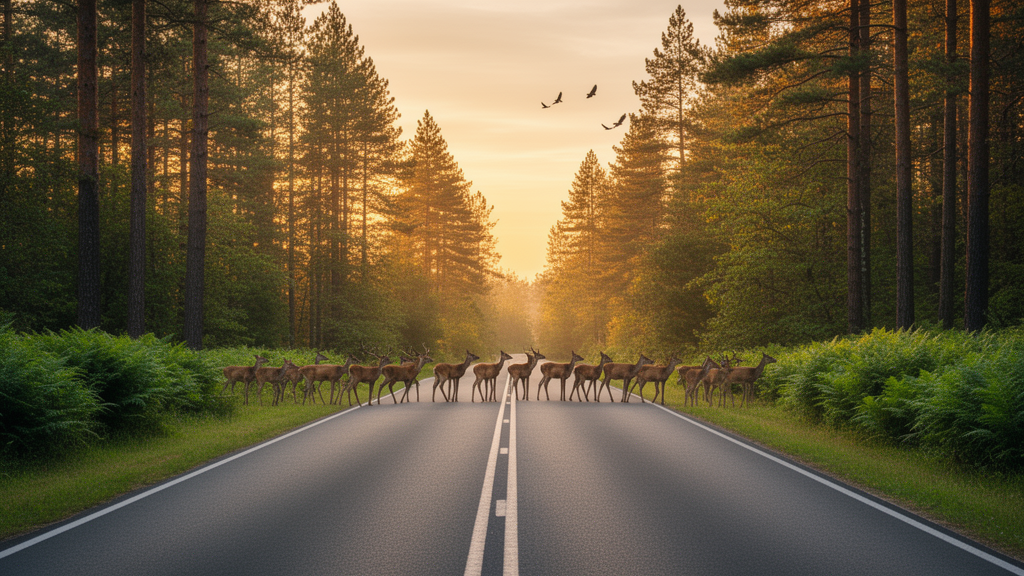
Every year, humanity lays down more asphalt than almost any other material we manufacture, and the ribbon of road now slices through virtually every terrestrial ecosystem on Earth. A new systematic review and meta-analysis published in Frontiers in Ecology and Evolution has delivered one of the most comprehensive quantitative assessments ever attempted of what this infrastructure does to the animals living in its shadow. Drawing on 643 effect sizes extracted from 160 studies, researchers Mengmeng Wang and Yun Wang of the China Academy of Transportation Sciences found that road proximity is associated with wildlife outcomes roughly 32 percent lower than in comparable road-free conditions. The finding, expressed on the log-response-ratio scale as lnRR = −0.3872 with a 95 percent confidence interval of −0.7293 to −0.0452, represents the clearest statistical signal in the entire synthesis — and it arrives with important caveats about just how messy and context-dependent road ecology really is.
The scale of the underlying evidence base is staggering. The researchers searched Web of Science and Scopus using structured Boolean queries combining road-infrastructure terms such as road, highway, and traffic with wildlife-response terms including abundance, density, activity, and genetic differentiation. The search returned 5,617 records, which deduplication reduced to 4,155 unique entries. After title and abstract screening against predefined eligibility criteria, 995 records advanced to full-text review, and the final dataset comprised 784 publications yielding 9,825 initial effect-size records. Rigorous filtering followed: only effects convertible to one of three standard metric families, with absolute effect sizes no greater than 10 and sampling variances no greater than 25, made it into the analytic dataset. That funnel narrowed thousands of raw records down to the 643 effects that powered the final models, a testament to how much published road-ecology data cannot be straightforwardly compared.
Methodologically, the study is notable for refusing to mash incompatible statistics together. The authors fitted separate three-level random-effects models for each of three effect-size scales: Hedges’ g for standardized group differences, the log response ratio for proportional changes relative to a control, and Fisher’s Z for signed correlations between animal responses and continuous road-exposure gradients. Each scale answers a different biological question, and combining them would obscure rather than clarify the underlying ecology. The three-level structure, in which individual effect sizes are nested within studies, partitions heterogeneity into within-study and between-study variance components and accommodates the non-independence that arises when a single publication contributes multiple species, sites, or response metrics. The team assumed a within-study correlation of 0.5 — a conventional default — but then stress-tested that assumption with robust variance estimation using the CR2 small-sample correction and with a study-averaged model that collapsed each study to a single mean.
The headline result survived those stress tests in direction, if not always in statistical significance. Under robust variance estimation, the ratio-scale estimate remained significant at −0.387, while the Hedges’ g and Fisher’s Z confidence intervals included zero. When effects were averaged within studies, all three intervals included zero, though every point estimate kept its original sign. Heterogeneity was substantial throughout: between-study variance reached 1.2854 on the ratio scale, and prediction intervals spanned both reductions and increases across sites. In plain terms, roads do not impose a uniform penalty on all wildlife everywhere. Some populations crash near pavement; others, particularly species attracted to roadside resources or released from predation pressure, may hold steady or even benefit. The average hides a wild spread of ecological realities.
That heterogeneity is exactly where the biology lives. The researchers coded each effect into one of eight mutually exclusive response categories — roadkill and mortality, abundance and density, activity, behavioural avoidance, habitat use and selection, genetic differentiation, fitness, and other endpoints — and the patterns differed sharply across metric families. On the ratio scale, road-exposed mortality and roadkill rates were significantly lower, at lnRR = −0.893, a counterintuitive result the authors interpret as evidence that roads change how animals use space and how often they encounter vehicles at all. Behavioural avoidance keeps animals away from roads, which suppresses both the roadkill counts researchers record and the activity levels they measure. Meanwhile, on the correlation scale, roadkill and mortality showed a strongly positive association with road exposure (Z = 0.822), illustrating how the same biological process can appear to point in opposite directions depending on the measurement scale — a cautionary tale for anyone who reads a single meta-analytic number as the whole truth.
Taxon-specific results added further texture. Mammals showed a significant proportional reduction near roads (lnRR = −0.371), yet their standardized mean-difference estimate hovered near zero. On the correlation scale, the mammal estimate was actually positive (Z = 0.474), while bird estimates were uncertain across all scales. Reptiles and amphibians, though consistently negative in direction, suffered from sparse study-level support, with confidence intervals spanning zero. Between-taxon heterogeneity tests were not significant, suggesting that the dominant variation in road effects runs across sites and response types rather than along tidy taxonomic lines. The authors argue that body size, reproductive rate, locomotor speed, and movement capacity are the mechanistic moderators that matter — traits that determine whether a road functions as a deadly filter, an impenetrable barrier, or a marginal edge habitat.
Reptiles deserve special mention because they embody the collision of attraction and peril that roads create. Small, ectothermic, and often slow-moving, reptiles may approach road surfaces to bask or nest, treating warm asphalt as a thermal resource, even as slow crossing speeds and freezing responses expose them to vehicle strikes. For long-lived species such as turtles and snakes, which mature late, reproduce slowly, and depend on high adult survival, even modest road mortality can undermine population viability. The synthesis captures this mortality pressure, but the authors note a critical gap: available studies rarely measure recruitment or age-specific survival well enough to reconstruct the full demographic trajectory connecting a dead snake on the shoulder to a vanishing population.
Perhaps the most sobering finding concerns what the evidence base cannot yet say. Annual average daily traffic — the single most important dose metric in road ecology — was reported for only 21.9 percent of converted records, and for just 91 of the 643 analysed effects, drawn from a mere 17 studies. Road width appeared in 6.6 percent of records, speed limits in 5.3 percent. The traffic-volume meta-regression on the Hedges’ g scale, based on 72 effects from 15 studies, produced a slope of 0.0491 with a confidence interval spanning zero. In other words, the evidence currently identifies road-presence effects far more clearly than any transferable traffic-volume threshold. Because animals alter crossing and avoidance behaviour as vehicle encounters change, traffic volume does not act as a simple biological dose: the same increase in vehicles can shift different components of the road effect in different species. Without consistent reporting of traffic, geometry, surface, and habitat context, dose–response relationships remain out of reach.
The management implications are pathway-specific, and the authors are careful not to overreach. Crossing structures can address movement barriers, but their effectiveness should be evaluated against pre-road or no-mitigation baselines rather than assumed from their mere presence. Speed management and roadkill reduction measures target collision mortality, and meta-analytic evidence shows their effectiveness varies by intervention type and study design. At the network scale, graph-based prioritisation can identify the roads that sever high-quality habitat or contribute most to lost connectivity. Most included studies were observational, so the synthesis estimates road-associated responses rather than the causal effect of any intervention. The authors call for longitudinal and before–after controlled studies that jointly track traffic exposure, movement, mortality, and demographic rates. Until then, the message is clear: roads exert a broad, measurable ecological pressure — roughly a one-third reduction in the clearest average estimate — but effective mitigation demands knowing which pathway dominates at each site, from barrier effects demanding permeability to collision hotspots demanding slower cars.
Subject of Research: Meta-analytic synthesis of road effects on terrestrial vertebrate populations
Article Title: Road effects on animal populations: a systematic review and meta-analysis
Article References: Wang, M., & Wang, Y. (2026). Road effects on animal populations: a systematic review and meta-analysis. Frontiers in Ecology and Evolution, 14, Article 1940830. https://doi.org/10.3389/fevo.2026.1940830
Image Credits: AI Generated
DOI: 10.3389/fevo.2026.1940830
Keywords: roads, wildlife, meta-analysis, roadkill, habitat fragmentation, traffic volume, conservation, mammals, reptiles, behavioural avoidance, population ecology, systematic review
Cite Scienmag News
Margaret Porter. (October 16, 2026). Roads Cut Wildlife Numbers by Nearly a Third, Landmark Meta-Analysis Finds. Scienmag. https://scienmag.com/roads-cut-wildlife-numbers-by-nearly-a-third-landmark-meta-analysis-finds/
Margaret Porter. "Roads Cut Wildlife Numbers by Nearly a Third, Landmark Meta-Analysis Finds." Scienmag, 16 October 2026, https://scienmag.com/roads-cut-wildlife-numbers-by-nearly-a-third-landmark-meta-analysis-finds/. Accessed 16 October 2026.
Margaret Porter. "Roads Cut Wildlife Numbers by Nearly a Third, Landmark Meta-Analysis Finds." Scienmag. October 16, 2026. https://scienmag.com/roads-cut-wildlife-numbers-by-nearly-a-third-landmark-meta-analysis-finds/


