


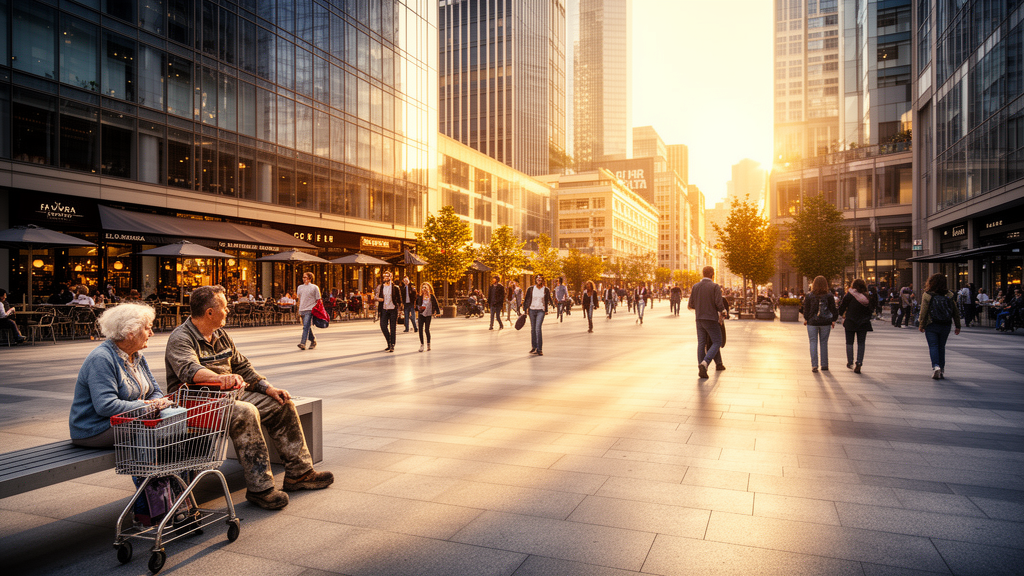
When a city pours tens of millions of dollars into revitalizing its downtown, who actually benefits? A new study from the International Journal of Public Health suggests that in one mid-size Canadian city, the answer was not the young and socially marginalized people who lived there. Researchers from Université de Sherbrooke, Simon Fraser University, and the University of Saskatchewan interviewed ten key informants involved in a downtown revitalization initiative in a Quebec city of roughly 200,000 inhabitants. Their findings reveal a sobering truth: despite good intentions, the needs and interests of the very people most likely to be affected by the transformation were never explicitly considered.
The downtown area in question covers just 1.1 square kilometers but was home to approximately 3,020 residents in 2016, 34.1 percent of whom were young people between 18 and 29 years old. The statistics paint a picture of deep precarity: 93.3 percent of residents were renters, 57.1 percent lived below the poverty line, and the median after-tax household income was three times lower than the city as a whole. Unemployment rates among 25 to 64 year-olds were twice as high as elsewhere in the city. These are the social determinants of health that revitalization efforts plausibly affect, for better or worse.
In the first phase of the initiative, 80 million Canadian dollars were invested, with 25 million from public funds, to build two new towers housing 60 residential rental units, office and retail space, a rooftop garden, and a daycare center. A public space was also developed atop an indoor parking lot, and streetscape aesthetics were improved. The changes were hypothesized to positively impact downtown residents through increased housing availability, proximity to services, and opportunities for social connections. But according to the researchers, the initiative predominantly aimed to improve the downtown physical and economic environment rather than to address social equity.
Using an interpretive descriptive approach, the team conducted nine semi-structured interviews with informants representing municipal staff, elected officials, community organizations, private builders, and advocacy groups. They analyzed transcripts following the framework method, a structured qualitative approach recommended for multidisciplinary teams. The analysis revealed that participants were open to collaborating for a more equitable and inclusive revitalization, but diverging perspectives on four key themes constrained fulsome consideration of young and socially marginalized people.
The first tension surrounded the very reasons for revitalizing the downtown. Participants agreed the area was in disrepair and that economic development was essential for attracting new residents, businesses, and workers. But some felt that pursuing infrastructural and economic interests at the detriment of social equity was problematic. One elected official described the project as more like an investment to advance certain economic interests than a real downtown revitalization. A community organization representative expressed frustration that, given the amount invested, more thought had not gone into securing the people who would be victims of the project’s consequences, noting that taking care of poverty is not that expensive.
The second barrier concerned how participants implicitly defined young and socially marginalized people. Some municipal and private actors assumed the new infrastructure, such as the rooftop garden and daycare center, would serve most young people, whom they defined as young professionals and families. Community organization representatives countered that this population-wide approach failed to address the needs of a specific subgroup over-represented downtown: those living on low incomes, in precarious housing, or struggling with mental health conditions. One representative pointed out that a $2,000 per month apartment with a river view and home automation was not created for the people they worked with, but rather to bring new people downtown while doing very little for those already there.
Third, contrasting experiences of collaborative structures and mechanisms limited inclusion. Early on, the city created an intersectoral committee bringing together entrepreneurs, merchants, community groups, cultural groups, citizens, residents, and health institution representatives. Municipal and private actors considered this structure legitimate given the privileged information discussed and the influence participants could have on decision-making. But community organization representatives reported that final decisions seemed to be taken by the city and private developers, leaving them with little real influence. As a result, their unique expertise regarding young and socially marginalized people was not fully harnessed, potentially leading to superficial solutions such as installing public restrooms for unhoused individuals rather than addressing structural needs.
Finally, public participation processes and strategies fell short. Information was communicated through social media, local radio campaigns, and the city website, and consultation events included a co-creation design charette in 2017 and a question-and-answer online event in 2020. But participants noted these strategies were not tailored to young and socially marginalized people. Organizers seemed to assume social media would naturally reach these groups, although many lacked internet access or social media accounts. Basic outreach, such as posting advertisements near the construction site directly opposite housing for socially marginalized young people, was lacking. Common barriers to participation, including social precariousness, over-solicitation, and mental health issues, were not considered when designing activities.
Despite these shortcomings, all participants recognized that the lack of social inclusiveness likely stemmed from limited knowledge of young and socially marginalized people’s realities rather than conscious attempts to exclude them. One community organization representative noted there was a desire to understand and an open door on the city side to discuss these issues, suggesting that education on both sides could enable deeper intersectoral collaboration in the future. The researchers argue that anchoring urban interventions in the social context of place is essential for equity-focused action, and that defining key terms, establishing a clear understanding of local residents’ characteristics and needs, and centering all phases of revitalization around social equity would be useful moving forward.
The study’s findings serve as a springboard for devising solutions for inclusive and health-promoting urban planning. The researchers recommend early and sustained engagement of those most likely to experience intervention impacts firsthand, accessible and diverse communication strategies, training for citizens and municipal and private actors in inclusive collaboration, and accountability for including marginalized groups. As cities worldwide continue deploying neighborhood revitalization initiatives to improve aging infrastructure and build resilience against climate change, this research underscores that different aims and visions of urban revitalization lead to different action priorities and, consequently, unequal social and health benefits. For urban transformations to be health-promoting and socially inclusive, innovative collaborative governance and public participation structures are needed from the outset.
Subject of Research: Urban Health
Article Title: Considering young and socially marginalized people in urban revitalization: evidence on enablers and barriers from a mid-size Canadian city
Article References: Considering young and socially marginalized people in urban revitalization: evidence on enablers and barriers from a mid-size Canadian city. (n.d.). https://doi.org/10.3389/ijph.2026.1609821
Image Credits: AI Generated
DOI: 10.3389/ijph.2026.1609821
Keywords: urban revitalization, health equity, local governance, public participation, social determinants of health, youth, urban planning, Considering, young, socially, marginalized, people
Cite Scienmag News
Phoebe Ingram. (October 16, 2026). Who Gets Left Out When Cities Revitalize Their Downtowns? Scienmag. https://scienmag.com/who-gets-left-out-when-cities-revitalize-their-downtowns/
Phoebe Ingram. "Who Gets Left Out When Cities Revitalize Their Downtowns?" Scienmag, 16 October 2026, https://scienmag.com/who-gets-left-out-when-cities-revitalize-their-downtowns/. Accessed 16 October 2026.
Phoebe Ingram. "Who Gets Left Out When Cities Revitalize Their Downtowns?" Scienmag. October 16, 2026. https://scienmag.com/who-gets-left-out-when-cities-revitalize-their-downtowns/


