


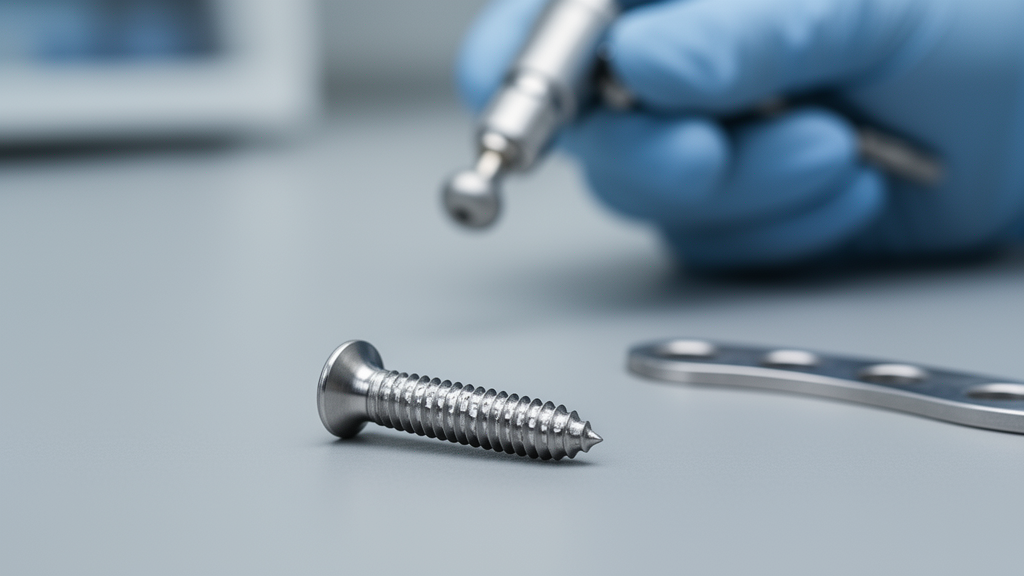
Deep inside the human body, a familiar workhorse of surgery is quietly fighting a battle on a scale of billionths of a meter. AISI 316L stainless steel — the austenitic alloy that has anchored fracture plates, spinal rods, dental hardware, and cardiovascular components for decades — owes its clinical longevity not to its bulk strength but to a thin, chromium-rich oxide film only nanometers thick. When that passive film holds, the implant endures. When it fails, corrosion, wear, and biology conspire against it. A new systematic review published in Frontiers in Biomaterials Science argues that the decisive factor in this struggle is something manufacturers have long controlled but rarely optimized with biology in mind: surface integrity, the complete physical, mechanical, and microstructural fingerprint left on a metal by the way it is made.
The review, authored by Ricardo Luiz Perez Teixeira of the Federal University of Itajubá in Brazil and published on 24 August 2026, takes an unusually rigorous approach for a materials-science synthesis. Following the PRISMA 2020 reporting framework, the author searched the CAPES Journal Portal — which provides access to Web of Science, Scopus, ScienceDirect, and other major databases — for peer-reviewed studies published between January 2000 and June 2026, with particular emphasis on the most recent four years. The screening funnel was steep: 70 records identified, 52 screened by title and abstract, 23 assessed in full text, and just 11 studies surviving every eligibility criterion. The author deliberately chose a qualitative critical synthesis over a statistical meta-analysis, because the included studies varied so widely in treatment parameters, electrochemical protocols, and biological assays that pooling their numbers would have been misleading.
Why does surface integrity matter so much for a metal that has been implanted successfully since the mid-twentieth century? The answer lies in where degradation begins. Once an implant enters the body, its surface becomes the primary interface with proteins, cells, bacteria, and mechanical forces. Corrosion in physiological fluid is an electrochemical process: chloride ions attack the passive film, nucleating pits that act as stress concentrators and crack-initiation sites. Wear from cyclic loading strips the film away, exposing fresh metal that dissolves faster than protected surfaces. The two processes feed each other in a phenomenon called tribocorrosion, in which total material loss exceeds the sum of wear alone and corrosion alone — a synergistic excess that the review frames using the standard ASTM G119 decomposition into mechanical wear, electrochemical corrosion, and their interaction term. For load-bearing implants such as modular orthopedic junctions, this synergy is arguably the single most important limit on service life.
The review’s central technical argument concerns mechanical surface treatments: processes such as shot peening, severe shot peening, burnishing, deep rolling, ultrasonic surface modification, and laser shock peening that deform the near-surface region without changing the alloy’s bulk chemistry. Each treatment leaves a different microstructural signature. Shot peening bombards the surface with spherical media, generating compressive residual stresses and work hardening that delay fatigue-crack initiation. Severe shot peening pushes deformation further, producing ultrafine-grained or even nanocrystalline surface layers with dramatically increased dislocation density. Burnishing and deep rolling smooth the surface while pressing compressive stresses deeper into the subsurface. Ultrasonic nanocrystal surface modification uses high-frequency impacts to build nanostructured layers. Laser shock peening, the most exotic of the family, drives plasma shock waves from pulsed laser irradiation into the metal, achieving deep compressive stress fields with minimal surface roughening — an advantage the review highlights for preserving passive-film stability.
But here is where the review delivers its most provocative finding: none of these microstructural improvements reliably predicts corrosion resistance on its own. Grain refinement, for instance, has been reported both to accelerate passive-film formation — because denser grain boundaries provide more diffusion pathways for chromium migration — and to increase susceptibility to localized corrosion, because the same boundaries create electrochemical heterogeneity that chloride ions can exploit. Strain-induced martensitic transformation, a hallmark of deformed metastable austenitic steels like 316L, improves hardness and wear resistance but can introduce galvanic coupling between martensitic and austenitic regions, with consequences for pitting that vary with martensite fraction, morphology, and distribution. Compressive residual stresses, the workhorse of fatigue improvement, show similarly contradictory electrochemical effects. The review’s conclusion is blunt: no single surface-integrity parameter — roughness, residual stress, grain size, or phase fraction — can predict how an implant will behave in the body.
This matters clinically because the biological consequences of surface modification are equally entangled with the electrochemical ones. Protein adsorption, the first event after implantation, is governed by surface energy, roughness, and chemistry, and it sets the stage for everything that follows: osteoblast attachment, macrophage polarization, fibroblast migration, angiogenesis, and bacterial colonization. Nanostructured surfaces produced by severe plastic deformation have shown promise in promoting osteogenic differentiation and even steering macrophages toward pro-regenerative phenotypes — an emerging field the review identifies as osteoimmunomodulation. Yet the same roughness that helps bone integrate can increase bacterial adhesion, and corrosion-induced release of iron, chromium, nickel, and molybdenum ions can trigger chronic inflammatory signaling and osteolysis in susceptible patients. The review emphasizes that these biological processes cannot be evaluated independently of the tribocorrosion and corrosion behavior that feed them ions and debris.
The methodological critique running through the review is as important as its scientific synthesis. Because tribocorrosion outcomes depend sensitively on contact geometry, counterbody material, electrolyte composition, loading regime, and repassivation kinetics, studies using different protocols frequently reach opposite conclusions about the same treatment. The author calls for internationally standardized testing protocols that reproduce clinically relevant mechanical and electrochemical conditions, alongside implant retrieval analyses and long-term in vivo validation — the missing links between laboratory promise and clinical reality. Without such standardization, the field risks optimizing surface treatments against laboratory benchmarks that do not translate to decades of service inside a living patient.
Looking forward, the review identifies several converging frontiers. Mechanical surface treatments are increasingly viewed not as standalone solutions but as substrate-preparation steps for multifunctional surfaces: calcium phosphate and hydroxyapatite coatings that mimic bone mineral, oxide layers that double as platforms for bioactive molecules, antibacterial nanotopographies that reduce colonization without compromising host-cell compatibility, and gradient architectures that combine hardness with toughness. The author also highlights the growing role of computational tools — machine-learning-guided materials design, digital twins for implant performance prediction, and artificial-intelligence-assisted optimization of processing parameters — as approaches that could finally tame the parameter space that has made mechanical surface treatment results so difficult to compare across laboratories.
For a material often dismissed as old-fashioned next to titanium and cobalt-chromium alloys, AISI 316L retains a stubborn advantage: it is cheap, manufacturable, clinically familiar, and — crucially — highly responsive to surface engineering. The review’s ultimate message is that the next generation of stainless-steel implants will not be defined by new alloy chemistries but by a more sophisticated understanding of how deformation, microstructure, electrochemistry, and biology interact at the surface. Getting that picture right, the author argues, is the difference between an implant that merely survives and one that actively promotes healing while resisting the combined assault of wear, corrosion, and infection for the rest of a patient’s life.
Subject of Research: Mechanical surface treatments, corrosion resistance, and tribocorrosion behavior of AISI 316L stainless steel biomedical implants
Article Title: Surface integrity and biofunctional performance of AISI 316L stainless steel implants: the role of mechanical surface treatments, corrosion resistance, and tribocorrosion behavior
Article References: Perez Teixeira, R. L. (2026). Surface integrity and biofunctional performance of AISI 316L stainless steel implants: the role of mechanical surface treatments, corrosion resistance, and tribocorrosion behavior. Frontiers in Biomaterials Science, 5, Article 1913354. https://doi.org/10.3389/fbiom.2026.1913354
Image Credits: AI Generated
DOI: 10.3389/fbiom.2026.1913354
Keywords: AISI 316L stainless steel, biomaterials, surface integrity, mechanical surface treatments, corrosion resistance, tribocorrosion, passive film, orthopedic implants, osseointegration, surface engineering, PRISMA review, biocompatibility
Cite Scienmag News
Denise Maddox. (October 16, 2026). How Hammering the Surface of Stainless Steel Implants Could Decide Whether They Survive the Body. Scienmag. https://scienmag.com/how-hammering-the-surface-of-stainless-steel-implants-could-decide-whether-they-survive-the-body/
Denise Maddox. "How Hammering the Surface of Stainless Steel Implants Could Decide Whether They Survive the Body." Scienmag, 16 October 2026, https://scienmag.com/how-hammering-the-surface-of-stainless-steel-implants-could-decide-whether-they-survive-the-body/. Accessed 16 October 2026.
Denise Maddox. "How Hammering the Surface of Stainless Steel Implants Could Decide Whether They Survive the Body." Scienmag. October 16, 2026. https://scienmag.com/how-hammering-the-surface-of-stainless-steel-implants-could-decide-whether-they-survive-the-body/


