


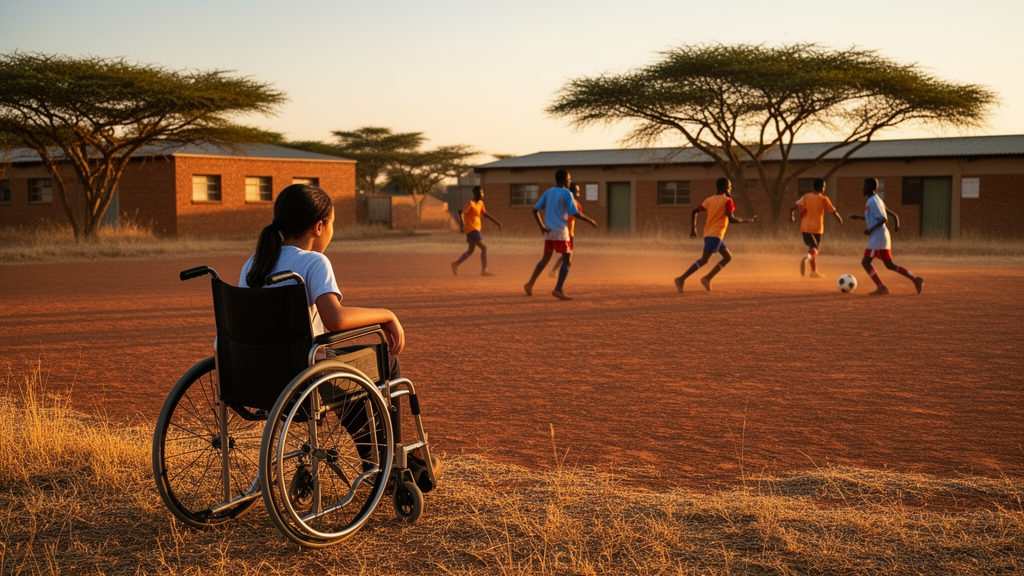
In the rural municipality of Ba-Phalaborwa, in South Africa’s Limpopo Province, a striking disconnect has emerged between the people who design recreational programs and the young people with disabilities who are meant to use them. A new qualitative study published in Frontiers in Sports and Active Living by T. B. Ngobeni and M. J. Malema of the University of the Western Cape reveals that while recreation service providers believe they understand how to build inclusive programs, the youth with physical disabilities on the receiving end describe a very different reality—one of exclusion, inaccessible buildings, missing equipment, and planning processes that happen entirely without them. The research, which examined the twofold experiences of providers and end-users, offers a rare side-by-side comparison of how the same recreational landscape looks from opposite sides of the service counter.
The study rests on a well-established theoretical foundation: the social model of disability. Unlike older frameworks that locate disability within an individual’s body, the social model argues that people are disabled by society—by attitudinal, environmental, and organisational barriers that could otherwise be removed or mitigated. Ngobeni and Malema applied this lens deductively across three social domains: environmental, attitudinal, and organisational. The choice is deliberate. Despite national policy instruments such as South Africa’s White Paper on Sport and Recreation and the National Sport and Recreation Plan, introduced in 2011 and 2012 respectively, most communities have yet to see those commitments translated into accessible facilities on the ground. The social model also carries a warning the researchers take seriously: removing physical barriers alone does not automatically produce participation, because attitudes and institutional practices must change alongside ramps and doorways.
Methodologically, the study adopted an interpretive paradigm with an exploratory qualitative design. From a registered population of 125 people with physical disabilities at identified centres, the researchers used purposive sampling to recruit five recreation service providers—including sport promotion officers, a director of sport and recreation, a sport development officer, and a community sport liaison—and twelve young people with physical disabilities aged 18 to 31. Their conditions ranged from spinal cord injuries caused by car accidents and gunshot wounds, to strokes and congenital disabilities. Data were collected through semi-structured, face-to-face interviews lasting 30 to 50 minutes, audio-recorded with consent and transcribed verbatim. The researchers then applied Braun and Clarke’s six-step thematic analysis, coding the transcripts in ATLAS.ti 9 and cross-coding themes across all interviews until consensus was reached on five overarching themes.
The study’s rigour procedures were notably thorough for a small-scale qualitative project. The researchers triangulated findings across participant groups and against the existing literature, conducted member-checking by returning transcripts to participants for verification, and maintained a reflexive journal to manage potential bias—particularly relevant because the first author is a resident of Phalaborwa and personally familiar with the centres where data were collected. Ethical approval came from the University of the Western Cape’s Human Social Science Research Ethics Committee, with informed consent forms translated into Xitsonga for participants who did not speak English. Transcripts and recordings were stored in encrypted, password-protected files, and participation was voluntary with the right to withdraw at any time.
The five themes that emerged—Inclusion Practice, Service Providers’ Headaches, Frustrations in Recreation Engagement, Availability of Facilities, and Recommendations to Bridge the Gap—paint a picture of good intentions colliding with structural neglect. On the provider side, there is genuine evidence of adaptive thinking. One service provider described adjusting table heights for wheelchair users and supplying lighter rackets; another explained the rules of Para volleyball, a modified version of the sport designed for players with limb differences or wheelchair users. A third described how goalball, a sport played by rolling a ball containing a ringing bell toward a goal, is adapted locally using a size-five ball with a ring inside. These accounts demonstrate that some providers possess real technical knowledge of inclusive practice and are actively trying to implement it.
Yet the youth participants told a starkly different story. Several reported that community-initiated recreational programs required participants to buy their own equipment, effectively pricing out those with the fewest resources. One young man stated that organizers consistently overlooked the need to involve persons with disabilities in sport because they were deemed unfit to participate due to their physical conditions. Others described being marginalised from activities entirely, watching only people without disabilities take part, and noted that when local municipalities plan community recreational programs, people living with physical disabilities are not included during the planning phases. Under the social model, these accounts map directly onto the attitudinal barrier domain: the obstacle is not the impairment itself but the community’s assumption that participation is neither desired nor possible.
The environmental and organisational barriers were equally concrete. Providers admitted they own no facilities of their own and must outsource halls from the municipality, checking in advance whether wheelchair ramps exist—meaning accessible venues are available only sporadically, typically during tournaments. One provider recounted a demoralising incident in which wheelchair users could not enter a facility because it had no ramps and had to remain outside. From the user side, a young woman who loves chess described a venue full of staircases with non-adjustable tables and chairs, forcing her to struggle into her seat alone, and noted that bystanders were not always willing to help—a cumulative experience she said left her disheartened and discouraged from pursuing her passion. Buildings designed with nondisabled users in mind, narrow sidewalks, inadequate lighting, and inaccessible doorknobs all compound the problem.
The stakes of this exclusion extend well beyond fairness. The study situates recreational participation within a public health framework, noting that physical inactivity carries a 20 to 30 percent higher risk of death compared with more active people, and raises the likelihood of heart disease, diabetes, high blood pressure, stroke, weaker bones, and several cancers. People with physical disabilities already face elevated health-related risks, and inactivity can lead to fatigue, depression, and increased dependence on others. Conversely, participation in recreation builds psychological well-being, friendships, self-identity, and a sense of meaning and purpose. The researchers argue that recreation is routinely misunderstood as a luxury, when the evidence positions it as a determinant of health and quality of life—one that people with disabilities are systematically denied in rural South Africa.
The study’s recommendations converge on a central actor: the local municipality. Ngobeni and Malema call for municipal teams that include both people with and without disabilities from each community, so that inclusion is built in rather than bolted on, and so that people with disabilities are not isolated into separate provisions. They urge awareness campaigns about the rights and dignity of people with disabilities, training for recreation staff, caregivers, and participants, and improved maintenance of stadiums and community halls to ensure genuine accessibility. They also propose dedicated community sports units where people with disabilities can learn about upcoming tournaments and request equipment and training. Providers themselves recommended educating caregivers from the household level upward, while the youth participants asked for direct funding allocations to their centres, appropriate equipment, and facilities designed for wheelchair users from the outset.
Ultimately, the study’s most important finding may be the gap itself—the disconnect between providers who believe they are practising inclusion and young people who experience abandonment. The researchers frame this as the difference between formal equality, where identical facilities are nominally open to everyone, and substantive accessibility, where accessibility is systematically incorporated into the planning, design, and management of recreational environments. Meaningful participation, they conclude, requires collaboration between service providers and community members, particularly people with disabilities themselves. The authors acknowledge that the small sample limits generalisability, but the voices captured in Ba-Phalaborwa carry a message with resonance far beyond Limpopo: no amount of goodwill substitutes for consulting the people a program is meant to serve, and inclusive recreation begins with a seat at the planning table.
Subject of Research: Recreational program access and inclusion for youth with physical disabilities in Ba-Phalaborwa, South Africa
Article Title: Recreation providers' and end-users' twofold experiences: perception and knowledge about recreation programs in the Ba-Phalaborwa Local Municipality, South Africa
Article References: Recreation providers' and end-users' twofold experiences: perception and knowledge about recreation programs in the Ba-Phalaborwa Local Municipality, South Africa. (n.d.). https://doi.org/10.3389/fspor.2026.1713807
Image Credits: AI Generated
DOI: 10.3389/fspor.2026.1713807
Keywords: disability inclusion, recreation programs, South Africa, rural communities, social model of disability, adaptive sports, accessibility, qualitative research, youth with disabilities, local municipalities, physical activity, Limpopo
Cite Scienmag News
Cassandra Pierce. (October 16, 2026). Who Gets to Play? Rural South African Youth With Disabilities Face a Recreation Gap. Scienmag. https://scienmag.com/who-gets-to-play-rural-south-african-youth-with-disabilities-face-a-recreation-gap/
Cassandra Pierce. "Who Gets to Play? Rural South African Youth With Disabilities Face a Recreation Gap." Scienmag, 16 October 2026, https://scienmag.com/who-gets-to-play-rural-south-african-youth-with-disabilities-face-a-recreation-gap/. Accessed 16 October 2026.
Cassandra Pierce. "Who Gets to Play? Rural South African Youth With Disabilities Face a Recreation Gap." Scienmag. October 16, 2026. https://scienmag.com/who-gets-to-play-rural-south-african-youth-with-disabilities-face-a-recreation-gap/


