


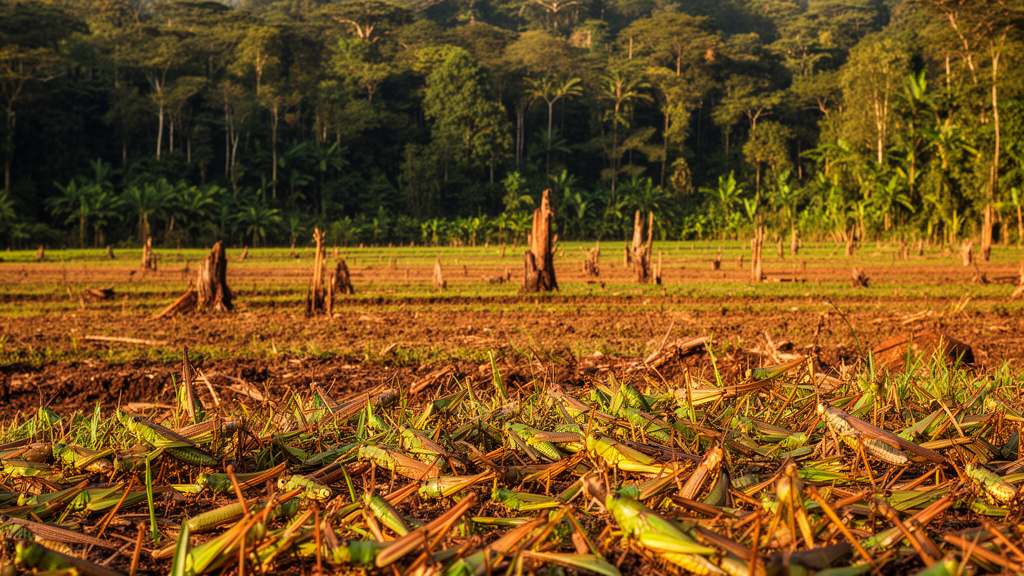
Grasshoppers are among the most dominant and diversified groups in terrestrial ecosystems, and in West-Central Africa and the Congo Basin their short-horned fauna is ruled by the families Acrididae, Pyrgomorphidae, Thericleidae, and Ixalidiidae. Yet this biodiversity remains profoundly understudied, even as deforestation reshapes the landscapes these insects inhabit. A new study published in the Journal of Orthoptera Research has now compared grasshopper communities across four vegetation types in the Bangou district of West Cameroon, a transitional zone bridging the low altitudes of southern Cameroon and the peaks of the Cameroon Volcanic Line. The findings reveal a striking pattern: as land use intensifies, the number and proportion of generalist species rise markedly, while rare species shrink to lower proportions in the most disturbed habitats.
The research team sampled grasshoppers monthly from January to December 2024 across 24 sites in the Bangou district, situated at 1,500 meters above sea level. Four habitat types were examined: crop fields, fallowlands, forest patches, and bare soil. Sampling relied on sweep netting during the daytime, with researchers walking through each vegetation type for a 120-minute period, actively flushing grasshoppers using a net mounted on a wooden frame. Collected specimens were photographed in the field and transported to the Zoology Laboratory of the University of Douala, where they were identified to species level through external morphology and genitalia structure using taxonomic keys spanning decades of orthopteran research.
The results were unambiguous. A total of 48 grasshopper species were recorded, belonging to three families: Acrididae with 39 species, Pyrgomorphidae with eight, and Thericleidae with one. These species spanned 10 subfamilies, from the very abundant Acridinae, which accounted for 54.66 percent of all individuals, to the rare Thericleinae, represented by just 0.41 percent. Among the 1,191 specimens sampled, 561 were collected from fallowland, 449 from crop fields, 126 from bare soil, and only 55 from forest. Fallowland hosted the highest species richness with 39 species, followed by crop fields with 33, bare soil with 21, and forest with just 12. The Shannon diversity index mirrored this gradient, peaking in fallowland at 2.42 and dropping to 2.11 in forest.
Each habitat supported a distinct species assemblage, and the statistical fingerprints of disturbance were written into the very structure of the communities. In bare soil and fallowland, the abundance distribution of grasshopper species followed Motomura’s geometric model, a signature of heavily disturbed ecosystems marked by intense interspecific competition and hierarchical resource use. In forest, the broken-stick model of MacArthur prevailed, reflecting minimal interactions between species in a habitat where ecological resources are shared randomly. Crop fields, somewhat unusually, followed Preston’s log-normal model, which the researchers attribute to the polyculture practiced in Bangou: mixed plantings of corn, beans, plantains, and groundnuts create a diversity of plant resources that multiplies ecological niches, allowing most species to persist at moderate abundances while only a few become very rare or highly dominant.
The indicator species analysis, using 9,999 random permutations, identified clear bioindicators of habitat condition. Chrotogonus homalodemus, with an IndVal of 51.39 percent, served as a specialist of bare soil. Four species indicated forest habitat: Parepistaurus sp. with an IndVal of 75 percent, Pterotiltus coeruleocephalus at 37.04 percent, Thericles sp. at 33.33 percent, and Parapterotiltus minimoides at 25 percent. These forest specialists, including the recently described P. minimoides, were confined to the remaining degraded forest patches, which consist of a few trees such as Ficus and Ceiba pentandra along with raffia palms. Their restriction to these relics underscores how vulnerable specialist taxa become as original vegetation disappears.
In contrast, the proportion of generalist species climbed steadily with land-use intensification. Using the IndVal framework, the researchers categorized one species as generalist in forest, four in bare soil, five in crop fields, and 11 in fallowland. Rare species moved in the opposite direction, accounting for 50 percent of the community in forest, 61 percent in bare soil, 30 percent in crop fields, and just 23 percent in fallowland. This pattern aligns with ecological theory: generalist species, whose niches tolerate a wider range of conditions, can actually benefit from habitat destruction, while specialists with narrowly defined requirements face heightened extinction risk as their preferred biotopes fragment and shrink.
The study also documented a troubling consequence of environmental degradation: increased pest activity in cultivated fields. Species such as Eyprepocnemis plorans and Catantops melanostictus, which thrived across the disturbed landscape, were most active in crop fields during the dry season, when their densities surged. In southern Cameroon rainforest areas, forest clearing has similarly created suitable environments for the proliferation of pest grasshopper species, with consequences for crop yields and ecosystem balance. The Bangou results suggest that habitat disturbance does not simply reduce biodiversity; it reshapes community composition in ways that can amplify agricultural damage while simultaneously pushing threatened species toward the margins of survival.
Bangou’s location on the Cameroon Volcanic Line, recognized worldwide as a biodiversity hotspot in the Congo Basin with high rates of endemism, helps explain the elevated species richness observed. Previous studies in Cameroon reported fewer grasshopper species: 38 in the coastal Littoral region, 43 in the south Cameroon plateau, 27 in the Kouoptamo district of West Cameroon, and 28 in the Menoua division. The 48 species found in Bangou, including endemic taxa, confirm the first hypothesis of the researchers, who expected high and endemic grasshopper diversity in this volcanic zone. Comparable patterns have emerged in other African volcanic landscapes, such as Mount Kilimanjaro in East Africa and the Nimba mountains in West Africa.
The broader implications are clear. As human-driven forest clearing continues across West-Central Africa, grasshopper communities are fragmenting into assemblages that favor herbaceous-adapted generalists while imperiling vulnerable specialists. Polyculture, by enhancing plant-resource diversity, offers a partial buffer, but the overall trajectory points toward simplified communities dominated by adaptable species. The researchers emphasize the need for sustainable land management practices that maintain herbaceous cover while conserving the remaining forest patches. Protecting habitat heterogeneity, they argue, is essential to preserve the observed grasshopper diversity, the ecological functions these insects perform as food for birds, reptiles, amphibians, mammals, and other arthropods, and the long-term stability of natural ecosystems in this biodiversity hotspot.
Grasshoppers are not merely subjects of academic curiosity. They are potential bioindicators whose community structure reliably detects environmental disturbances, and they are increasingly incorporated into Western diets through derived food products. Their dual role as ecosystem components and nutritional resources makes their conservation a matter of both ecological and human interest. The Bangou study, by revealing how generalist dominance rises across vegetation types under intensifying land use, provides a diagnostic framework for assessing habitat condition and guiding conservation strategies in one of Earth’s most biologically rich yet imperiled regions.
Subject of Research: Grasshopper community structure and the rising dominance of generalist species across vegetation types in a biodiversity hotspot
Article Title: Grasshopper community structure and the rising dominance of generalist species across vegetation types in a biodiversity hotspot
Article References: Oumarou Ngoute, C., Kouahou Chekep, I. D., Ngameni Tchatak, O. R., Nohen Mam, M., Kameni, G. F., Simeu Noutchom, A., Otiobo Atibita, E. N., Missoup, A. D., Mbida Mbida, J. A., Tindo, M., Akono Ntonga, P., & Lehman, L. G. (2026). Grasshopper community structure and the rising dominance of generalist species across vegetation types in a biodiversity hotspot. Journal of Orthoptera Research, 35(1), 215-232. https://doi.org/10.3897/jor.35.178306
Image Credits: AI Generated
Keywords: Grasshopper, community, structure, rising, dominance, generalist, species, across, vegetation, types, biodiversity, hotspot
Cite Scienmag News
Margaret Porter. (October 16, 2026). Generalist grasshoppers surge as land use intensifies in Cameroon biodiversity hotspot. Scienmag. https://scienmag.com/generalist-grasshoppers-surge-as-land-use-intensifies-in-cameroon-biodiversity-hotspot/
Margaret Porter. "Generalist grasshoppers surge as land use intensifies in Cameroon biodiversity hotspot." Scienmag, 16 October 2026, https://scienmag.com/generalist-grasshoppers-surge-as-land-use-intensifies-in-cameroon-biodiversity-hotspot/. Accessed 16 October 2026.
Margaret Porter. "Generalist grasshoppers surge as land use intensifies in Cameroon biodiversity hotspot." Scienmag. October 16, 2026. https://scienmag.com/generalist-grasshoppers-surge-as-land-use-intensifies-in-cameroon-biodiversity-hotspot/


