


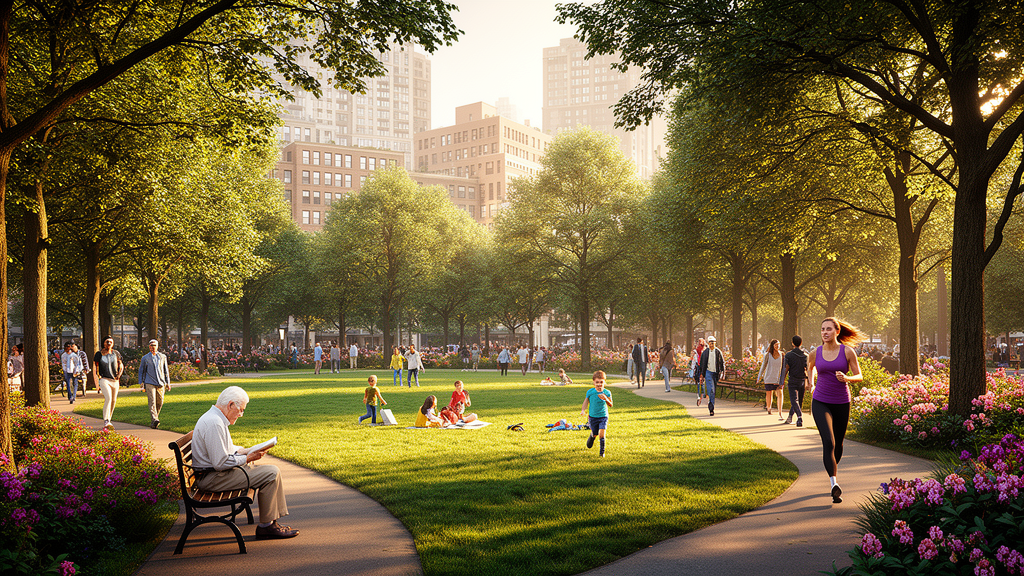
For decades, city planners and public health advocates have repeated a seductive claim: plant more trees, build more parks, and urban populations will get healthier. But a nagging question has haunted the field. Are the health benefits of urban green space a genuine causal reality, or simply an urban myth sustained by studies that confuse correlation with causation? A new systematic review published in Humanities and Social Sciences Communications tackles that question head-on, and its answer is striking. When researchers apply the most demanding tools of causal inference to observational data, the health-promoting power of green space does not fade. It holds firm.
The review, led by Jun Ying and colleagues at Zhejiang A&F University in Hangzhou, China, systematically examined recent empirical studies that go beyond simple regression models and instead deploy quasi-experimental designs borrowed from economics and epidemiology. The team identified 37 records, of which 33 were empirical studies, with the remaining four being research protocols. These studies employed five principal causal inference strategies: propensity score matching, the synthetic control method, instrumental variable analysis, difference-in-differences, and regression discontinuity design. Each of these approaches represents a different attempt to solve the same fundamental problem: how to isolate the true effect of green space from the tangle of confounding factors that shape both where people live and how healthy they are.
That problem, known in the literature as endogeneity, is the central obstacle to credible claims about green space and health. People are not randomly assigned to neighborhoods with leafy parks. Healthier, wealthier, and more health-conscious individuals often choose to live near green amenities, a phenomenon called self-selection bias. Cities that invest in parks may also invest in better clinics, safer streets, and cleaner air. A naive comparison of residents near and far from green space therefore risks attributing to trees and lawns the benefits of everything else that comes with them. The methodological revolution captured in this review lies in the growing arsenal of techniques designed to neutralize exactly this bias.
Difference-in-differences, one of the workhorse designs, compares changes in health outcomes over time between areas that gained or lost green space and areas that did not, effectively canceling out stable differences between places. Its validity, however, rests on the parallel trends assumption: in the absence of the intervention, treated and untreated areas would have followed the same health trajectory. The synthetic control method goes further, constructing a weighted combination of comparison units that mimics the pre-intervention trajectory of a treated city or district, creating a statistical counterfactual against which the real intervention can be judged. Instrumental variable analysis exploits external sources of variation, such as historical or geographic factors that influence green space availability but have no direct pathway to health, while regression discontinuity design capitalizes on arbitrary thresholds, such as distance cutoffs, that assign green exposure quasi-randomly at a boundary.
The headline finding of the review is unambiguous. Of the 33 empirical studies analyzed, 30 reported a positive causal effect of urban green space on at least one health outcome. That is a remarkable degree of consensus in a literature often criticized for inconsistency. More importantly, the authors did not simply tally positive results. They scrutinized whether each study explicitly addressed the key identification assumptions of its chosen design, and they assessed the risk of bias using ROBINS-I, a structured tool developed for evaluating causality in non-randomized intervention studies. This dual examination separates the review from earlier syntheses that aggregated findings without interrogating the credibility of the underlying causal claims.
The most persuasive evidence came from the methodologically strongest papers. The positive consensus remained consistent among studies that met all key assumptions of the difference-in-differences framework and among those that effectively combined propensity score matching with difference-in-differences, a hybrid that first balances treated and comparison groups on observable characteristics and then removes time-invariant unobserved confounding. In other words, the studies least vulnerable to self-selection and endogeneity bias were precisely the ones that continued to find health benefits. As the authors emphasize, when endogeneity and self-selection are strictly controlled, the health-promoting role of urban green space remains highly credible. The benefits are not an artifact of wealthy people living near parks.
Why does this matter beyond academic circles? Urbanization is one of the defining demographic transformations of the century, with a growing majority of humanity living in cities where chronic disease, mental stress, and heat exposure concentrate. Green space has been promoted as a low-cost, multi-benefit public health lever, potentially reducing cardiovascular risk, improving mental well-being, encouraging physical activity, and cooling neighborhoods. But public budgets are finite, and city governments need evidence that withstands scrutiny before committing land and money. A causal, not merely correlational, foundation for the green space-health link transforms parks from a pleasant amenity into a defensible intervention, comparable in evidentiary standing to other public health measures.
The review also exposes the limits of the current evidence base. Thirty-three empirical studies is a modest number for a question of this global importance, and the authors note that many investigations still fall short of fully addressing identification assumptions. Designs such as instrumental variables and regression discontinuity remain underused, in part because they demand data and institutional settings that are hard to come by. Risk of bias assessments revealed that few studies were free of methodological concerns, a reminder that even quasi-experimental designs can be undermined by measurement error, ambiguous treatment definitions, or selective reporting of health outcomes. The field, in short, has made real progress but has not yet reached the evidentiary maturity of, say, pharmaceutical trials.
Looking forward, the authors chart a clear agenda. Future studies should integrate multiple causal approaches within the same investigation, so that findings that survive several distinct identification strategies command far greater confidence than those resting on a single design. They call for leveraging big data and machine learning technologies, which can improve the measurement of green exposure through satellite imagery and street-level imagery, sharpen the construction of matched comparison groups, and help detect heterogeneous effects across populations. They also stress the need for interdisciplinary collaboration, uniting landscape architects, epidemiologists, economists, and data scientists around a shared standard of causal rigor. Such collaboration could finally connect the granular realities of park design with the population-scale evidence that policymakers need.
The broader lesson of this review extends past green space itself. It is a demonstration that observational research, often dismissed as inherently second-rate, can produce credible causal evidence when researchers take identification seriously. The debate over whether parks make people healthier has been reframed: it is no longer whether the association is real, but how large the effect is, who benefits most, and which kinds of green interventions deliver the greatest return. For the billions of people who will live in cities by mid-century, the answer emerging from the most rigorous studies to date is quietly revolutionary. The tree-lined street and the neighborhood park are not decorations. They are, on the weight of the best available causal evidence, working pieces of public health infrastructure.
Subject of Research: Causal inference methods for estimating the health effects of urban green space in observational studies
Article Title: Urban green space as a public health intervention: a systematic review of causal inference methods in observational studies
Article References: Urban green space as a public health intervention: a systematic review of causal inference methods in observational studies. (n.d.). https://doi.org/10.1038/s41599-026-09417-9
Image Credits: AI Generated
DOI: 10.1038/s41599-026-09417-9
Keywords: urban green space, public health, causal inference, difference-in-differences, synthetic control method, instrumental variable, regression discontinuity, propensity score matching, self-selection bias, systematic review, urbanization, ROBINS-I
Cite Scienmag News
Phoebe Ingram. (October 16, 2026). Parks That Heal: Rigorous Causal Methods Confirm Urban Green Space Boosts Health. Scienmag. https://scienmag.com/parks-that-heal-rigorous-causal-methods-confirm-urban-green-space-boosts-health/
Phoebe Ingram. "Parks That Heal: Rigorous Causal Methods Confirm Urban Green Space Boosts Health." Scienmag, 16 October 2026, https://scienmag.com/parks-that-heal-rigorous-causal-methods-confirm-urban-green-space-boosts-health/. Accessed 16 October 2026.
Phoebe Ingram. "Parks That Heal: Rigorous Causal Methods Confirm Urban Green Space Boosts Health." Scienmag. October 16, 2026. https://scienmag.com/parks-that-heal-rigorous-causal-methods-confirm-urban-green-space-boosts-health/


