


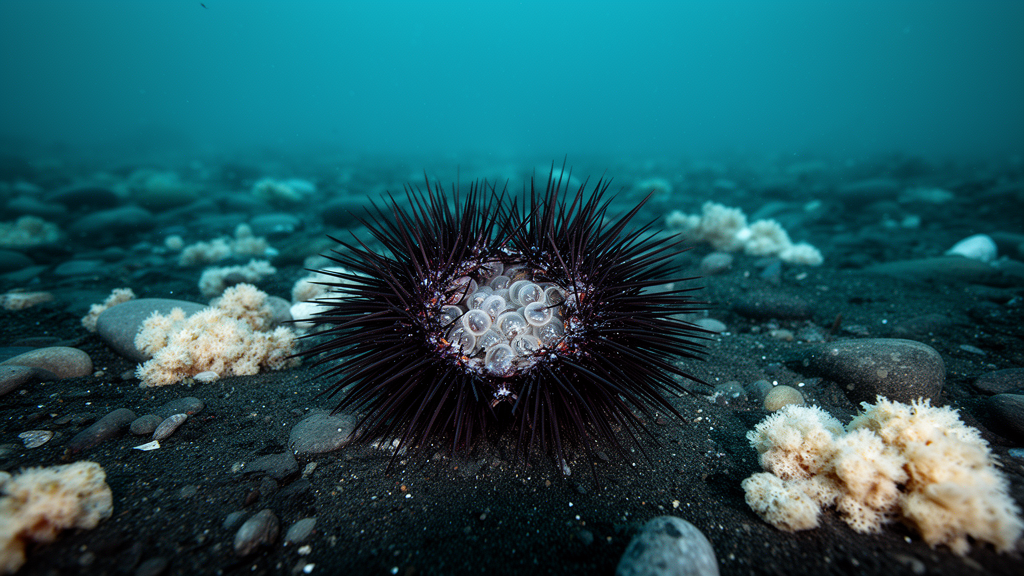
Deep in the cold, sediment-floored shallows of the Southern Ocean, a group of unassuming heart urchins has been quietly teaching scientists how life persists at the ends of the Earth. Now, after twenty years of expeditions, a team of researchers has released the most complete picture yet of where these remarkable animals live — and the dataset is already reshaping how scientists think about vulnerability, endemism and conservation across the Antarctic and Subantarctic realms.
The genus Abatus belongs to the family Schizasteridae, a lineage of irregular sea urchins that diverge dramatically from their spiky, spherical relatives. Rather than grazing on algae, these deposit feeders burrow through soft sediment, ingesting surface detritus in the subtidal zone down to roughly 1,000 metres depth. What makes them truly extraordinary, however, is their reproductive strategy. Unlike most marine invertebrates, which release vast clouds of eggs and sperm into the water column, Abatus species practise direct development: females brood their young internally, with no free-swimming larvae at all. This brooding lifestyle fundamentally constrains dispersal, meaning populations are finely tuned to their local environments and acutely sensitive to habitat fragmentation.
Three species form a closely related clade within the genus: Abatus agassizii, Abatus cavernosus and Abatus cordatus. These heart urchins have served as model organisms for decades, illuminating everything from developmental biology and biogeography to host-associated microbiota and evolutionary patterns. More recently, they have been deployed as sentinels — biological barometers for detecting the effects of global change in one of the planet’s most rapidly warming regions. Yet their documented distributions remained fragmented, hampered by uneven sampling across regions and years, a problem that plagues much of Southern Ocean biodiversity research.
To address this gap, researchers led by Fernando Moya and colleagues at the Millennium Institute Biodiversity of Antarctic and Subantarctic Ecosystems (BASE) and the University of Chile compiled and curated occurrence records gathered between 2004 and 2024. The resulting dataset, published in the Biodiversity Data Journal and released through the Global Biodiversity Information Facility (GBIF), documents 27 georeferenced occurrences of the three recognised species, plus two additional records identified only at genus level. The specimens were collected from five main regions spanning the Southern Ocean: the Magellan Strait in Patagonia, the Falkland/Malvinas Islands, South Georgia, the Kerguelen Islands and the South Shetland Islands near the Antarctic Peninsula.
Sampling these elusive burrowers required two complementary techniques. In shallow infralittoral zones, researchers hand-picked specimens at low tide. Where the subtidal habitat deepened, they turned to SCUBA diving, surveying systematically spaced transects at roughly 100-metre intervals in the Falkland/Malvinas Islands, Magellan Strait, South Shetland Islands and South Georgia, and 500-metre intervals at Kerguelen sites. Collected urchins were transported to research vessels or scientific stations in seawater, then preserved in 95% ethanol for both morphological and molecular analyses. Each specimen was revised by taxonomic experts using diagnostic morphological characteristics and an online identification key, reducing the risk of misidentification that has long complicated Abatus research.
The geographic patterns that emerge are striking and biologically meaningful. Abatus agassizii appears highly localised within the South Shetland Islands and Antarctic Peninsula region, where it is most reliably encountered in the protected, ice-free embayments of Fildes Bay on King George Island. Abatus cordatus, by contrast, is endemic to the Kerguelen Plateau and widespread in shallow soft-bottom habitats there. Abatus cavernosus occupies the Subantarctic region of South America, primarily the eastern Magellan Strait. The Subantarctic zone accounts for 62.1% of recorded occurrences, while the Antarctic zone contributes the remaining 37.9%. Repeated detections of A. cordatus at Kerguelen and A. agassizii at Fildes Bay across multiple expeditions in different years suggest persistent local presence — a temporary maintenance of patches consistent with the species’ short generation times of around five years and their brooding life history.
But the dataset also exposes a thorny problem: taxonomic uncertainty. Unresolved phylogenetic relationships and overlapping morphological characters — such as pedicellariae type and test shape — have led to erroneous identifications within the genus. Records from the Falkland/Malvinas Islands, which typically share fauna with Patagonia, document the presence of A. agassizii or potentially A. philippii, rather than the expected A. cavernosus. Similarly, published syntheses of the Scotia Arc report multiple species co-occurring, and discrepancies between A. cavernosus and A. bidens are evident in Maritime Antarctica. The researchers flag the Falkland/Malvinas and South Georgia occurrences as priorities for DNA sequencing and standardised re-identification to determine whether they belong to A. cavernosus, A. philippii or an undescribed evolutionary unit.
The brooding life history of Abatus — direct development, maternal brooding and absence of pelagic larvae — constrains dispersal and gene flow, favouring fine-scale spatial genetic structure and demographic sensitivity to habitat fragmentation. Empirical studies document long brooding cycles, limited mobility and significant micro-spatial genetic variation. Individual-based simulations indicate these populations are vulnerable to local disturbances, and recent morphological and microbiological analyses confirm this fragility, especially in response to metal contamination. For brooders whose realised dispersal is intrinsically low, shallow Antarctic and Subantarctic soft-bottom communities face multiple interacting drivers — ocean warming, marine heatwaves, sea-ice and iceberg-scour dynamics, acidification, pollution and fisheries — whose effects are magnified by narrow depth and temperature envelopes.
Methodologically, the researchers advocate rigorous quality control before downstream analyses. Open biodiversity aggregators such as GBIF and OBIS are indispensable for contextualising Southern Ocean biodiversity, but exhibit strong spatial, temporal and taxonomic biases due to remoteness, logistics and route-based sampling. The team recommends routine occurrence-data QA/QC — including CoordinateCleaner pipelines for georeferencing artefacts, depth and land-sea mismatch checks and institutional centroid filters — before constructing Species Distribution Models. Such models for benthic taxa should be built with careful bias correction and environmental realism, incorporating substrate, bathymetry and near-bottom climatologies, as recent echinoid-focused assessments caution that model robustness otherwise suffers.
From a conservation standpoint, the curated baseline enables future assessments to quantify Extent of Occurrence and Area of Occupancy following current IUCN Red List guidance, explicitly accounting for sampling bias and taxonomic uncertainty. Region-specific ecoregionalisations based on echinoid distributions can help translate occurrence baselines into spatial priorities, such as marine protected area design and updates, under IPCC-consistent climate scenarios. Taken together, the dataset documents persistent populations at key localities, highlights taxonomic uncertainty where integrative work is needed, provides curated inputs for bias-aware distribution models and monitoring, and establishes a reproducible backbone against which to test hypotheses about brooder vulnerability, range dynamics and conservation status across the Southern Ocean. For a genus whose females carry their young through the coldest waters on Earth, knowing exactly where they live may prove the first step in ensuring they keep living there.
Subject of Research: Two Decades of Data Reveal Hidden Lives of Antarctic Brooding Sea Urchins
Article Title: Some temporal and geographic records of Abatus species ( Echinoidea , Schizasteridae ) in Antarctic and Subantarctic environments
Article References: Moya, F., Maturana, C., Rosenfeld, S., Delleuze, M., Schwob, G., Neder, C., Brickle, P., Saucède, T., Cabrol, L., Gerard, K., Díaz, A., & Poulin, E. (2026). Some temporal and geographic records of Abatus species (Echinoidea, Schizasteridae) in Antarctic and Subantarctic environments. Biodiversity Data Journal, 14, Article e202389. https://doi.org/10.3897/bdj.14.e202389
Image Credits: AI Generated
Keywords: Some, temporal, geographic, records, Abatus, species, Echinoidea, Schizasteridae, Antarctic, Subantarctic, environments, scientific research
Cite Scienmag News
Margaret Porter. (October 16, 2026). Two Decades of Data Reveal Hidden Lives of Antarctic Brooding Sea Urchins. Scienmag. https://scienmag.com/two-decades-of-data-reveal-hidden-lives-of-antarctic-brooding-sea-urchins/
Margaret Porter. "Two Decades of Data Reveal Hidden Lives of Antarctic Brooding Sea Urchins." Scienmag, 16 October 2026, https://scienmag.com/two-decades-of-data-reveal-hidden-lives-of-antarctic-brooding-sea-urchins/. Accessed 16 October 2026.
Margaret Porter. "Two Decades of Data Reveal Hidden Lives of Antarctic Brooding Sea Urchins." Scienmag. October 16, 2026. https://scienmag.com/two-decades-of-data-reveal-hidden-lives-of-antarctic-brooding-sea-urchins/


