


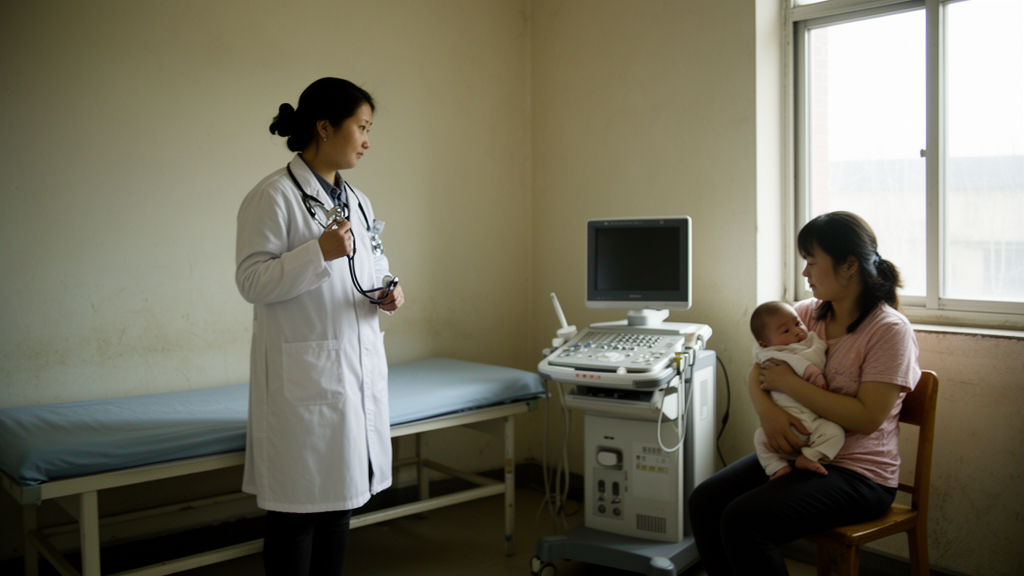
In the rolling farmlands and mountain counties of rural China, a quiet efficiency crisis is unfolding inside the specialized hospitals entrusted with the health of pregnant women, mothers, infants, and young children. A new study published in BMC Health Services Research has tracked the performance of maternal and child health (MCH) hospitals across rural China from 2012 to 2021, and its findings read like a warning label for health systems everywhere that face shrinking populations. Using a sophisticated battery of econometric tools, a research team led by Yongmu Jiang of Sichuan University’s School of Economics found that the average efficiency of these hospitals consistently declined over the decade, even as the gaps between China’s major regions narrowed in most of the country.
The timing of the study could hardly be more pointed. China’s birth and marriage rates have continued to fall in recent years, a demographic shift that strikes directly at the patient base of MCH hospitals. These institutions are dedicated healthcare facilities focused on the well-being of pregnant women, mothers, infants, and young children, and their financial and operational health depends on a steady stream of births and pediatric visits. When birth rates slide, hospital revenues fall, but the fixed costs of staff, buildings, and equipment do not disappear at the same pace. The result is a widening mismatch between what these hospitals spend and what they deliver, which is precisely the kind of inefficiency the researchers set out to quantify.
To measure that mismatch, the team deployed data envelopment analysis, a mathematical technique that compares each hospital against a frontier of best performers and calculates how far the laggards fall short. The method works by treating hospitals as decision-making units that convert inputs, such as personnel and beds, into outputs, such as services delivered. Because conventional frontier analysis can be distorted by extreme values, the researchers used a slack-based measure, which captures not just the proportion of inefficiency but also the specific shortfalls in individual inputs and outputs. They then wrapped this in a meta-frontier framework, which allows hospitals in different regions to face different technological environments while still being compared on a common underlying frontier, a crucial refinement when Eastern, Central, Western, and Northeastern China differ so dramatically in economic development and infrastructure.
The two-stage design of the study is what gives it its analytical teeth. In the first stage, the efficiency scores and productivity changes were estimated for the decade. In the second stage, a Tobit regression, a model built for dependent variables that are bounded between zero and one, was used to examine how efficiency relates to external factors such as birth rate, marriage rates, and education levels. This two-step approach separates the measurement of performance from the explanation of performance, preventing the common statistical pitfall of conflating the two. The researchers also applied a global Malmquist index, a tool that tracks changes in total-factor productivity over time by decomposing them into technological advancement and efficiency improvement, allowing the team to determine whether hospitals were getting better because they were catching up to best practices or because the best practices themselves were advancing.
The results established four critical points that reshape how we should think about rural health services in China. First, the average efficiency of MCH hospitals in rural China consistently decreased over the study period, a finding that suggests these hospitals were not adapting their operations quickly enough to the demographic headwinds. Second, although this pattern did not hold for the Northeast, the efficiency gaps between the Eastern, Central, and Western regions narrowed, indicating that hospitals in less developed areas were catching up to their more prosperous counterparts. Third, changes in total-factor productivity primarily depended on technological advancements rather than on hospitals simply becoming more efficient at using existing resources. Fourth, and perhaps most strikingly, birth rate, marriage, and the level of education all had a significantly positive impact on service efficiency, linking the demographic and social environment directly to hospital performance.
That fourth finding deserves particular attention because it elevates the study from a narrow efficiency audit to a broader statement about human capital. The researchers found that education level, alongside birth and marriage rates, acts as a key indicator affecting efficiency, suggesting that communities with more educated populations enable their hospitals to operate more effectively. This could reflect better health literacy among patients, more effective communication between providers and families, or a workforce that is itself more skilled and adaptable. The implication is that hospital efficiency is not purely an internal management problem but is shaped by the social and environmental context in which hospitals are embedded, a conclusion that echoes a growing body of health services research on the social determinants of institutional performance.
The regional narrowing of efficiency gaps, with the notable exception of the Northeast, tells a story about convergence in Chinese health services. The Eastern region, with its dense population and advanced infrastructure, has long been the benchmark for hospital operations. The fact that the Central and Western regions closed the distance suggests that policy investments and technology diffusion have spread beyond the most developed areas. The Northeast, however, stands apart, possibly because its demographic decline has been more severe or its economic transition more difficult, leaving its hospitals unable to benefit from the same catch-up dynamics. This regional exception is a reminder that convergence is not automatic and that some areas may require targeted interventions rather than uniform national policies.
The decomposition of productivity change into technological advancement and efficiency improvement is one of the study’s most technically significant contributions. When total-factor productivity rises primarily because of technological progress, it means the frontier of best practice is moving forward, but hospitals may still be operating below their own potential. When productivity rises because of efficiency gains, it means hospitals are catching up to the frontier. The finding that technological advancement was the primary driver suggests that rural MCH hospitals have adopted new methods and equipment, but that their internal management and resource allocation have not kept pace. This distinction matters enormously for policy, because the remedies for a technology gap and a management gap are entirely different, requiring investment in innovation on one hand and administrative reform on the other.
The study’s recommendations follow directly from its findings. The researchers argue that MCH hospitals should match supply and demand, aligning their capacity with the actual number of births and pediatric patients they serve, and strengthen their service innovation to remain viable in a shrinking market. Governments, they say, should implement policies to improve human capital, investing in education and social conditions that indirectly boost hospital performance. This framing treats health system efficiency as a supply-and-demand equilibrium problem rather than a pure cost-cutting exercise, and it places responsibility on both hospital administrators and policymakers. The authors also note that the study was financially supported by the Medical Interdisciplinary Key Project of Sichuan University and the National Natural Science Foundation of China, reflecting the interdisciplinary nature of an analysis that bridges economics, demography, and health services.
For a global audience, the study offers a preview of challenges that many countries will face as birth rates decline. Specialized maternal and child health services everywhere depend on demographic vitality, and the Chinese experience demonstrates how efficiency erodes when the patient base contracts faster than hospital capacity can adjust. The methodological framework, combining meta-frontier slack-based measures with Tobit regression and global Malmquist analysis, provides a template for other health systems seeking to diagnose whether their own hospitals are falling behind because of technology, management, or demographic context. As populations age and birth rates fall across East Asia, Europe, and beyond, the question of how to keep specialized health services efficient in a shrinking market is becoming one of the defining health policy puzzles of the century, and this study of rural China offers both a warning and a roadmap.
Subject of Research: Efficiency of maternal and child health hospital services in rural China from 2012 to 2021, analyzed with a two-stage meta-frontier slack-based measure Tobit model
Article Title: Maternal and child health hospital services efficiency in rural China (2012–2021): a two-stage meta-frontier slack-based measure Tobit model
Article References: Jiang, Y., Hu, Z., Tang, Y., Zhao, S., Zeng, L., Zou, K., Li, H., Bo, Z., Han, L., & Zhang, L. (2026). Maternal and child health hospital services efficiency in rural China (2012–2021): a two-stage meta-frontier slack-based measure Tobit model. BMC Health Services Research. https://doi.org/10.1186/s12913-026-15275-7
Image Credits: AI Generated
DOI: 10.1186/s12913-026-15275-7
Keywords: maternal and child health, hospital efficiency, rural China, data envelopment analysis, health economics, demographic decline, Tobit regression, Malmquist index, health services research, human capital, Maternal, child
Cite Scienmag News
Harold Sullivan. (October 16, 2026). Rural China’s Maternal and Child Health Hospitals Are Getting Less Efficient, a Decade of Data Reveals. Scienmag. https://scienmag.com/rural-chinas-maternal-and-child-health-hospitals-are-getting-less-efficient-a-decade-of-data-reveals/
Harold Sullivan. "Rural China’s Maternal and Child Health Hospitals Are Getting Less Efficient, a Decade of Data Reveals." Scienmag, 16 October 2026, https://scienmag.com/rural-chinas-maternal-and-child-health-hospitals-are-getting-less-efficient-a-decade-of-data-reveals/. Accessed 16 October 2026.
Harold Sullivan. "Rural China’s Maternal and Child Health Hospitals Are Getting Less Efficient, a Decade of Data Reveals." Scienmag. October 16, 2026. https://scienmag.com/rural-chinas-maternal-and-child-health-hospitals-are-getting-less-efficient-a-decade-of-data-reveals/


