


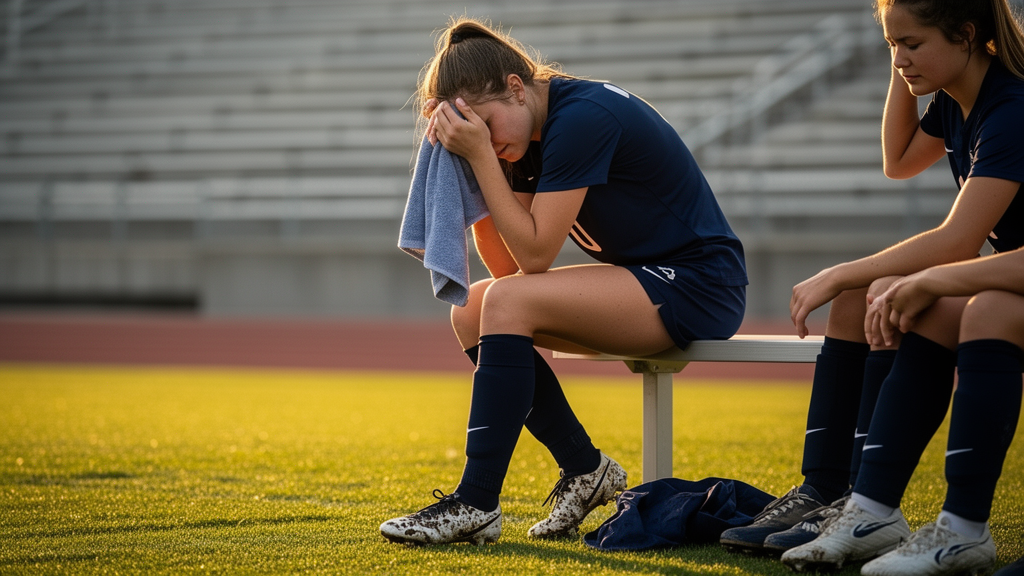
Female college soccer players may be quietly rewiring the way their muscles work every time they step onto the field exhausted, according to new research that offers one of the most detailed looks yet at how fatigue reshapes lower limb neuromuscular control in women athletes. The study, published in Frontiers in Sports and Active Living, tracked twenty collegiate players through a battery of landing and cutting tasks before and after a standardized fatigue protocol, and found that exhaustion does not simply blunt muscle output uniformly. Instead, it appears to trigger task-specific shifts in how the quadriceps, hamstrings, and stabilizers coordinate to protect the knee.
The research team, led by investigators at Huazhong University of Science and Technology in Wuhan, China, recruited twenty female college soccer players aged nineteen to twenty-three from two university teams. Each participant completed the Yo-Yo Intermittent Endurance Level 2 Test, a widely validated soccer-specific fatigue protocol involving repeated twenty-meter shuttle runs at progressively increasing speeds. Fatigue was confirmed when athletes reached a heart rate of at least eighty-five percent of their estimated maximum or reported a rating of fifteen or higher on the Borg six-to-twenty perceived exertion scale. All twenty participants met the fatigue criteria before post-fatigue testing began.
Researchers assessed three movement tasks before and after fatigue induction: single-leg landing from a thirty-centimeter platform, double-leg landing from the same height, and a zigzag running course with four five-meter segments and a one-hundred-degree turning angle. Surface electromyography recorded activity from twelve lower limb muscles, including the rectus femoris, vastus lateralis, vastus medialis, biceps femoris, semitendinosus, and tibialis anterior on both legs. Force plates simultaneously captured peak vertical ground reaction forces, stabilization time, and center of pressure displacement, providing a complementary kinetic picture of how fatigue altered landing mechanics.
The most robust finding emerged during double-leg landing, where normalized muscle activation dropped significantly in three key quadriceps muscles. The right vastus lateralis showed a decrease from a median of 8.58 to 7.78 percent peak amplitude, the left vastus lateralis fell from 9.45 to 8.36, and the right vastus medialis declined from 9.86 to 8.27. Critically, these three results survived false discovery rate correction, a statistical safeguard that filters out findings likely to be false positives. Every other significant change in the study remained exploratory, meaning the authors urge caution in interpreting them as definitive fatigue effects.
During single-leg landing, the picture shifted. Peak vertical ground reaction force, normalized to body weight, decreased significantly on both sides after fatigue. The left foot dropped from 2.52 to 2.34 body weights while the right fell from 2.69 to 2.40, both surviving statistical correction. Stabilization time, the duration from ground contact until force fluctuations settled within five percent of body weight, also lengthened on the left side, though this finding did not survive correction and remains tentative. The authors suggest this combination may reflect a more conservative landing strategy adopted under fatigue, where athletes deliberately soften impact forces to maintain control at the expense of explosive cushioning.
In zigzag running, a pre-fatigue asymmetry in rectus femoris activation between the left and right legs, which was statistically significant before correction, disappeared after fatigue. The researchers note this could indicate either a strategic shift toward more symmetrical muscle recruitment or simply bilateral neuromuscular fatigue dampening output on both sides. Without concurrent kinematic data capturing joint angles and moments, the team cannot determine which interpretation is correct. They also acknowledge that because zigzag running was tested last, six to eight minutes after the fatigue protocol, partial recovery may have influenced the result.
The study’s context matters. Women’s soccer participation has surged globally, reaching approximately 16.6 million organized players as of 2023, and female athletes face a substantially elevated risk of non-contact anterior cruciate ligament injuries compared to males, with soccer players sustaining four to six times the risk. Fatigue, bilateral lower limb asymmetry, and neuromuscular control deficits are recognized as key contributors. Collegiate athletes, who often train with less structured periodization than professionals, may be particularly vulnerable to fatigue-induced changes in movement strategy.
The authors are careful to frame their conclusions within the study’s limitations. The sample was drawn from only two university teams, the within-subject design lacked a non-fatigued control group, and the fixed testing sequence means task-order effects cannot be fully separated from fatigue effects. Sleep, nutrition, and menstrual cycle data were not collected. Nonetheless, the findings offer preliminary support for targeted training interventions, including unilateral stability work, quadriceps fatigue resistance, and multidirectional neuromuscular conditioning tailored to the demands of change-of-direction play.
For coaches and sports scientists, the message is that fatigue does not degrade all muscles equally or uniformly across tasks. The knee extensors appear most vulnerable during bilateral landing, while single-leg stability and cutting mechanics show different patterns of adaptation. As women’s soccer continues its rapid global expansion, understanding these task-specific neuromuscular responses may prove essential for designing injury prevention programs that keep athletes healthy deep into matches and tournaments.
Subject of Research: Effects of fatigue on lower limb neuromuscular control and landing biomechanics in female collegiate soccer players
Article Title: The impact of fatigue on lower limb neuromuscular control in female college soccer players
Article References: Xiang, T., Zhu, T., Ma, H., Mu, Z., Han, Z., Imai, K., Shen, S., Guo, Z., & Zhou, X. (2026). The impact of fatigue on lower limb neuromuscular control in female college soccer players. Frontiers in Sports and Active Living, 8, Article 1918634. https://doi.org/10.3389/fspor.2026.1918634
Image Credits: AI Generated
DOI: 10.3389/fspor.2026.1918634
Keywords: sports science, female athletes, soccer, neuromuscular control, fatigue, ACL injury, biomechanics, electromyography, impact, lower, limb, neuromuscular
Cite Scienmag News
Faith Mcneil. (October 16, 2026). Fatigue Rewires Muscle Control in Female College Soccer Players, Study Finds. Scienmag. https://scienmag.com/fatigue-rewires-muscle-control-in-female-college-soccer-players-study-finds/
Faith Mcneil. "Fatigue Rewires Muscle Control in Female College Soccer Players, Study Finds." Scienmag, 16 October 2026, https://scienmag.com/fatigue-rewires-muscle-control-in-female-college-soccer-players-study-finds/. Accessed 16 October 2026.
Faith Mcneil. "Fatigue Rewires Muscle Control in Female College Soccer Players, Study Finds." Scienmag. October 16, 2026. https://scienmag.com/fatigue-rewires-muscle-control-in-female-college-soccer-players-study-finds/


