


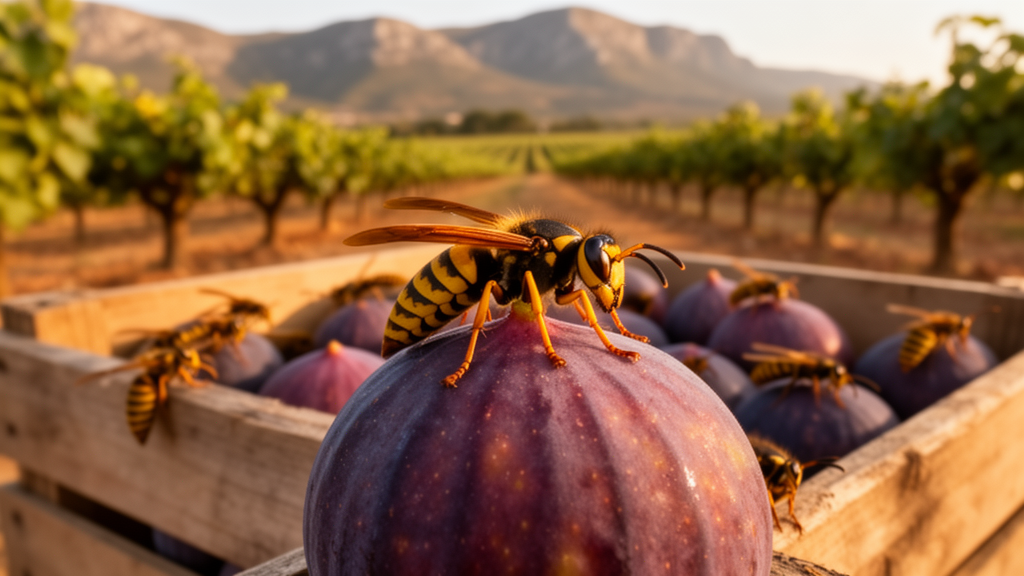
A quiet invader that has lurked on the slopes of Table Mountain for half a century may be on the verge of becoming one of South Africa’s most expensive ecological problems. The German wasp, Vespula germanica, an aggressive social wasp native to Europe and the Mediterranean, has been modeled in new research as a creeping economic threat to the country’s fruit farms, vineyards, and households. If it continues to spread unchecked, scientists estimate the total bill could reach US$160–300 million over the next 50 years, with the damage accelerating sharply after an initial deceptive lull.
The study, published in the journal NeoBiota, used a Monte Carlo simulation model to project how the wasp’s spread would ripple through three sectors: horticulture, wine grape production, and private households. The researchers assumed no coordinated eradication or containment effort would be mounted, creating a worst-case baseline against which future government interventions could be measured. Their conclusion is stark: doing nothing carries a price tag equivalent to roughly US$3–6 million every year, which sets a clear ceiling on what a rational eradication or spread-mitigation program should cost.
Vespula germanica is no stranger to invasion biology. Since World War II, increased movement of people and cargo has carried it from its native range to North America, Argentina, Chile, Iceland, New Zealand, Australia, and South Africa. It was first recorded in the Western Cape in 1972, though it may have arrived before 1970. Genetic analysis suggests two separate incursion events: a dominant haplotype, Hap2, established around the Cape Peninsula, while a second haplotype, Hap1, appears to have arrived in the Boland region northeast of Cape Town around the year 2000 and has since spread north, east, and south. Researchers suspect Hap1 is better suited to the local climate, raising concerns about faster expansion in the decades ahead.
What makes the wasp particularly dangerous to agriculture is its appetite for honeybees. Workers attack both wild and managed colonies of the European honeybee, Apis mellifera, sometimes raiding hives directly but more often picking off individual bees at ground level. South Africa is unusually vulnerable to this kind of pressure. Wild pollinators currently supply only about one fifth of the pollination services that fruit and vegetable growers need, and managed hive rental services are already insufficient to meet peak seasonal demand. Because growers cannot easily substitute other pollination sources, demand for hive rentals is highly inelastic, meaning any reduction in commercial hive capacity translates almost directly into higher costs for farmers.
The simulation modeled fourteen horticultural industries, from apples and pears to macadamia nuts, avocados, and strawberries, covering roughly 220,000 hectares and a gross value of about US$1.6 billion. As wasp predation shrinks the effective supply of commercial hives, the model predicts hive hire prices will climb. For the first 25 to 30 years the effect is negligible, but after 50 years the price per hive is projected to rise from US$75.00 to between US$78.20 and US$84.50, while yield losses in pollinator-dependent crops increase by 4 to 13 percent. Over the full simulation period, these pollination disruptions are expected to cost the horticulture sector US$30–55 million.
Wine grapes face a different kind of threat. German wasps hollow out grapes on the vine, causing direct yield losses and introducing foreign yeasts that interfere with fermentation. In unmanaged vineyards elsewhere, losses of 10 to 15 percent have been recorded. South African wine grape production spans about 87,850 hectares, concentrated in the Cape Winelands around Stellenbosch, Paarl, Franschhoek, and Constantia, and was valued at roughly US$393 million in 2022/23. The model assumes vineyard managers would respond by deploying bait stations at around five per hectare, costing US$120–150 per hectare annually, which suppresses damage to negligible levels. Even so, the cumulative cost of this control effort over 50 years is estimated at US$1–3 million, a relatively minor share of the total.
By far the largest burden falls on households. In warm climates, German wasp colonies can breed continuously and grow to contain many thousands of individuals by late summer, making them a serious nuisance and health hazard in urban areas. The researchers assumed that 5 percent of urban wasp colonies would pose enough of a risk to residents’ health and recreation to justify professional pest control, and that about 20 percent of South Africa’s 18.5 million dwellings fall into the middle-class category with sufficient disposable income to hire such services. At an assumed cost of US$120–300 per nest removal, household pest management expenses are projected to reach US$110–260 million over 50 years, accounting for a striking 82 percent of all modeled damages.
The model’s sensitivity analysis revealed which variables matter most. The results were overwhelmingly driven by the assumed rate of spread: stretching the time for the wasp to saturate each sector to 50 years cut the median damage estimate from US$225 million to US$115 million, while compressing it to 30 years pushed the figure up to US$345 million. The discount rate came a close second, with a one-percentage-point shift moving the median estimate by roughly 30 to 50 percent. This sensitivity cuts both ways: it means the projections carry real uncertainty, but it also means that even modest investments in slowing the wasp’s spread could yield enormous returns.
The authors argue this is precisely where the policy value lies. If a spread-mitigation program, whether nest surveillance, subsidies for pest control, bounties for reporting, or biological control, can push the spread timeline out to 50 years, it would avert about US$110 million in damages over 30 years, or roughly US$3.7 million per year. Any program costing less than that threshold produces a net benefit for society. Given that eradication may still be technically feasible thanks to the wasp’s historically slow expansion, the study effectively hands South African policymakers a price tag for inaction and a benchmark for action.
There are caveats. The model is deliberately aspatial, treating spread as a smooth logistic curve even though the wasp’s actual expansion has been sporadic, driven partly by human-mediated transport. It also assumes the supply of managed hives stays constant, reflecting real barriers: South Africa has banned live honeybee imports since the early 1980s, wild bee stock is limited, and forage resources in the dry climate are constrained. Adding a spatial dimension through dispersal or cellular automata models could sharpen regional predictions. But as a first estimate of what an unmanaged invasion would cost, the message is clear: the German wasp’s bill is coming, and the cheapest time to stop it is now.
Subject of Research: Economic impact modeling of the invasive German wasp Vespula germanica in South Africa
Article Title: Potential future economic impact of Vespula germanica (Fabricius) ( Hymenoptera , Vespidae ) in South Africa
Article References: Cook, D. C., McKirdy, S. J., & Veldtman, R. (2026). Potential future economic impact of Vespula germanica (Fabricius) (Hymenoptera, Vespidae) in South Africa. NeoBiota, 109, 67-84. https://doi.org/10.3897/neobiota.109.191014
Image Credits: AI Generated
DOI: 10.3897/neobiota.109.191014
Keywords: Vespula germanica, invasive species, South Africa, pollination, horticulture, wine grapes, household pest control, Monte Carlo simulation, economic modeling, NeoBiota, eradication, biosecurity
Cite Scienmag News
Alan Morgan. (October 16, 2026). Invasive German wasp could cost South Africa US$300 million over 50 years. Scienmag. https://scienmag.com/invasive-german-wasp-could-cost-south-africa-us300-million-over-50-years/
Alan Morgan. "Invasive German wasp could cost South Africa US$300 million over 50 years." Scienmag, 16 October 2026, https://scienmag.com/invasive-german-wasp-could-cost-south-africa-us300-million-over-50-years/. Accessed 16 October 2026.
Alan Morgan. "Invasive German wasp could cost South Africa US$300 million over 50 years." Scienmag. October 16, 2026. https://scienmag.com/invasive-german-wasp-could-cost-south-africa-us300-million-over-50-years/


