


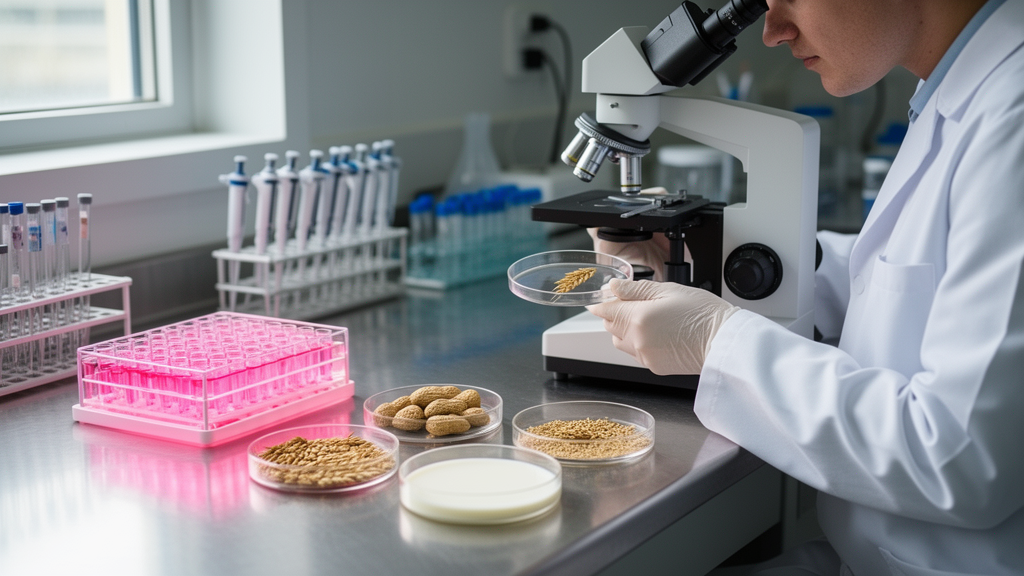
As plant-based diets sweep across Europe, legumes are being hailed as the sustainable protein of the future. But there is a hidden problem lurking in this green revolution: every new legume introduced to the market carries an unknown allergenic risk. Peanuts and soybeans are already among the most dangerous food allergens, capable of triggering severe, even life-threatening reactions. Now, a team of European researchers has developed what could become the gold standard for testing whether novel legume foods are safe before they reach our plates.
The research, published in Frontiers in Allergy, comes from the EU-funded ALLPreT project, a Marie Sklodowska-Curie network spanning institutions in Germany, Denmark, Luxembourg, the United Kingdom, and the Netherlands. The team, led by Thomas Holzhauser of the Paul-Ehrlich-Institut, set out to solve a fundamental technical challenge that has plagued allergenicity risk assessment for years: the lack of standardized protein preparations that allow results from different laboratories and different testing methods to be meaningfully compared.
Under EU Regulation 2015/2283, any food not significantly consumed before May 1997 must undergo rigorous safety assessment before market authorization. Common food allergens are proteins, so any novel food containing proteins is considered potentially allergenic. Yet while methods for assessing nutritional, microbiological, and toxicological risks are well established, the allergenicity assessment of novel foods remains a weak link. Current approaches rely on a weight-of-evidence framework originally designed for genetically modified organisms, focusing on sequence homology to known allergens, stability to gastrointestinal digestion, and the capacity of proteins to bind Immunoglobulin E, the antibody central to allergic reactions.
The problem is that these methods may not predict de novo sensitization for unknown proteins. In vivo animal testing and in vitro cellular models have been proposed to fill this gap, but here is where the technical bottleneck emerges: every published study has relied on its own study-specific protein preparations, extracted using different buffers, different pH values, and different processing conditions. The result is a patchwork of data with limited comparability across studies, making it nearly impossible to distinguish between weakly and strongly allergenic proteins with confidence.
The ALLPreT team tackled this by testing four different extraction buffers across thirteen legume species, including common dietary legumes like peanut, soybean, lupine, pea, lentil, chickpea, white bean, and field bean, as well as small-seeded legumes like fenugreek, alfalfa, and red and white clover, which serve as examples of potential novel foods. The buffers ranged from pH 7.1 to 9.6 and included Tris-buffered saline, phosphate-buffered saline, ammonium carbonate, and sodium carbonate. Seeds were frozen in liquid nitrogen, ground to a fine powder using a cryogenic mill, and then extracted under controlled conditions of suspension, incubation, centrifugation, filtration, and lyophilization.
The winner was ammonium carbonate buffer at pH 9.0. This buffer extracted significantly more protein than the lower-pH alternatives, with mean concentrations of 5.8 milligrams per milliliter compared to 3.4 for Tris-buffered saline and 2.8 for phosphate-buffered saline. But the real genius lies in a property that seems almost too elegant: ammonium carbonate is an unstable salt that completely decomposes into gaseous ammonia, carbon dioxide, and water during freeze-drying. This means that after lyophilization, no buffer components remain in the final protein preparation. The extracts can then be reconstituted in any buffer required for downstream testing, making them compatible with virtually any in vitro cellular assay, in vivo animal model, or diagnostic IgE screening method.
Mass spectrometric analysis confirmed that the optimized protocol recovered proteins from all the important allergenic protein families in legumes, including 11S globulins, 7S globulins, 2S albumins, seed albumins, pathogenesis-related 10 proteins, profilins, lipid transfer proteins, oleosins, defensins, cyclophilins, annexins, and late embryogenesis abundant proteins. The estimated extraction efficiency ranged from 33.6 percent for roasted peanut to 96.7 percent for alfalfa, with a median of 62.3 percent across all species. Notably, the team found that roasting dramatically altered allergen composition, with roasted peanuts containing higher levels of 11S globulins but nearly four times less 2S albumins than unroasted peanuts.
Perhaps the most striking finding was the team’s decision to skip a defatting step. While treating seed powder with n-hexane increased protein yield from roasted peanut threefold, from 14.4 to 45.9 milligrams per milliliter, Western blot analysis revealed that the defatted extracts showed weaker immunostaining with anti-peanut antibodies, suggesting that the solvent may negatively affect the immunological properties of the proteins. This is particularly relevant because conventional defatting procedures frequently exclude lipophilic proteins such as oleosins, which have been recognized as clinically relevant allergens associated with severe peanut allergy. By preserving the natural oil body fraction, the optimized protocol ensures a broader allergenic profile.
The functional validation was equally impressive. All extracts bound IgG from polyclonal peanut or soybean antisera and IgE from legume-sensitized human subjects. In a humanized mediator release assay using rat basophilic leukemia cells transfected with the human IgE receptor alpha-chain, all extracts demonstrated functional IgE-crosslinking capacity after passive sensitization with allergen-specific human IgE. The sera also showed mediator release with the small-seeded legume extracts, comparable to the common legumes, demonstrating some degree of IgE cross-binding between dietary legumes and potential novel foods like alfalfa and clover.
This harmonized panel of well-characterized legume allergen preparations now provides the ALLPreT consortium with standardized study materials for use across all in silico, in vitro, and in vivo tools being developed within the project. Once validated across multiple experimental platforms, this protocol may be proposed for future allergenicity studies of novel legume foods, potentially transforming how regulators evaluate the safety of the next generation of plant-based products before they reach consumers.
Subject of Research: ALLPreT standardized legume allergen extracts for novel food allergenicity testing
Article Title: The ALLPreT panel of legume allergen preparations: characterization of optimized protein extracts for allergen composition, IgE-binding and IgE-crosslinking properties
Article References: Olivares-Martínez, A. L., Yue, S. R., Randow, S., Vestergaard Lukassen, M., Assugeni, I., Oliver, M., Kuehn, A., Verhoeckx, K., Bøgh, K. L., & Holzhauser, T. (2026). The ALLPreT panel of legume allergen preparations: characterization of optimized protein extracts for allergen composition, IgE-binding and IgE-crosslinking properties. Frontiers in Allergy, 7, Article 1938923. https://doi.org/10.3389/falgy.2026.1938923
Image Credits: AI Generated
DOI: 10.3389/falgy.2026.1938923
Keywords: food allergy, legumes, allergenicity, novel foods, IgE, ALLPreT, protein extraction, mass spectrometry, mediator release assay, EU regulation, panel, legume
Cite Scienmag News
Daisy Hatcher. (October 16, 2026). The Secret Recipe That Could Change How We Test New Foods for Allergies. Scienmag. https://scienmag.com/the-secret-recipe-that-could-change-how-we-test-new-foods-for-allergies/
Daisy Hatcher. "The Secret Recipe That Could Change How We Test New Foods for Allergies." Scienmag, 16 October 2026, https://scienmag.com/the-secret-recipe-that-could-change-how-we-test-new-foods-for-allergies/. Accessed 16 October 2026.
Daisy Hatcher. "The Secret Recipe That Could Change How We Test New Foods for Allergies." Scienmag. October 16, 2026. https://scienmag.com/the-secret-recipe-that-could-change-how-we-test-new-foods-for-allergies/


