


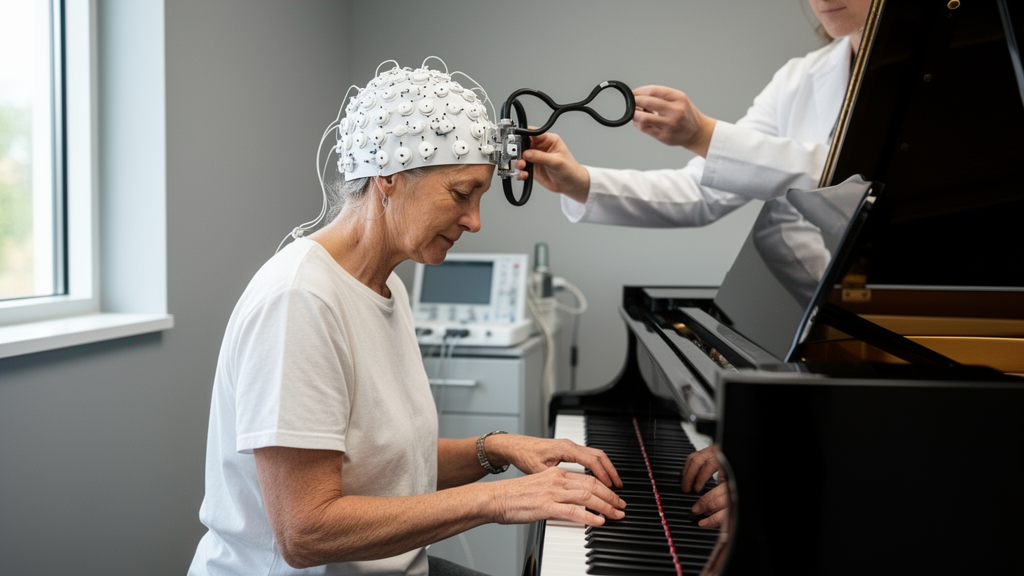
For musicians and writers whose careers collapse under the weight of a hand that refuses to obey, treatment options have long been bleak. Focal hand dystonia, a rare neurological disorder in which involuntary muscle contractions twist the fingers into abnormal postures during skilled tasks, affects an estimated 15 people per million and has no cure. Botulinum toxin injections and oral medications offer only limited, temporary relief, and deep brain stimulation, while approved for generalized and cervical dystonia, is not an option for the hand form of the condition. Now, a new systematic review and meta-analysis from Duke University School of Medicine, published in the journal Dystonia, offers the clearest evidence yet that a non-invasive alternative may work: transcranial magnetic stimulation, or TMS.
The research team, led by neurologist Noreen Bukhari-Parlakturk with colleagues including Zeynep B. Simsek, Patrick J. Mulcahey, Michael W. Lutz, and biomedical engineer Angel V. Peterchev, combed through PubMed, Embase, and Web of Science up to January 2026, following PRISMA guidelines. From an initial haul of 330 papers, nine clinical trials survived rigorous screening, encompassing 111 individuals with focal hand dystonia. The pooled results were striking in their consistency: TMS produced a mild to moderate improvement in dystonia symptoms, with a random-effects Hedges’ g of 0.36 (95% confidence interval 0.17 to 0.56, p < 0.001) when comparing behavior before and after stimulation.
Crucially, the team did not stop at pre-post comparisons, which are vulnerable to placebo effects, learning, regression to the mean, and the natural waxing and waning of dystonic symptoms. Eight of the nine studies included sham stimulation controls, allowing a cleaner test of whether the magnetic pulses themselves, rather than expectation or practice, drove the improvement. They did. Across 102 participants, active TMS outperformed sham stimulation with a Hedges’ g of 0.35 (95% CI 0.12 to 0.57, p = 0.002), a moderate effect that closely mirrored the uncontrolled analysis.
Perhaps most remarkable was the statistical homogeneity. In both meta-analyses, Cochrane’s Q statistic fell below its degrees of freedom, meaning the spread of effect sizes across studies was smaller than sampling error alone would predict. The variance of true effects was estimated at zero, and all heterogeneity indices, including I-squared, were set to zero. For a field plagued by mixed results, this consistency is unusual. Funnel plots were symmetrical, and Egger’s tests found no significant publication bias for either analysis, though the authors caution that such tests have limited power when fewer than ten studies are included.
The nine trials varied considerably in their technical approach, and this diversity is itself informative. Six studies targeted the premotor cortex, two the primary motor cortex, two the primary somatosensory cortex, one the supplementary motor area, and one the ipsilateral cerebellum. Most delivered low-frequency repetitive TMS at 1 Hz or 0.2 Hz, protocols generally considered inhibitory, while two studies used continuous theta-burst stimulation, a pattern of three 50 Hz pulses repeated at 5 Hz, and one used high-frequency 10 Hz stimulation. Intensities ranged from 80 to 100 percent of resting or active motor threshold, and total pulses per site ranged from 600 to 9,000. All studies used figure-of-eight coils, and cortical targets were localized by scalp measurements in seven trials and by functional MRI in two.
The outcome measures spanned three categories: digital behavioral metrics such as pen pressure, writing velocity, tracking error, and peak accelerations; clinician rating scales including the Burke-Fahn-Marsden Dystonia Severity Scale and the Writer’s Cramp Rating Scale; and patient-reported outcomes such as the Arm Dystonia Disability Scale. Where studies reported results only in graphs, the team used Plot Digitizer software, which has demonstrated high interrater reliability, to extract numerical values. Follow-up assessments ranged from immediately after stimulation to 28 days post-intervention, though few studies extended beyond one month.
Methodological quality was assessed with both the Cochrane Risk of Bias tool and the PEDro scale. All nine studies showed low risk of bias in randomization, eligibility criteria, between-group comparisons, and reporting of point estimates, and most maintained intention-to-treat analyses and adequate follow-up. Blinding was reported primarily at the level of participants, with fewer studies blinding assessors and only one blinding the TMS technician. On the PEDro scale, all trials were at minimum fair quality, and seven of nine reached the good-quality range. The authors argue that this combination of low bias risk, low heterogeneity, and no detectable publication bias makes the mild-to-moderate effect estimate likely to reflect the true predicted benefit.
The comparison with deep brain stimulation is telling. The humanitarian device exemption that allowed DBS approval for generalized dystonia rested on retrospective symptom improvement in just 40 patients across three studies. The new TMS meta-analysis, by contrast, documents improvement in a larger cohort using a technique that requires no surgery, no implanted hardware, and no anesthesia. TMS is already FDA-approved for depression, obsessive-compulsive disorder, smoking cessation, and migraine, meaning the regulatory and clinical infrastructure for delivering it already exists. Repurposing an approved, non-invasive technology for a rare disorder with no disease-modifying treatment represents an attractive path forward.
The authors also emphasize that dystonia is a clinical syndrome rather than a single disease, and that adult focal dystonia subtypes, including cervical dystonia, blepharospasm, and laryngeal dystonia, may arise from distinct abnormalities within a shared motor network. The optimal stimulation target, protocol, and brain state may therefore differ for each subtype, and they recommend testing each subtype individually or in basket trial designs. Their own prior work suggests that high-frequency 10 Hz stimulation of the somatosensory cortex, delivered after a motor priming task rather than in a naive resting state, can also yield improvement, hinting that more than one parameter set may benefit patients. The interplay of target site, frequency, intensity, waveform, and brain state, they argue, will ultimately determine clinical benefit.
Limitations remain. The small number of trials precluded moderator analyses, the apparent homogeneity may partly reflect low statistical power, and long-term durability data are scarce, with few studies following patients beyond a month. Outcome measures were not standardized across trials. Still, the message is clear and cautiously optimistic: magnetic stimulation of the premotor or somatosensory cortex can measurably improve hand control in people whose livelihoods depend on it. The authors call for larger, well-designed clinical trials to optimize stimulation parameters and test whether the benefits endure, a step that could finally bring a meaningful therapy to a patient population that has waited decades for one.
Subject of Research: Efficacy of transcranial magnetic stimulation for treating focal hand dystonia
Article Title: Effect of transcranial magnetic stimulation on focal hand dystonia: a systematic review and meta-analysis
Article References: Simsek, Z. B., Mulcahey, P. J., Lutz, M. W., Peterchev, A. V., & Bukhari-Parlakturk, N. (2026). Effect of transcranial magnetic stimulation on focal hand dystonia: a systematic review and meta-analysis. Dystonia, 5, Article 16666. https://doi.org/10.3389/dyst.2026.16666
Image Credits: AI Generated
Keywords: focal hand dystonia, transcranial magnetic stimulation, meta-analysis, systematic review, neuromodulation, dystonia, premotor cortex, writer's cramp, non-invasive brain stimulation, movement disorders, sham-controlled trials, neurology
Cite Scienmag News
Cassandra Pierce. (October 16, 2026). Magnetic Brain Stimulation Shows Modest but Real Gains Against Focal Hand Dystonia. Scienmag. https://scienmag.com/magnetic-brain-stimulation-shows-modest-but-real-gains-against-focal-hand-dystonia/
Cassandra Pierce. "Magnetic Brain Stimulation Shows Modest but Real Gains Against Focal Hand Dystonia." Scienmag, 16 October 2026, https://scienmag.com/magnetic-brain-stimulation-shows-modest-but-real-gains-against-focal-hand-dystonia/. Accessed 16 October 2026.
Cassandra Pierce. "Magnetic Brain Stimulation Shows Modest but Real Gains Against Focal Hand Dystonia." Scienmag. October 16, 2026. https://scienmag.com/magnetic-brain-stimulation-shows-modest-but-real-gains-against-focal-hand-dystonia/


