


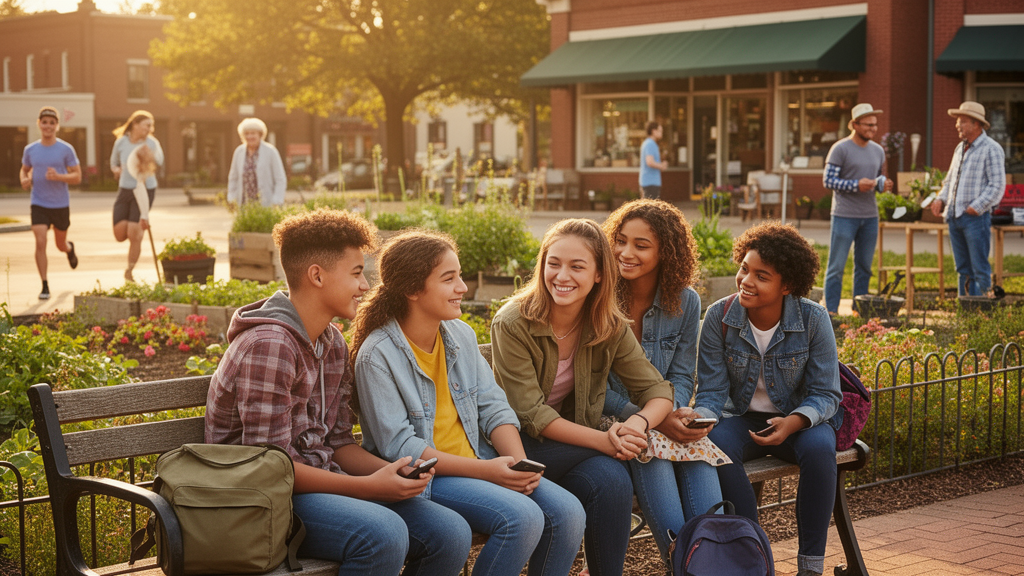
In the small Catalan town of Bellpuig, a group of teenagers did something unusual: they helped design their own mental health intervention. Rather than sitting through lectures about the dangers of smartphones, adolescents aged twelve to sixteen worked alongside families, teachers, healthcare professionals, and local community stakeholders to build a program around screen use from the ground up. The results, published in PLOS One, suggest that this participatory approach paid off, with measurable improvements in self-esteem, self-concept, and positive body image among the participants.
The research team, led by Eva Artigues-Barberà and colleagues, set out to test whether a community co-created intervention could shift how young people feel about themselves in an era when social media platforms encourage constant comparison with curated images of other people’s lives. Excessive screen use has been repeatedly linked to poorer self-esteem and body dissatisfaction in adolescents, largely because digital platforms amplify social comparison. Yet most educational interventions have struggled to produce lasting change, and researchers increasingly argue that programs designed without input from the communities they serve often fail to connect with the young people they aim to help.
Bellpuig, a rural municipality in the region of Catalonia in northeastern Spain, offered an ideal setting. Rural areas often face limited access to mental health resources, making community-based prevention strategies particularly valuable. The study took place at the Lo Pla d’Urgell institute, where adolescents enrolled in the program participated in educational and participatory activities designed to foster digital balance and promote healthier self-perception. Crucially, the content of these activities was not imposed from above. Through a structured participatory design process, the adolescents themselves, together with the adults around them, shaped what the intervention would look like and how it would unfold.
Methodologically, the study was a quasi-experimental single-group design with measurements taken before and after the intervention. Participants completed validated self-report instruments assessing self-esteem, self-concept, and positive body image at both time points. Because there was no control group, the researchers cannot rule out that some changes might have occurred naturally over time, a limitation common to pre-post designs in community settings. Nevertheless, the statistical approach was rigorous for this type of study. Changes within the group were assessed using two-sided Wilcoxon signed-rank tests, a non-parametric method suited to ordinal or non-normally distributed data. Differences in individual change scores between girls and boys were examined with two-sided Mann-Whitney U tests, and the team reported rank-biserial correlations with 95 percent confidence intervals as effect-size estimates, providing a transparent picture of how large the observed changes actually were.
The findings were encouraging. Following the intervention, adolescents showed a moderate improvement in positive body image, self-esteem, and self-concept. In psychological research, a moderate effect is far from trivial; it suggests a meaningful shift in how participants perceived themselves after weeks of engaging with activities they had helped to create. Notably, the improvement appeared to be remarkably equitable. When the researchers compared change scores between girls and boys, they found no notable differences in how much each group benefited, indicating that the intervention worked across sexes rather than favoring one group over another.
However, the baseline data told a more complicated story. Before the intervention began, boys reported higher initial levels of self-esteem and body image than girls. This starting gap is consistent with a substantial body of literature showing that adolescent girls, on average, experience greater body dissatisfaction and lower self-worth, pressures that are often intensified by visual social media platforms and the culture of comparison they foster. The fact that both groups improved to a similar degree suggests the intervention lifted everyone, but it also raises the question of whether targeted approaches might be needed to close the initial gap between girls and boys before or alongside universal programs.
The co-creation element deserves particular attention. Traditional school-based interventions on screen use often rely on top-down messaging: warnings about screen time limits, lectures on cyberbullying, or presentations on the psychological harms of social media. Such approaches frequently meet resistance from adolescents, who may perceive them as out of touch with the realities of their digital lives. By contrast, a co-created program gives young people ownership over the content and format. When adolescents help decide what activities take place, how they are framed, and what goals matter to them, the resulting intervention is more likely to feel relevant and authentic rather than imposed. This participatory logic reflects a broader shift in public health toward ecological models, which recognize that health behaviors are shaped not just by individual knowledge but by families, schools, peer groups, and the wider community environment.
The implications extend beyond one rural town. If community co-creation can produce moderate improvements in self-esteem, self-concept, and body image in a setting with limited mental health infrastructure, the model could be adapted to other communities facing similar constraints. The authors emphasize that the findings offer practical guidance for health professionals, educators, and policymakers who design and evaluate programs aimed at fostering healthy self-perception and digital habits. Rather than prescribing a fixed curriculum, the Bellpuig experience suggests a process: bring together adolescents, families, teachers, healthcare workers, and local stakeholders, and let them collectively define what digital balance means for their community.
Still, important questions remain. The single-group pre-post design cannot establish causality with certainty, and the absence of a control group means that factors such as seasonal effects, natural maturation, or heightened attention from participating in a study could have contributed to the observed improvements. The researchers themselves call for future work to explore the long-term effects of the intervention and to test its adaptability to diverse populations beyond the initial rural Catalan context. Whether the gains in self-esteem and body image persist months or years after the program ends, and whether the co-creation model transfers to urban settings or different cultural contexts, are critical next steps.
What the study does demonstrate is that adolescent mental health in the digital age may be best addressed not by experts talking at young people, but by communities building solutions together. In a period when concerns about screens, social comparison, and youth well-being dominate public debate, the Bellpuig experiment offers a refreshingly constructive counterpoint: when teenagers are treated as partners rather than problems, their self-esteem, self-concept, and body image can move in the right direction, and the whole community learns something in the process.
Subject of Research: Community co-created screen use intervention and adolescent self-esteem, self-concept, and body image
Article Title: A pre–post study of self-esteem, self-concept and body image among adolescents in the context of a co-created community intervention on screen use
Article References: Artigues-Barberà, E., Pollina-Pocallet, M., García-Martínez, E., Sol, J., Pallés, A. A., & Bravo, M. O. (2026). A pre–post study of self-esteem, self-concept and body image among adolescents in the context of a co-created community intervention on screen use. PLOS One, 21(10), e0360373. https://doi.org/10.1371/journal.pone.0360373
Image Credits: AI Generated
DOI: 10.1371/journal.pone.0360373
Keywords: adolescents, screen use, self-esteem, body image, self-concept, co-creation, community intervention, digital balance, rural health, Catalonia, participatory design, mental health
Cite Scienmag News
Glenn Wilkins. (October 16, 2026). Teens Build Better Body Image When Whole Town Shapes Their Screen Habits. Scienmag. https://scienmag.com/teens-build-better-body-image-when-whole-town-shapes-their-screen-habits/
Glenn Wilkins. "Teens Build Better Body Image When Whole Town Shapes Their Screen Habits." Scienmag, 16 October 2026, https://scienmag.com/teens-build-better-body-image-when-whole-town-shapes-their-screen-habits/. Accessed 16 October 2026.
Glenn Wilkins. "Teens Build Better Body Image When Whole Town Shapes Their Screen Habits." Scienmag. October 16, 2026. https://scienmag.com/teens-build-better-body-image-when-whole-town-shapes-their-screen-habits/


