


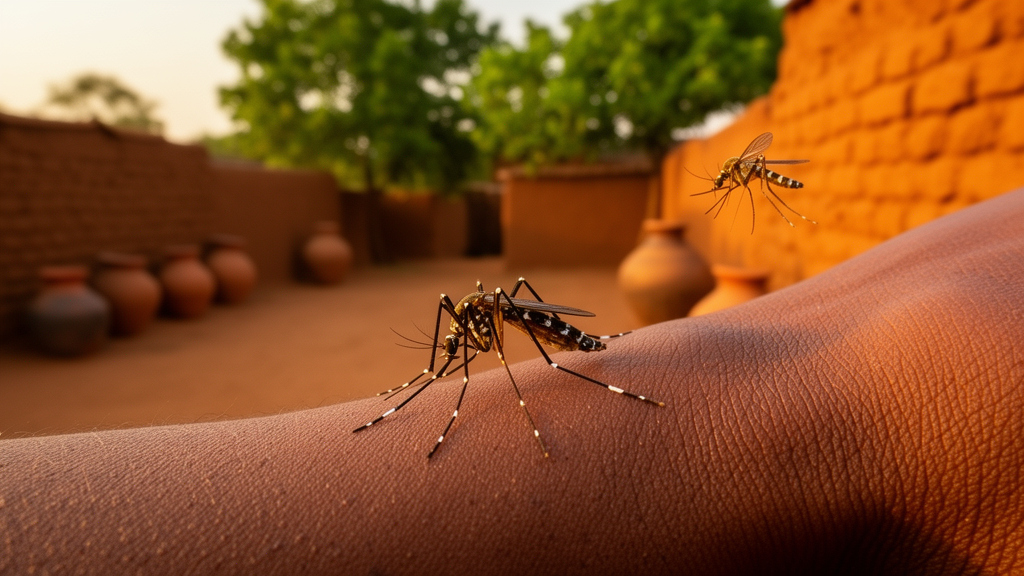
An extensive entomological investigation into the 2021 yellow fever outbreak in Ghana’s Savannah Region has revealed a landscape primed for arbovirus transmission, even though the mosquitoes collected during the response tested negative for the virus itself. The study, published in PLOS Global Public Health by a team of Ghanaian researchers led by Joseph Harold Nyarko Osei of the Noguchi Memorial Institute for Medical Research, documents dense populations of Aedes aegypti mosquitoes, an overwhelming dominance of the sylvatic subspecies Aedes aegypti formosus, and container-breeding conditions that placed the affected communities squarely above World Health Organization outbreak thresholds. The findings carry significant implications for how West African nations monitor and contain a virus that continues to erupt unpredictably across the continent.
The outbreak that prompted the investigation was severe by any measure. Health authorities recorded 202 suspected cases, of which 70 were laboratory confirmed, with 35 deaths attributed to the disease. The case fatality rate among suspected cases stood at 17 percent, but among confirmed cases it reached a startling 50 percent, meaning that half of the people whose infections were confirmed by testing did not survive. Such mortality is consistent with the clinical course of yellow fever, a viral hemorrhagic disease that progresses from an initial febrile phase, in many severe cases, to a toxic phase marked by jaundice, organ failure, internal bleeding, and shock. The Savannah Region, one of Ghana’s newest administrative areas carved from the former Northern Region in 2019, had not previously been regarded as a yellow fever hotspot, and the sudden eruption of cases demanded an urgent, multidisciplinary response.
A team assembled specifically for its expertise in yellow fever outbreak response was tasked with assessing the extent of vector activity and identifying practical measures to contain or control the rapid spread of the virus. The entomological component of that response formed the backbone of the published study. In arbovirus epidemiology, entomological investigations serve a dual purpose: they quantify the density and distribution of competent vectors, which determines the force of transmission, and they attempt to isolate virus from field-caught mosquitoes, which provides direct evidence of ongoing transmission. The team employed a combination of larval surveys and adult mosquito collections designed to capture the full picture of vector abundance across the affected communities.
The larval survey was exhaustive. Investigators examined 12,264 potential breeding containers in and around houses, a scale of surveillance that speaks to the density of water-holding receptacles in the surveyed settlements. From these containers, they recovered 3,885 larvae and 1,186 pupae distributed across 173 positive containers, yielding a container positivity rate of 1.26 percent. Of the 1,001 houses surveyed, 130 harbored larvae or pupae, a house positivity rate of 12.99 percent. These raw counts were converted into the classical World Health Organization larval indices: the House Index, the Container Index, the Breteau Index, and the Pupal Demographic Index. Collectively, these metrics assess the risk of arbovirus transmission, with established thresholds separating low-risk from high-risk conditions. The indices recorded in the Savannah Region exceeded the levels generally regarded as indicative of epidemic risk, meaning that the density of Aedes breeding was sufficient to sustain and amplify viral transmission had competent, infected mosquitoes been present in sufficient numbers.
Morphological identification of the immature stages followed standard taxonomic criteria. The larvae were recognized by their short and stout siphons, the breathing tubes characteristic of Aedes species, which distinguish them from the longer, more slender siphons of Culex larvae. Pupae were identified by the short but distinctly serrated spicules along the paddle fringe and by the branched, fanlike seta 9-VIII bearing six to seven branches, anatomical characters that allow entomologists to separate Aedes pupae from those of other medically important culicines. Such morphological work remains the practical foundation of outbreak entomology in resource-limited settings, where molecular identification of every specimen is rarely feasible and where rapid, accurate triage of mosquitoes determines how sampling proceeds.
The composition of the breeding containers offered a revealing portrait of peridomestic risk. Plastic containers accounted for the largest share, 6,529 receptacles or 46.95 percent of those examined, followed by metallic containers at 6,024, or 43.32 percent. Clay jars contributed 753 receptacles, or 5.42 percent, while discarded tires made up 565, or 4.06 percent, and open wells the remaining 34, or 0.24 percent. This distribution reflects the water storage practices common in rural northern Ghana, where households store water in a variety of containers that, if left uncovered or allowed to collect rainwater, become ideal developmental sites for Aedes aegypti. Plastic and metallic containers dominate the profile, underscoring how modern materials have multiplied breeding opportunities in communities where water supply is intermittent and storage is essential. Discarded tires, long recognized as among the most productive Aedes habitats worldwide, added another layer of risk.
Adult mosquito collections added a crucial dimension to the assessment. The team deployed BG-Sentinel traps, a design that uses visual cues and chemical attractants to lure host-seeking Aedes, and supplemented these with oral aspirators, hand-held suction devices that collect mosquitoes resting on walls and other surfaces, and Prokopack aspirators, motorized backpack units that allow rapid collection from elevated indoor and outdoor resting sites. A total of 1,571 adult mosquitoes were identified in the collections. The species composition was striking: 35 were Aedes aegypti aegypti, the domesticated subspecies that prefers to feed on humans and breeds in human-made containers, while 619 were Aedes aegypti formosus, the wild, sylvatic form that typically feeds on non-human hosts in forest cycles. The remaining 917 specimens were Culex species, vectors of filariasis and West Nile virus but not primary yellow fever vectors. Outdoor collections overwhelmingly outnumbered indoor ones, accounting for 86.4 percent of the adult catch against 13.6 percent indoors.
The dominance of Aedes aegypti formosus is arguably the study’s most significant entomological finding. The formosus subspecies is the ancestral, feral form of the yellow fever vector, adapted to breeding in tree holes and feeding on primates and other wild animals in the sylvatic cycle, the forest transmission loop in which the yellow fever virus circulates between monkeys and canopy-dwelling mosquitoes. Yet formosus populations in West Africa are known to occupy a transitional ecological role: they colonize peridomestic containers, feed opportunistically on humans when wild hosts are scarce or when humans encroach on forest edges, and can therefore act as bridge vectors, carrying virus from sylvatic reservoirs into human populations. The authors suggest that this subspecies may have been the driver of the outbreak and of yellow fever transmission in the Savannah Region, a hypothesis consistent with the pattern seen in several recent African epidemics where spillover from sylvatic cycles into unvaccinated rural communities ignited explosive human-to-mosquito-to-human amplification.
Despite the abundance of vectors, the virological screening came back empty. All mosquitoes collected during the investigation were tested by real-time reverse-transcription polymerase chain reaction for four arboviruses: yellow fever, dengue, chikungunya, and Zika. The assay’s detection limit of fewer than 10 RNA copies per reaction meant that even very low-level infections would likely have been detected. No arbovirus was found in any specimen. This negative result does not contradict the outbreak; rather, it reflects the practical realities of arbovirus field investigation. Adult mosquito collections typically take place after the peak of transmission, once control measures, case isolation, and insecticide spraying have reduced both vector density and infection prevalence. Infection rates in wild mosquito populations during endemic transmission are often on the order of one infected individual per thousand or fewer, so capturing an infected mosquito requires collecting very large numbers of adults, something a short outbreak-response survey can rarely achieve. The absence of virus in the sampled mosquitoes therefore reinforces, rather than undermines, the study’s central conclusion drawn from the vector indices: that conditions in the region posed a high risk of arbovirus transmission.
The wider context sharpens the public health urgency of these findings. Yellow fever, dengue, Zika, and chikungunya are among the most consequential emerging and re-emerging infectious diseases on the planet, and by recent estimates half the world’s population lives at risk of infection by the viruses that mosquitoes of the Aedes complex transmit. Recent African epidemics have confirmed 19,569 cases with 820 deaths, a toll that underscores both the persistence of sylvatic yellow fever reservoirs and the vulnerability of communities with incomplete vaccination coverage. The Savannah Region outbreak, with its 50 percent case fatality rate among confirmed cases, fits a familiar pattern: a rural population with low immunity, abundant vectors, and proximity to sylvatic transmission cycles. The study’s authors argue that the entomological evidence, dominated by Aedes aegypti formosus breeding above epidemic thresholds, poses a continuing public health threat that demands robust Aedes mosquito surveillance systems and sustained vector control strategies, including source reduction of plastic and metallic water-storage containers, larviciding of productive habitats, and vaccination campaigns to close the immunity gap. Without such measures, the region remains primed for the next spillover.
Subject of Research: Entomological investigation of Aedes mosquito vectors during a yellow fever outbreak in northern Ghana
Article Title: Entomological investigations into yellow fever outbreak in northern Ghana
Article References: Osei, J. H. N., Pi-Bansa, S., Frempong, K. K., Ofei, M., Boakye, H. A., Ansah-Owusu, J., Akorful, S.-C. A., Malm, R. O.-T., Tawiah-Mensah, C. N. L., Abudu, M., Asafu-Adjaye, A., Addo, S. O., Agbodzi, B., Bentil, R., Pratt, D., Nimo-Paintsil, S., Bonney, J. H. K., Appawu, M. A., Koffi, M.-C. A. A., … Dadzie, S. K. (2026). Entomological investigations into yellow fever outbreak in northern Ghana. PLOS Global Public Health, 6(10), e0007346. https://doi.org/10.1371/journal.pgph.0007346
Image Credits: AI Generated
DOI: 10.1371/journal.pgph.0007346
Keywords: yellow fever, Aedes aegypti formosus, vector surveillance, Ghana, arboviruses, Savannah Region, entomological indices, sylvatic transmission, outbreak response, larval survey, vector control, public health
Cite Scienmag News
Courtney Benton. (October 16, 2026). Dengue-Carrying Mosquitoes Signal High Yellow Fever Risk in Northern Ghana Outbreak Zone. Scienmag. https://scienmag.com/dengue-carrying-mosquitoes-signal-high-yellow-fever-risk-in-northern-ghana-outbreak-zone/
Courtney Benton. "Dengue-Carrying Mosquitoes Signal High Yellow Fever Risk in Northern Ghana Outbreak Zone." Scienmag, 16 October 2026, https://scienmag.com/dengue-carrying-mosquitoes-signal-high-yellow-fever-risk-in-northern-ghana-outbreak-zone/. Accessed 16 October 2026.
Courtney Benton. "Dengue-Carrying Mosquitoes Signal High Yellow Fever Risk in Northern Ghana Outbreak Zone." Scienmag. October 16, 2026. https://scienmag.com/dengue-carrying-mosquitoes-signal-high-yellow-fever-risk-in-northern-ghana-outbreak-zone/


