


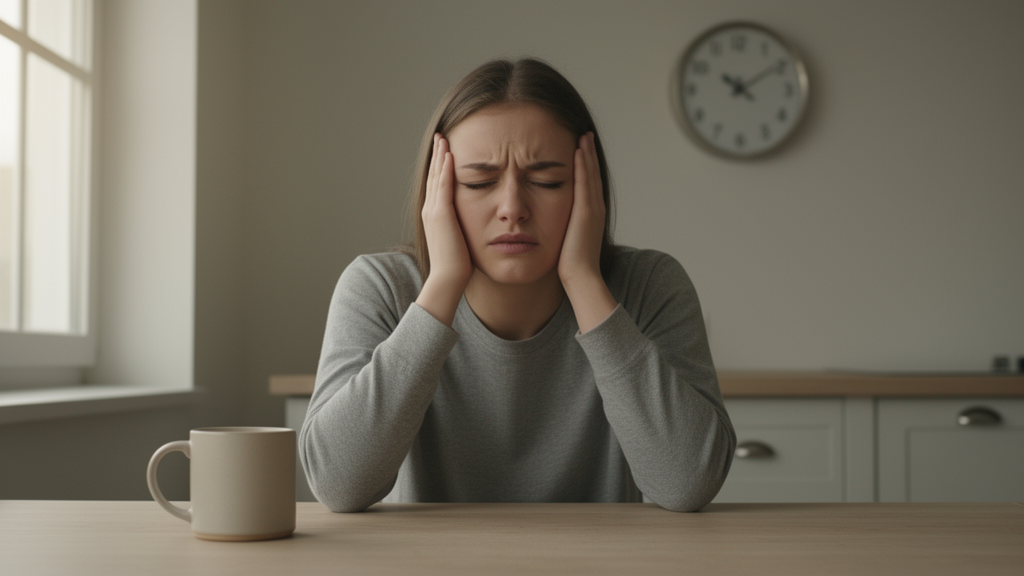
For people with misophonia, the soft sound of a colleague chewing gum or the rhythmic tap of a keyboard can ignite a surge of rage, disgust, or panic that feels entirely out of proportion to the noise itself. A new study published in Frontiers in Cognition offers one of the most detailed longitudinal portraits yet of how these symptoms fluctuate in daily life, and it points to a specific psychological trait that may determine who suffers most when trigger sounds strike. Researchers led by Jeffrey M. Pavlacic of the Medical University of South Carolina found that anxiety sensitivity, the fear of anxiety-related bodily sensations, predicted elevated misophonia symptoms during trigger episodes even after accounting for a range of clinical variables.
Misophonia, characterized by decreased tolerance to specific sounds and related stimuli, affects an estimated five percent of adults in the United States according to epidemiological studies. Central to the condition are triggers: repetitive or rhythmic sounds such as chewing, slurping, throat clearing, pen clicking, or keyboard tapping that provoke intense affective, behavioral, and cognitive responses. While previous research has identified neurological, psychological, and social correlates of misophonia, most studies have relied on cross-sectional snapshots, leaving scientists with limited understanding of how symptoms rise and fall in real time and which factors drive those fluctuations.
The research team recruited fifty-eight adults who screened positive for clinical misophonia symptoms through the soQuiet research pool, a nonprofit organization focused on misophonia support and awareness. Participants excluded were those reporting a diagnosis of autism spectrum disorder or psychotic disorder. After completing a baseline battery of questionnaires, each volunteer carried a digital survey program for thirty days, responding three times daily. The surveys used both interval-contingent prompts and event-contingent assessments triggered whenever participants encountered a bothersome sound, allowing the researchers to separate misophonia experiences during triggers from those occurring in their absence.
At the heart of the study were two transdiagnostic factors: anxiety sensitivity and distress tolerance. Anxiety sensitivity refers to the fear of anxiety-related sensations themselves, such as a racing heart or tight chest, and is a well-established risk factor for anxiety disorders. Distress tolerance describes a person’s perceived ability to withstand and manage negative emotional states. Both are considered malleable emotional-vulnerability factors that can be targeted in brief clinical interventions, making them attractive candidates for understanding and eventually treating misophonia symptom amplification.
The baseline measures included the sixteen-item Anxiety Sensitivity Index, the fifteen-item Distress Tolerance Scale, the eighteen-item Obsessive-Compulsive Inventory-Revised, and the six-item Amsterdam Misophonia Scale, all with good to excellent internal consistency. During the daily phase, participants rated momentary misophonia symptoms using an adapted version of the Duke-Vanderbilt Misophonia Screening Questionnaire, with the phrase right now added to capture in-the-moment experience. Momentary emotion dysregulation was assessed with a six-item version of the Difficulties in Emotion Regulation Scale covering domains such as impulse control, awareness, clarity, and non-acceptance of emotional responses.
The results revealed a nuanced pattern. In bivariate correlations, higher baseline anxiety sensitivity was associated with greater misophonia symptoms both during triggers and in their absence, while higher distress intolerance correlated with more severe symptoms during triggers but not when triggers were absent. Obsessive-compulsive symptoms and baseline misophonia severity also correlated with longitudinal symptom levels. However, when the researchers entered all predictors simultaneously into multilevel models that controlled for momentary emotion dysregulation, baseline misophonia, and obsessive-compulsive symptoms, most of these effects attenuated dramatically.
One exception stood out. Anxiety sensitivity remained a significant predictor of misophonia symptoms during triggers when analyzed in a standalone model, with individuals higher in anxiety sensitivity reporting more elevated symptoms in response to momentary trigger sounds. Yet even this effect faded when the researchers applied a Benjamini-Hochberg correction for multiple comparisons, yielding an adjusted p-value of 0.055 that fell just short of conventional significance thresholds. The authors emphasize that replication in larger samples is needed before firm conclusions can be drawn about anxiety sensitivity as an independent predictor.
The null findings for distress tolerance proved theoretically informative rather than disappointing. Exploratory mediation analyses suggested that momentary emotion dysregulation served as a mediator of the relation between distress intolerance and misophonia symptoms, both during and outside trigger episodes. In other words, people who cannot tolerate distress appear to experience misophonia symptoms indirectly through their struggles to regulate emotions in the moment. Anxiety sensitivity, by contrast, showed a pattern more consistent with a direct effect, since emotion dysregulation did not significantly mediate its relation with misophonia.
The researchers offer a compelling mechanistic explanation for the anxiety sensitivity finding. Individuals with high anxiety sensitivity tend to misinterpret innocuous bodily sensations as dangerous, for example interpreting a racing heart as a sign of a heart attack. People with misophonia commonly experience physiological arousal when anticipating or encountering triggers, including increased heart rate. This sensitivity to and catastrophization of arousal signals may amplify the emotional cascade that trigger sounds set off. Notably, anxiety and anger share similar markers of physiological arousal, and both emotions are commonly reported in response to misophonia triggers, suggesting that anxiety sensitivity may capture a broader tendency to catastrophize emotional arousal regardless of whether it manifests as fear or rage.
The clinical implications are significant. Anxiety sensitivity can be reduced through brief interventions, some delivered in as little as a single session, and prior randomized controlled trials have shown that decreases in anxiety sensitivity temporally mediate reductions in anger, hostility, and aggression. For individuals with misophonia and high distress intolerance, interventions targeting emotion regulation abilities may prove more appropriate. The authors caution that their sample was relatively homogeneous, predominantly White, female, and recruited from an advocacy organization, potentially limiting generalizability to the broader population of people with misophonia. They also note that the modest number of independent participants, despite the high volume of repeated daily observations, warrants caution. Future research should examine cognitive, behavioral, and physiological responses across all stages of trigger episodes, potentially using dynamic structural equation models to capture the temporal interplay between affective reactions and misophonia symptoms. For now, the study provides a roadmap for identifying malleable psychological targets that could eventually inform clinical interventions for a condition that remains poorly understood and difficult to treat.
Subject of Research: Longitudinal predictors of misophonia symptoms including anxiety sensitivity, distress tolerance, and emotion dysregulation
Article Title: Transdiagnostic and clinical predictors of longitudinal misophonia symptoms
Article References: Transdiagnostic and clinical predictors of longitudinal misophonia symptoms. (n.d.). https://doi.org/10.3389/fcogn.2026.1945899
Image Credits: AI Generated
DOI: 10.3389/fcogn.2026.1945899
Keywords: misophonia, anxiety sensitivity, distress tolerance, emotion dysregulation, ecological momentary assessment, trigger sounds, transdiagnostic factors, obsessive-compulsive symptoms, clinical psychology, longitudinal study, Transdiagnostic, clinical
Cite Scienmag News
Glenn Wilkins. (October 16, 2026). Anxiety Sensitivity Emerges as Key Predictor of Misophonia Symptoms in 30-Day Study. Scienmag. https://scienmag.com/anxiety-sensitivity-emerges-as-key-predictor-of-misophonia-symptoms-in-30-day-study/
Glenn Wilkins. "Anxiety Sensitivity Emerges as Key Predictor of Misophonia Symptoms in 30-Day Study." Scienmag, 16 October 2026, https://scienmag.com/anxiety-sensitivity-emerges-as-key-predictor-of-misophonia-symptoms-in-30-day-study/. Accessed 16 October 2026.
Glenn Wilkins. "Anxiety Sensitivity Emerges as Key Predictor of Misophonia Symptoms in 30-Day Study." Scienmag. October 16, 2026. https://scienmag.com/anxiety-sensitivity-emerges-as-key-predictor-of-misophonia-symptoms-in-30-day-study/


