


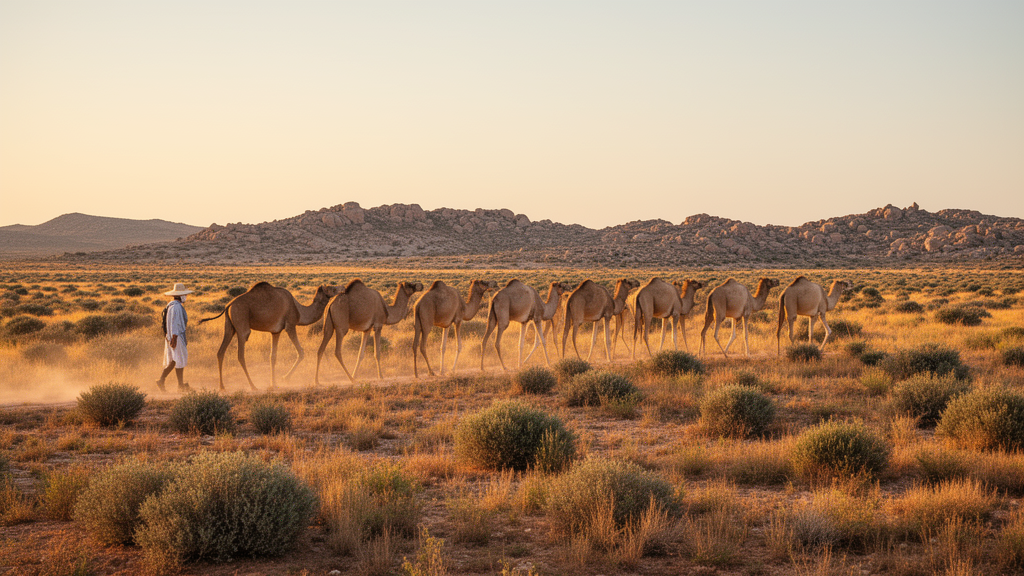
Across the parched rangelands of southern Tunisia, where roughly 5.5 million hectares of arid and desert land support pastoral grazing under increasing pressure from desertification, an unexpected economic engine is being taken seriously: the one-humped dromedary camel. A new exploratory study published in Pastoralism argues that Tunisia’s dromedary value chains, long neglected relative to other livestock sectors, could attract private investment powerful enough to drive both economic development and the restoration of degraded rangelands. The research, led by Asma Souissi of the Higher School of Agriculture of Mograne with colleagues from ICARDA, ILRI, CIAT and the University of New England, combines a desk review, eleven key informant interviews and a SWOT analysis to map where the sector’s profits could flow back into the landscapes on which it depends.
The global backdrop gives the Tunisian question real urgency. Worldwide camel numbers have climbed steadily past 40 million head by 2022, with African herds growing particularly fast to around 1.5 million in a recent assessment of the continent’s expansion and Asian herds accelerating after the early 2000s to exceed one million. Camel milk and meat are increasingly marketed as climate-resilient foods, and niche markets are emerging in both traditional and non-traditional consuming countries. Against this growth, Tunisia’s national herd appears modest: official livestock statistics report between 56,000 and 80,000 animals, mostly breeding females, down from approximately 225,000 head in the 1950s, a decline attributed to illegal export, low breeding efficiency, social change and limited investment. Other estimates that correct for under-reporting place the true population closer to 230,000 to 240,000 head when all age and sex categories are counted, a discrepancy the authors attribute to contrasting census methodologies rather than any biological boom.
What the sector lacks in scale it makes up for in strategic importance. Dromedaries are concentrated in the southern governorates of Kebili and Tataouine, grazing natural pastures under predominantly nomadic and transhumant systems. Earlier work cited in the study found that dromedary-based activities account for as much as 79 percent of household income in parts of southeastern Tunisia, and camel milk can fetch prices up to six times higher than cow milk in the region. Yet the market data reveal structural chaos. Tunisia produces an estimated 15,000 tons of camel milk annually, but only about 1,000 tons are officially documented, according to the National Observatory of Agriculture, a gap reflecting the dominance of informal, household-level sales. Raw milk composition is promising, with total solids of 11 to 13 percent, fat of 2.5 to 3.5 percent and protein of 3 to 3.5 percent, but recent research shows that microbial counts, including coliforms and Staphylococcus aureus, frequently exceed regulatory thresholds at retail because hygiene and cold-chain conditions collapse between farm and market.
The meat chain fares little better. Production has fluctuated over two decades while controlled slaughter has declined markedly, and around 94 percent of camel meat is marketed outside controlled slaughter systems, according to a 2024 diagnosis of the meat value chain in southwestern Tunisia. Processing is informal, preservation relies on traditional drying and salting, and short and long supply chains coexist with direct transactions among breeders, butchers and intermediaries. Beyond milk and meat, the dromedary supplies secondary value streams, including fibre for weaving, hides for leather, and cultural services: camel races and caravans anchored in events such as the International Sahara Festival of Douz tie the animal to Bedouin identity, oasis life and territorial image.
To understand how stakeholders themselves see the sector, the researchers conducted face-to-face, semi-structured interviews lasting 20 to 30 minutes with eleven purposively selected informants: five researchers and development specialists, three dromedary breeders and three government officials. Responses were thematically coded in Excel and grouped into a SWOT matrix distinguishing internal strengths and weaknesses from external opportunities and threats. The authors are explicit that this is a hypothesis-generating diagnosis rather than a statistically representative survey, and that key private actors such as dairy processors and urban retailers were not directly interviewed. Still, the pattern of responses is striking. Researchers and policymakers dominate sustainable development initiatives and policy formulation, while producers show limited participation in conservation and market access and total disengagement from value addition, a fragmented engagement ecosystem the authors say mirrors weak structured dialogue between producers and institutional actors.
The ranked perceptions table tells its own story. The highest-ranked concern was that the sector needs support to overcome limited processing capacity and market access, tied with the perception that traditional herding practices are declining and young people are not interested, and with the need for innovation and investment to revitalise the sector. Respondents agreed that untapped potential and growing demand are real, ranking that belief third, but were skeptical that camel raising provides meaningful additional income or that milk production shows promising growth. The authors reconcile this apparent paradox with economics: camel milk is structurally expensive to produce because feed, labour and veterinary inputs consume a large share of the cost per litre, margins are hypersensitive to feed price volatility, and weak collection and processing infrastructure allows traders, transporters and retailers to capture much of the value added. Concerns about adulteration with bovine milk or water further erode consumer trust; the authors point to portable near-infrared spectroscopy and lateral-flow immunoassays at collection points as technologies that could underpin quality-based payment schemes.
On opportunities, participants rated growing demand as the highest-priority economic driver, followed by the development of short value chains, promising prospects for camel meat in the Arab world and potential milk subsidies. Environmentally, the standout was the dromedary’s adaptability: camels thrive in arid environments, tolerate heat and water scarcity, face little competition from other livestock, and can be managed with deferred grazing. Challenges, however, ranked just as high: low milk yields, degradation of natural pastures, the absence of a structured camel milk value chain, insufficient investment and organisation, a shrinking pool of qualified herders, and persistent problems such as milk spoilage in hot weather and camel diseases. Proposed solutions span conventional breeding and genetic improvement, quality fodder including valorised date palm byproducts, milk collection centres in rangelands, rangeland rehabilitation with participatory grazing management and water point development, shepherd training programmes for youth, and process upgrading with product diversification across the chain.
On conservation, perceptions were more sobering. Informants gave high ratings to camel organisations, public-private partnerships, ecotourism and cultural heritage, and integration with reforestation efforts as channels for rangeland restoration, but ranked contributions to soil health, reduced grazing pressure, biodiversity, water efficiency and fossil fuel reduction as low. The authors interpret this as stakeholders prioritising income stability over regulating ecosystem services, a tendency observed in other rangeland systems, and conclude that value chain profits currently represent a prospective pathway to restoration rather than an observed practice. Potential mechanisms they sketch include earmarking a share of revenues from value-added camel products into locally managed pasture funds and payments for ecosystem services that reward restoration-oriented grazing. They caution that intensification must not simply displace pressure: semi-intensive systems should complement extensive rangeland use, with supplemental feeding based on agri-food byproducts, stocking rates constrained by locally defined carrying capacity, and public investment made conditional on pasture-use plans and basic monitoring of vegetation and animal health.
The study’s SWOT synthesis distils the sector’s future. Strengths include climatic adaptation, market potential, cultural capital and a supportive policy environment; weaknesses centre on low productivity, unstructured informal value chains, weak farmer organisations and low-skilled labour. Opportunities lie in niche products such as camel milk cosmetics, formal market structures and standardisation, while threats include climate change, land conflicts, disease outbreaks, price volatility and youth disinterest, with rising aridity and drought jeopardising feed and water even as camels’ physiological resilience gives them a comparative advantage over other livestock. The authors frame their recommendations around three priorities: formalising marketing channels and milk collection circuits in the short term; building producer cooperatives, youth engagement and co-management arrangements between public agencies and local organisations in the medium to long term; and embedding genetic improvement, biosecurity and sustainable resource management throughout. The United Nations designation of 2024 as the International Year of Camelids, they note, offered a timely window. Whether Tunisia seizes it will determine if the dromedary becomes an engine of rural development and rangeland restoration, or drifts into what the authors warn could be marginalisation, a luxury pursuit rather than a viable livelihood.
Subject of Research: Dromedary camel value chains and rangeland restoration in arid Tunisia
Article Title: An exploratory analysis of the Tunisian dromedary camel value chains for sustainable development in arid rangelands
Article References: An exploratory analysis of the Tunisian dromedary camel value chains for sustainable development in arid rangelands. (n.d.). https://doi.org/10.3389/past.2026.16487
Image Credits: AI Generated
Keywords: dromedary camel, Tunisia, value chains, rangeland restoration, camel milk, pastoralism, SWOT analysis, arid rangelands, sustainable development, livestock economics, desertification, key informant interviews
Cite Scienmag News
William Thompson. (October 16, 2026). Camels Could Bankroll the Restoration of Tunisia’s Dying Rangelands. Scienmag. https://scienmag.com/camels-could-bankroll-the-restoration-of-tunisias-dying-rangelands/
William Thompson. "Camels Could Bankroll the Restoration of Tunisia’s Dying Rangelands." Scienmag, 16 October 2026, https://scienmag.com/camels-could-bankroll-the-restoration-of-tunisias-dying-rangelands/. Accessed 16 October 2026.
William Thompson. "Camels Could Bankroll the Restoration of Tunisia’s Dying Rangelands." Scienmag. October 16, 2026. https://scienmag.com/camels-could-bankroll-the-restoration-of-tunisias-dying-rangelands/


