


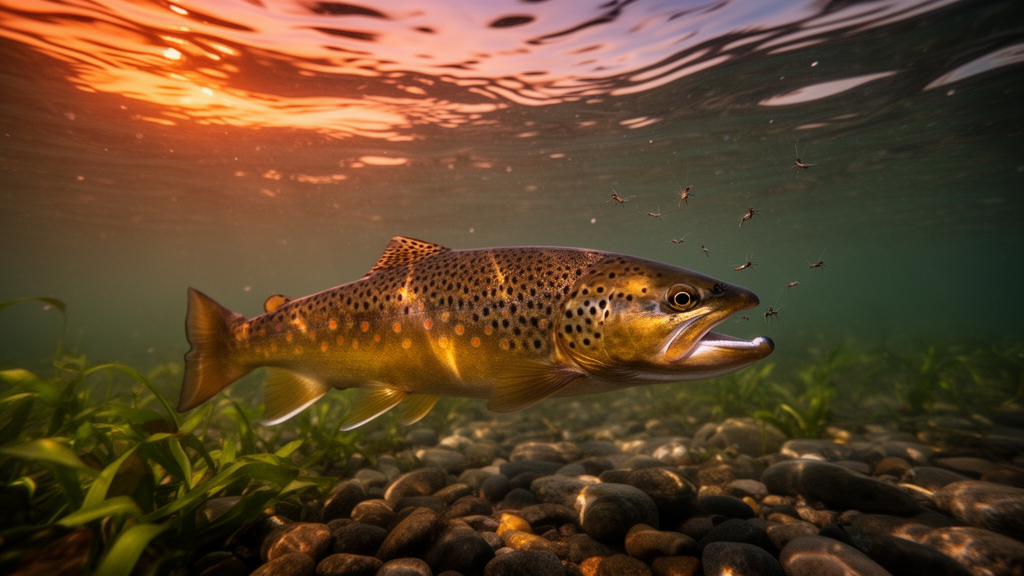
At the southern edge of their range, where rivers already run warm in summer, brown trout are quietly rewriting their daily schedules. A new modeling study published in Individual-based Ecology shows that these fish can dramatically reorganize when they feed over the course of a day, and that this behavioral flexibility may be one of their most important defenses against climate change. The finding offers a rare quantitative glimpse of how a single, seemingly small behavioral adjustment could ripple upward to determine whether entire populations persist or vanish as streams heat up.
The research team, led by Daniel Ayllón and including Steven F. Railsback, Bret C. Harvey, Graciela G. Nicola, Benigno Elvira, and Ana Almodóvar, focused on stream-dwelling salmonids living at the warmest, lowest-altitude margins of the species’ distribution. These peripheral populations are among the most vulnerable to climate change, because rising air temperatures translate directly into warmer water, reduced flow, and longer periods of thermal stress. Yet the same populations also harbor a suite of evolutionary, plastic, and behavioral mechanisms that can buffer them against rapid environmental deterioration. Among these, behavioral plasticity stands out because it operates on timescales of hours and days rather than generations, making it potentially decisive under fast-moving change.
To test how much this flexibility actually matters, the researchers built an individual-based model, a computational environment in which every virtual fish is simulated as a distinct organism with its own body size, energy reserves, growth trajectory, and behavioral decisions. Individual-based models of this kind are powerful precisely because population-level patterns emerge from the accumulated choices of individuals rather than being imposed from above. In this case, the model simulated the trajectory of a brown trout population under three environmental-change scenarios of increasing warming and streamflow reduction, spanning a gradient from moderate to severe climate stress.
The first key result concerned how trout organized their foraging in time and space under current conditions. In the baseline simulations, fish of different age classes segregated their feeding both temporally and spatially. Younger trout and older trout exploited different parts of the stream and different windows of the day, a partitioning that reduces competition and reflects the species’ well-documented territorial structure. This baseline pattern provided a reference point against which the effects of environmental change could be measured.
When the simulated climate began to warm and streamflows began to decline, the most consistent behavioral response was a pronounced shift toward more diurnal feeding. Every age class adopted this strategy, and the strength of the shift increased with the severity of the environmental change. In other words, the harsher the conditions, the more the trout concentrated their foraging into daylight hours. Alongside this temporal reorganization, total daily foraging activity increased across all age classes, indicating that fish were not merely rescheduling their meals but also working harder to meet their energy demands in a more challenging environment.
The logic behind this shift is rooted in trout physiology. Salmonids are ectotherms, meaning their body temperature, and therefore their metabolic rate, tracks that of the surrounding water. As water warms, metabolic costs rise, but warm water also holds less dissolved oxygen, and trout often become less willing to move or feed during the hottest parts of the day. By shifting feeding toward periods when conditions are comparatively favorable, the fish in the model were effectively optimizing the trade-off between energy intake and physiological stress. The fact that this pattern emerged consistently across scenarios and age classes suggests it is a robust, adaptive response rather than a modeling artifact.
The second experiment addressed the question at the heart of the study: does this flexibility actually change population outcomes? The researchers compared virtual populations whose individuals could flexibly adjust their circadian feeding patterns with populations restricted to fixed feeding schedules. The result was clear. Populations capable of flexible circadian feeding were more resistant to environmental change than populations locked into rigid patterns. Under the same warming and flow-reduction scenarios, the flexible populations fared better, demonstrating that the ability to adaptively choose when, as well as where, to feed can buffer the demographic consequences of long-term environmental deterioration.
This finding carries weight because it connects a phenomenon that is well documented at the individual level in the empirical literature, namely flexible diel activity in salmonids, to a population-level consequence that has remained largely theoretical. Field studies have long observed that trout adjust their activity windows in response to temperature, light, predation risk, and food availability, sometimes shifting toward nocturnal feeding in warm conditions and toward crepuscular or diurnal patterns in others. What has been missing is a quantitative demonstration that such adjustments can meaningfully alter the long-term fate of a population. The new simulations provide exactly that bridge, showing that behavioral timing is not merely an interesting detail of trout natural history but a mechanism with demographic consequences.
The implications extend beyond brown trout. Stream-dwelling salmonids across the low-latitude and low-altitude margins of their global range, from southern Europe to the southern Appalachians, face some of the most acute climate threats of any freshwater fish group. Understanding which mechanisms confer resistance, and how strong those mechanisms are, is essential for conservation planning. If behavioral plasticity provides a meaningful buffer, then management strategies that preserve the environmental conditions allowing fish to express flexible behavior, such as maintaining habitat complexity, thermal refuges, and natural flow regimes, could enhance population resilience. Conversely, if populations are forced into rigid behavioral patterns by degraded habitat or fragmented streams, their capacity to cope with warming may be severely compromised.
The study also highlights the value of individual-based modeling as a tool for ecology. By simulating each fish as an autonomous decision-maker, the approach captures emergent population dynamics that simpler models miss, and it allows researchers to run counterfactual experiments, such as disabling behavioral flexibility, that would be impossible in the field. As climate change accelerates, this kind of computational experimentation is likely to become increasingly central to forecasting which species and populations will endure. For brown trout at the warm edge of their range, the message from the simulations is cautiously hopeful: the capacity to rethink their daily routines may buy them time, but the severity of the scenarios tested suggests that even flexible behavior has limits, and that protecting the streams these fish depend on remains an urgent priority.
Subject of Research: Behavioral plasticity in circadian foraging patterns of brown trout populations facing climate change
Article Title: Behavioural plasticity in circadian foraging patterns increases resistance of brown trout populations to environmental change
Article References: Behavioural plasticity in circadian foraging patterns increases resistance of brown trout populations to environmental change. (n.d.). Original publication
Image Credits: AI Generated
DOI: Not provided
Keywords: brown trout, behavioral plasticity, circadian foraging, climate change, individual-based model, salmonids, stream ecology, population persistence, diel activity, thermal stress, environmental change, conservation
Cite Scienmag News
Sloane Callahan. (October 16, 2026). Brown Trout Shift Their Feeding Clock to Survive a Warming World. Scienmag. https://scienmag.com/brown-trout-shift-their-feeding-clock-to-survive-a-warming-world/
Sloane Callahan. "Brown Trout Shift Their Feeding Clock to Survive a Warming World." Scienmag, 16 October 2026, https://scienmag.com/brown-trout-shift-their-feeding-clock-to-survive-a-warming-world/. Accessed 16 October 2026.
Sloane Callahan. "Brown Trout Shift Their Feeding Clock to Survive a Warming World." Scienmag. October 16, 2026. https://scienmag.com/brown-trout-shift-their-feeding-clock-to-survive-a-warming-world/


