


…
…
The choice of cafeteria wastewater as a cultivation substrate deserves particular attention, because food-service effluents differ in composition from typical municipal sewage. Kitchen and cafeteria discharges tend to carry elevated loads of biodegradable organic matter from food preparation and dishwashing, which is reflected in the chemical oxygen demand values that the microalgal culture was able to reduce by roughly three quarters. This organic fraction, together with the nitrogen and phosphorus contributed by food residues and cleaning agents, effectively substitutes for the synthetic nutrients that would otherwise be purchased in the form of prepared growth media. The comparison conducted in the study is therefore especially informative: the alga grown in diluted cafeteria wastewater not only matched but slightly exceeded the biomass concentration achieved in nitrate-supplemented Bold’s Basal Medium, reaching 0.65 grams per liter against 0.54 grams per liter. This outcome suggests that the wastewater matrix contained a nutrient profile sufficient to support growth without any artificial enrichment, provided the effluent was diluted to 75 percent of its original strength, presumably to moderate turbidity, osmotic stress, or the presence of inhibitory compounds such as surfactants.
The freshwater savings reported in the work merit emphasis from a water-resource perspective. Cultivating microalgae in conventional media requires substantial volumes of potable or deionized water, and at industrial scale this demand becomes a serious constraint, particularly in regions where water scarcity is already acute. By substituting nearly 80 percent of the freshwater requirement with an effluent stream that would otherwise require treatment before discharge, the process converts a disposal liability into an input resource. This aligns with the broader logic of the circular bioeconomy, in which waste streams from one activity serve as feedstock for another. Sri Lanka, where the study was conducted, faces pronounced seasonal and regional water stress, making the demonstration locally relevant as well as scientifically interesting.
The removal efficiencies observed for the three principal pollution indicators tell a nuanced story. Chemical oxygen demand, a proxy for the total oxidizable organic load, was reduced by about 76 percent, indicating that the alga metabolized or assimilated a large share of the dissolved and particulate organics. Total nitrogen removal reached roughly 48 percent, and total phosphorus removal about 38 percent. These figures fall within the ranges reported for microalgal treatment systems generally, where nitrogen removal of 22 to 100 percent and phosphorus removal of 20 to 98 percent have been documented across species and operating conditions. The somewhat lower nutrient removals relative to COD removal are consistent with the stoichiometry of algal biomass: microorganisms typically incorporate nitrogen and phosphorus in ratios that depend on growth conditions, and when organic carbon is abundant, assimilation of carbon can outpace nutrient uptake. It is also possible that a portion of the COD reduction arose from mechanisms other than direct assimilation, such as bacterial activity within the unsterilized wastewater, photo-oxidation, or flocculation and settling of particulates, although the study attributes the treatment performance primarily to the algal culture.
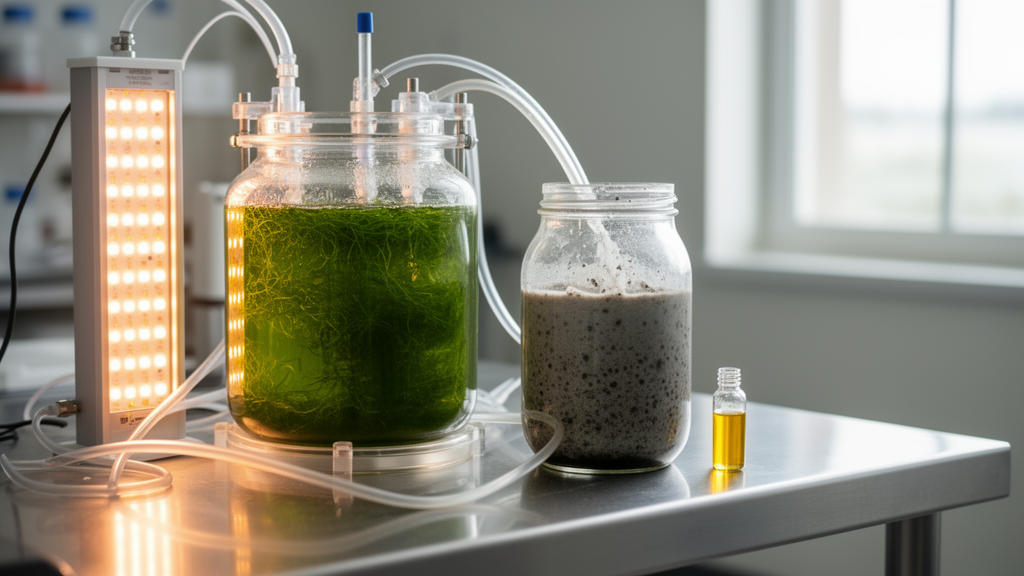
The light-stress experiment constitutes the most mechanistically interesting component of the investigation. When the photon flux supplied to the cultures was raised to 450 micromoles of photons per square meter per second, the lipid concentration in the biomass increased from 0.31 to 0.53 grams per liter, an increase of roughly 70 percent. The biochemical explanation lies in the way photosynthetic cells manage excess absorbed energy. Under moderate light, most captured photons drive growth and cell division, with assimilated carbon channeled into proteins, nucleic acids, and structural carbohydrates. When light intensity exceeds the capacity of the photosynthetic apparatus to use the energy for growth, a condition known as photoinhibition or light stress, cells redirect surplus carbon and reducing power toward storage compounds, chiefly triacylglycerols, which are energy-dense, non-structural lipids. This diversion protects the cell by consuming excess electrons that would otherwise generate reactive oxygen species, while simultaneously creating a reservoir of reduced carbon that can be mobilized later. The practical consequence is that stressing the culture with high light, without adding any exogenous carbon source or depriving it of nutrients, shifts metabolism toward lipid accumulation.
It is worth noting that the lipid values reported here are expressed as concentrations per liter of culture rather than as percentages of dry biomass, which makes direct comparison with other studies slightly less straightforward. The increase from 0.31 to 0.53 grams per liter, achieved on a wastewater substrate, is nonetheless meaningful because lipid productivity, the product of biomass concentration and lipid fraction, is the parameter that ultimately determines biodiesel yield per unit of cultivation volume. The fact that the enhancement occurred in wastewater-grown cells, rather than in cells cultivated on synthetic medium, strengthens the case for the integrated approach, since it demonstrates that the stress response operates even when the cells are simultaneously performing bioremediation duties.
The quality of the extracted lipids as a biodiesel feedstock was assessed by estimating the properties of the derived fatty acid methyl esters against two widely used benchmark standards, the American ASTM D6751-12 specification and the corresponding European EN standard. Compliance with these standards depends on a suite of fuel characteristics, including cetane number, oxidative stability, cold-flow properties such as cloud and pour point, kinematic viscosity, iodine value, and sulfur content. These properties are governed largely by the fatty acid chain lengths and degrees of unsaturation in the feedstock. Saturated, long-chain fatty acids such as palmitic acid, C16:0, and stearic acid, C18:0, confer high cetane numbers and good oxidative stability but worsen cold-flow behavior, while polyunsaturated fatty acids do the opposite. Desmodesmus species are known to accumulate fatty acid profiles dominated by C16 to C18 chains, the same range that predominates in conventional vegetable-oil biodiesel, which is precisely why the estimated properties could meet both specifications. The earlier finding that Desmodesmus maintains a saturated-fatty-acid-rich profile even when cultivated in wastewater, as reported in prior studies with related species, suggests that the substrate did not distort the lipid composition in a way that would compromise fuel quality.
The identification of the isolate itself followed standard molecular taxonomy. The chloroplast 23S ribosomal RNA gene, rather than the more commonly used nuclear 18S marker, was amplified and sequenced, a choice often made in green microalgae because the plastid marker can resolve relationships among closely related scenedesmoid genera where nuclear markers are ambiguous. Sequencing was outsourced to a commercial facility, and the resulting sequence was compared against curated reference databases to assign the organism to the genus Desmodesmus. This level of taxonomic rigor matters because the bioremediation and lipid phenotypes reported are strain-specific; a related species might behave quite differently on the same wastewater.
Several caveats and open questions remain before such a system could be deployed outside the laboratory. The experiments were conducted at small scale, likely in flasks or small photobioreactors under controlled temperature and illumination, conditions that rarely translate directly to open ponds or raceways where light availability fluctuates diurnally and seasonally, contamination by grazers and competing organisms is unavoidable, and evaporation concentrates the medium. The dilution of the wastewater to 75 percent, while effective, introduces a need for freshwater blending that partially offsets the water-savings benefit, and optimizing the dilution ratio against treatment performance and biomass yield is an obvious next step. The light intensity used to induce lipid accumulation, 450 micromoles per square meter per second, is achievable in outdoor systems on sunny days but would require artificial supplementation in covered reactors or during cloudy periods, with attendant energy costs that must be weighed against the value of the additional lipid. Moreover, the study measured removal of bulk parameters rather than tracking the fate of specific nutrient species, so the partitioning of nitrogen between assimilation into biomass, stripping as ammonia, and microbial transformation remains to be quantified. Harvesting, dewatering, and lipid extraction, which often dominate the energy and cost balance of algal biodiesel, were outside the scope of the reported work, as was the fate of the lipid-extracted residue, which could in principle be anaerobically digested or used as fertilizer, closing the nutrient loop further.
Nevertheless, the integrated demonstration carries real significance. It shows that a single locally isolated organism, grown on a genuine institutional waste stream without synthetic nutrient inputs, can simultaneously deliver meaningful pollutant removal and produce a lipid feedstock whose estimated fuel properties satisfy international biodiesel standards, and that a simple operational lever, elevated light, can substantially boost the energy content of the harvested biomass. The work adds to a growing body of evidence that the marginal economics of algal biofuels improve most when cultivation is coupled to a waste-treatment service that generates revenue or cost savings in its own right, rather than when biofuel production is pursued as a standalone venture. Future pilot-scale trials on cafeteria or comparable domestic effluents, with attention to seasonal variability, community dynamics of the algal culture, and full process-chain accounting, will determine whether the promising laboratory results can be realized at a scale relevant to municipal wastewater management and renewable energy production.
Subject of Research: …
Article Title: Light-induced lipid enhancement in domestic wastewater-grown Desmodesmus sp. for biodiesel production and bioremediation
Article References: Samaraweera, S. A. S. B., Vaishnevan, S., Dinithi, M. E. S., Rajenthiram, T., Hanifa, N. M., Nimarshana, P. H. V., Sakarika, M., & Ariyadasa, T. U. (2026). Light-induced lipid enhancement in domestic wastewater-grown Desmodesmus sp. for biodiesel production and bioremediation. Frontiers in Chemical Engineering, 8, Article 1894864. https://doi.org/10.3389/fceng.2026.1894864
Image Credits: AI Generated
DOI: 10.3389/fceng.2026.1894864
Keywords: microalgae, biodiesel, wastewater treatment, Desmodesmus, lipid accumulation, bioremediation, light stress, circular bioeconomy, resource recovery, cafeteria wastewater, renewable energy, Light-induced
Cite Scienmag News
Denise Maddox. (October 16, 2026). Cafeteria Wastewater Meets Light Stress: Microalga Turns Kitchen Runoff Into Biodiesel While Cleaning It. Scienmag. https://scienmag.com/cafeteria-wastewater-meets-light-stress-microalga-turns-kitchen-runoff-into-biodiesel-while-cleaning-it/
Denise Maddox. "Cafeteria Wastewater Meets Light Stress: Microalga Turns Kitchen Runoff Into Biodiesel While Cleaning It." Scienmag, 16 October 2026, https://scienmag.com/cafeteria-wastewater-meets-light-stress-microalga-turns-kitchen-runoff-into-biodiesel-while-cleaning-it/. Accessed 16 October 2026.
Denise Maddox. "Cafeteria Wastewater Meets Light Stress: Microalga Turns Kitchen Runoff Into Biodiesel While Cleaning It." Scienmag. October 16, 2026. https://scienmag.com/cafeteria-wastewater-meets-light-stress-microalga-turns-kitchen-runoff-into-biodiesel-while-cleaning-it/


