


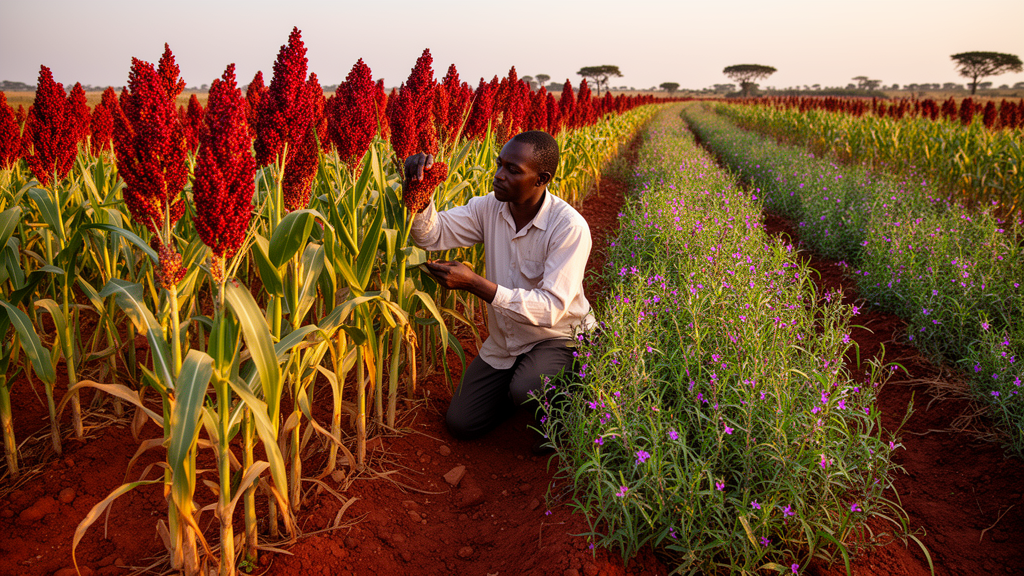
In the sorghum fields of Kobo, in Ethiopia’s North Wollo Zone, an invisible enemy lurks beneath the soil surface. Striga hermonthica, a parasitic weed known locally as one of the most devastating biotic constraints to cereal production, attaches itself to the roots of host plants and drains them of water, nutrients, and vitality. For millions of smallholder farmers across sub-Saharan Africa, Striga infestation can mean the difference between a harvest and a total loss, with yield reductions reaching as high as 90 percent in severely affected fields. Now, a new field study conducted during the 2022 main cropping season has evaluated 49 sorghum genotypes for their resistance to this parasitic menace, uncovering a handful of promising candidates that could reshape breeding programs across the region.
The research, carried out at the Kobo research sub-center under artificially infested field conditions, represents a systematic effort to quantify how different sorghum lines respond to Striga pressure while simultaneously maintaining agronomic performance. Sorghum, a staple food for over 300 million people in Africa, ranks fifth globally in cultivated area with 58 million hectares and sixth in production at 63.9 million metric tons. Ethiopia stands among the world’s top ten sorghum producers and is the third-largest producer on the African continent, yet the national average grain output of 2.7 tons per hectare remains constrained by a combination of drought and parasitic weed pressure, particularly in the northern and northeastern regions of the country.
The experimental design was rigorous and deliberate. Forty-nine sorghum genotypes, including susceptible and resistant checks obtained from the Melkasa Agricultural Research Center, were arranged in a 7 by 7 simple lattice design. Each genotype was planted on plots consisting of two rows of 3 meters in length with 0.75 meters between rows, covering a plot area of 4.5 square meters. Every planting plot was artificially infested with 5 grams of Striga hermonthica seeds collected in 2021 from heavily infested sorghum fields in the Kobo, Habru, and Dawa Chefa districts. The genotypes themselves were products of crossing programs that paired pure lines and early maturing varieties as female parents with Striga-resistant varieties including Framida, Gobiye, and Birehan as male parents, creating a diverse genetic pool for evaluation.
The results of the analysis of variance revealed highly significant differences among the tested genotypes across virtually all measured traits, including days to flowering, days to maturity, plant height, panicle length, panicle width, head count, head weight, biomass weight, grain yield, thousand kernel weight, harvest index, Striga count, and Striga severity. This breadth of variation signals ample genetic variability that breeders can exploit. Plant height alone ranged from 136 centimeters in the standard check Gobiye to 338 centimeters in genotype ETSC17028, while Striga count and severity varied from 0.57 to 22.07 and from 1.4 to 58, respectively. Grain yields spanned from a low of 2.5 tons per hectare in genotype ETSC17065-2 to a high of 6.5 tons per hectare in ETSC17096-2, demonstrating the enormous productive potential locked within the genetic diversity of the tested materials.
The correlation analysis between grain yield and Striga-related traits produced some of the most striking findings of the study. At the genotypic level, grain yield showed highly significant positive correlations with panicle length (0.68), head count (0.83), head weight (0.95), biomass yield (0.77), and harvest index (0.8). Conversely, grain yield was highly significantly and negatively correlated with Striga count (-0.9 at the phenotypic level and -0.94 at the genotypic level), Striga vigorosity (-0.24 and -0.36), and Striga severity (-0.89 and -0.93). These coefficients tell a clear biological story: the more Striga plants that emerge and the more severe the infestation, the lower the grain yield. The genotypic correlation values generally exceeded their phenotypic counterparts, suggesting that the underlying genetic associations between these traits are even stronger than what field observations alone reveal, a critical insight for selection strategy in breeding programs.
Principal component analysis further illuminated the structure of variation among the 49 genotypes. The first five principal components collectively explained 86.8 percent of the total variation, with the first component alone accounting for 48.19 percent. Traits loading heavily on the first component included head count (0.32), head weight (0.37), biomass yield (0.33), grain yield (0.38), and harvest index (0.32), while Striga count and Striga severity both carried negative loadings of -0.36. The second component, explaining 14.16 percent of the variation, was dominated by days to flowering (0.55), days to maturity (0.59), and plant height (0.46), while panicle width (0.76) was the most significant contributor to the third component. This multivariate picture confirms that no single trait can capture the full spectrum of variation among sorghum genotypes, underscoring the need for integrated selection approaches that consider multiple characteristics simultaneously.
Cluster analysis using Mahalanobis’s D2 statistic grouped the 49 genotypes into five distinct clusters, each with characteristic profiles of performance and Striga response. Cluster I was the largest, containing 20 genotypes, followed by Cluster II with 16, Cluster III with 10, Cluster IV with 2, and Cluster V with just 1. Cluster III emerged as the standout group, characterized by the highest plant height (287.2 centimeters), the longest panicles (35.6 centimeters), the largest head count (41), the heaviest head weight (8.2 tons per hectare), the highest biomass yield (18 tons per hectare), and the highest grain yield (6.04 tons per hectare). Critically, Cluster III also recorded the lowest Striga count (3.2) and the lowest Striga severity (7.9), making it a treasure trove of resistance alleles for future breeding. In stark contrast, Clusters II and IV harbored the most susceptible genotypes, with Striga severity scores of 48.2 and 50.9 respectively and correspondingly depressed grain yields of 3.2 and 2.8 tons per hectare.
The inter-cluster distances revealed the genetic architecture underlying these groupings. The maximum distance was observed between Cluster III and Cluster V (666.2), followed by Cluster II and Cluster V (561.6) and Cluster I and Cluster V (552.3). These large distances suggest that crosses between parents drawn from these maximally divergent clusters would likely produce the greatest heterosis, or hybrid vigor, in subsequent generations. Conversely, the shortest inter-cluster distance was found between Cluster II and Cluster IV (18.2), indicating that genotypes within these groups are genetically similar and crossing them would yield limited variability in segregating populations. The chi-square distribution test confirmed significant genotypic differences between clusters, reinforcing the utility of divergence analysis as a prerequisite step before any hybridization program begins, saving breeders time and resources by directing crosses toward genetically complementary parents.
Among the individual genotypes, ten stood out as Striga-resistant, having achieved the highest mean grain yields and the lowest mean Striga severity scores, outperforming even the resistant check Gobiye. These included ETSC17008-1, ETSC17016-1, ETSC17096-2, ETSC17009-1, ETSC17023-2, ETSC17028-1, ETSC17117-2, ETSC17090-1, ETSC17103-1, and ETSC17048-1. Thirteen additional genotypes showed better grain yield with moderate Striga counts and severity, placing them in an intermediate tolerance category, while the remaining twenty-four were classified as susceptible due to their low grain production, high emerging Striga counts, and high Striga severity. The resistant check Gobiye itself recorded 5 Striga plants per square meter with a severity of 12.1 and a grain yield of 5.1 tons per hectare, while the susceptible local check Jigurite carried a mean Striga count of 19.8 with a severity of 52.43 and a grain yield of only 3 tons per hectare, providing clear benchmarks against which the experimental lines could be judged.
The implications of this research extend well beyond the borders of the Kobo district. Striga is estimated to threaten the livelihoods of over 100 million people in sub-Saharan Africa and causes annual yield losses valued at approximately 7 billion dollars. In Ethiopia and Sudan, sorghum yield losses attributable to Striga have been reported to range from 65 to 100 percent in heavily infested fields. The identification of resistant genotypes represents the most economical, straightforward, and effective control strategy available to resource-constrained farmers, and the genotypes highlighted in this study, particularly those from Cluster III, offer a ready source of resistance alleles for incorporation into elite breeding lines. As the researchers note, further validation across multiple locations and seasons will be essential, given that Striga expression is heavily influenced by environmental variation, but the foundation has been laid for a new generation of sorghum cultivars that can stand firm against one of agriculture’s most insidious parasites.
Subject of Research: Sorghum genotype resistance to the parasitic weed Striga hermonthica and trait associations for breeding
Article Title: Evaluation of sorghum ( Sorghum bicolor ( l. ) Moench) genotypes for striga resistance and associations among yield and striga related traits
Article References: Evaluation of sorghum ( Sorghum bicolor ( l. ) Moench) genotypes for striga resistance and associations among yield and striga related traits. (n.d.). https://doi.org/10.3897/ia.2025.164256
Image Credits: AI Generated
Keywords: sorghum, Striga hermonthica, parasitic weed, grain yield, genetic correlation, cluster analysis, principal component analysis, Ethiopia, plant breeding, crop resistance, agronomic traits, food security
Cite Scienmag News
Alan Morgan. (October 16, 2026). Parasitic Weed Meets Its Match as Ethiopian Sorghum Trial Pinpoints Resistant Genotypes. Scienmag. https://scienmag.com/parasitic-weed-meets-its-match-as-ethiopian-sorghum-trial-pinpoints-resistant-genotypes/
Alan Morgan. "Parasitic Weed Meets Its Match as Ethiopian Sorghum Trial Pinpoints Resistant Genotypes." Scienmag, 16 October 2026, https://scienmag.com/parasitic-weed-meets-its-match-as-ethiopian-sorghum-trial-pinpoints-resistant-genotypes/. Accessed 16 October 2026.
Alan Morgan. "Parasitic Weed Meets Its Match as Ethiopian Sorghum Trial Pinpoints Resistant Genotypes." Scienmag. October 16, 2026. https://scienmag.com/parasitic-weed-meets-its-match-as-ethiopian-sorghum-trial-pinpoints-resistant-genotypes/


