


Who really decides what ends up on the world’s dinner plates? A new editorial published in Frontiers in Sustainable Food Systems argues that the answer may lie far from national ministries and corporate boardrooms, in the hands of indigenous and local community governments whose regulatory systems and self-determination principles have quietly sustained food production for generations. The editorial, led by Iván Antonio García-Montalvo and colleagues at the Tecnológico Nacional de México/Instituto Tecnológico de Oaxaca, introduces a Research Topic of 16 contributions that collectively make a striking case: the resilience of global food systems may depend less on top-down policy and more on the community governance structures that science has long overlooked.
The core argument is deceptively simple. Sustainability in food systems increasingly depends on governance models that integrate the environmental, social, and cultural needs of each territory, and community-based governments are uniquely positioned to deliver that integration. Drawing on their own regulatory frameworks and principles of self-determination, these governments have developed knowledge and practices to manage land, natural resources, and food production in ways that remain aligned with local ecosystems and cultural identity. Yet the editorial is blunt about the obstacles: a lack of legal recognition, insufficient institutional support, and weak integration into public policy continue to cap the potential of these governance forms, leaving some of the most adaptive food systems in the world structurally underpowered.
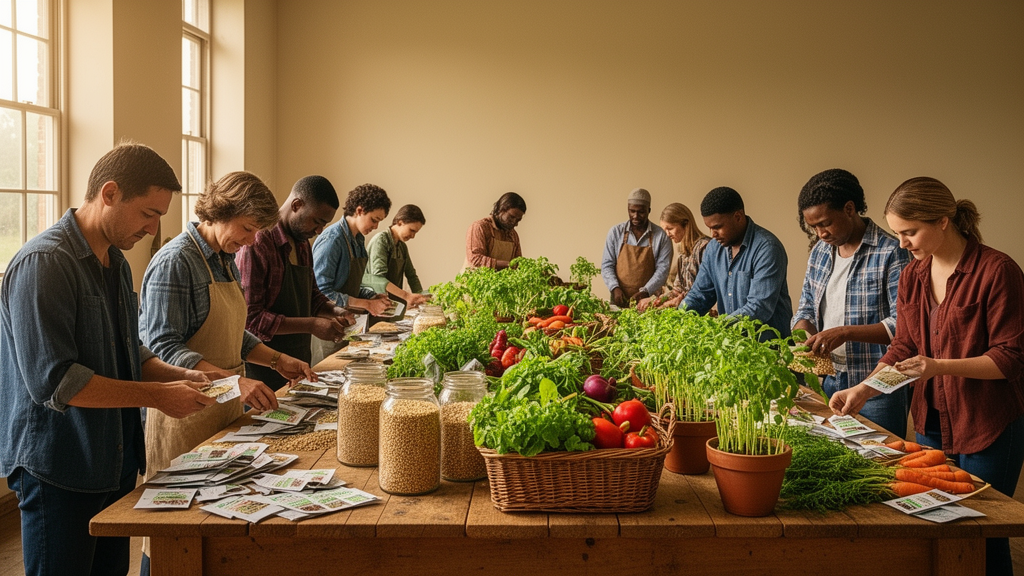
The 16 studies gathered under the Research Topic span continents and scales, from participatory citizen science in Indigenous communities to evolutionary game models of rice-crayfish co-culture in China. One of the most technically rich contributions, by Sarapura-Escobar and colleagues, examines how participatory citizen science can support Indigenous food sovereignty and relational approaches to One Health. The study highlights community gardens, seed saving, local knowledge, and collaborative research as mechanisms that strengthen relationships among people, land, animals, and food while reinforcing cultural continuity and community self-determination. In effect, the research reframes citizen science not as data extraction but as a governance practice in its own right.
Seed systems emerge as another critical frontier. Andersen and colleagues analyzed community seed banks across Ethiopia, Malawi, and Nepal, finding that locally managed seed systems improve access to climate-adapted varieties, strengthen farmer capacities, and promote seed exchange networks that function as living repositories of agrobiodiversity. But the evidence also exposes the fragility of these institutions: the authors identify institutional, technical, and genetic challenges that limit long-term expansion, a reminder that community innovation without structural support can plateau even when it demonstrably works.
Digital governance offers a contrasting pathway. A study by Zuo uses evolutionary game analysis to show that the sustainable transition of rice-crayfish co-culture systems depends on regulation, agricultural extension services, and data-based financial support operating in synergy to align the interests of governments, financial institutions, and small-scale producers. The modeling suggests that no single lever is sufficient; sustainability gains materialize only when these mechanisms move together, and even then the analysis stresses that intensification must not compromise the food-producing function of rice cultivation itself. Related work by Yang and colleagues in Guiyang, China, extends the digital theme to retail, showing that consumer satisfaction, delivery speed, purchasing experience, and product quality data can improve inventory management, reduce waste, and increase the efficiency of fresh food distribution.
Several contributions probe the social architecture of food systems with unusual granularity. Xu and colleagues used micro-level evidence from rural China to ask whether married women’s labor force participation can reduce consumption gaps among rural households, identifying income, social capital, and shifting consumption preferences as key mechanisms. Crucially, the benefits are conditional: long working hours and extended commuting can erode them by increasing women’s time burdens and reducing their capacity for care and household management. In Italy, Briamonte and colleagues analyzed food districts as instruments of multi-level governance, showing that their effectiveness hinges on coordinating national and regional regulations, local participation, institutional recognition, and monitoring mechanisms. And in disaster-prone areas, Hermiatin and colleagues proposed a resilience-oriented framework for food hubs, arguing that these organizations can serve both commercial and humanitarian functions by combining food distribution, local coordination, and emergency response capacities built on robustness, adaptability, recovery, and reconfiguration.
The darker findings concern what happens when communities are given responsibility without authority. Dring and colleagues diagnosed community food system governance in rural Western Canada, showing that local networks can strengthen food access, social cohesion, and emergency preparedness, but that their impact is restricted when communities lack control over land, infrastructure, markets, and public policy. The authors issue an explicit warning against transferring responsibilities to communities without providing adequate resources and institutional recognition, a finding with direct implications for governments that devolve food system functions as a cost-saving measure. A parallel study by Aysan and colleagues in Bozdogan, Türkiye, uncovered a quality paradox: regions producing high-quality olives can still fail to generate high-value olive oil, a failure the researchers trace to demographic change, weakened intergenerational knowledge transmission, limited cooperative organization, and a mismatch between local production practices and dominant market conventions. Certification and technological interventions, they argue, are insufficient without educational, cooperative, and institutional support.
Hybrid governance appears repeatedly as the operative model on the ground. Dado Tossou and colleagues documented how producers, cooperatives, NGOs, research institutions, and public agencies in Benin’s Atacora region respond to the limited institutional recognition of neglected and underutilized species by combining endogenous strategies, including seed exchange, collective labor, and local processing, with external support such as training, equipment, and certification. In Southern Brazil, Andrade and colleagues developed an indicator panel to measure the maturity of territorial goods, services, and governance arrangements in the Crediseara territory of Santa Catarina, finding moderate maturity anchored by a rural credit cooperative and a Family Agriculture Forum, alongside persistent gaps in coordination among public actors and insufficient representation of Indigenous perspectives. Zhou’s separate panel-data analysis of Jiangxi Province from 2021 to 2023 found that rural industrial integration significantly increases the scale of household participation in agribusiness, with e-commerce sales serving as the significant transmission mechanism, while contract premiums showed no statistically supported mediating effect.
Two opinion pieces sharpen the conceptual stakes. Sarubbi-Baltazar and colleagues argue that territorial food networks should be understood as governance infrastructures rather than mere distribution channels, emphasizing women’s contributions to organizing production, exchange, care, knowledge transmission, and trust-building, and suggesting that shorter supply chains, local knowledge, and resource reuse can support low-carbon transitions. Leyva-Hernández and colleagues identify centralized budgets, rigid legal frameworks, bureaucratic practices, and the limited recognition of traditional knowledge as the major institutional barriers to local food resilience, proposing multilevel governance, collective identity, and community participation as pathways toward more autonomous systems. Finally, Sadanand and colleagues propose a participatory, consumption-centered framework for rural food transformation, arguing that change must address how vulnerable communities access, select, prepare, and value food within their social and institutional contexts, not merely how it is produced and shipped.
The editorial’s synthesis is its most consequential claim: the field must move away from an exclusively production-oriented perspective toward an understanding of food systems in which culture, gender, justice, local knowledge, power relations, and local decision-making capacity all play defining roles. Strengthening community governance, the authors conclude, means creating the conditions for communities to define their own food priorities, protect their resources, and preserve their practices. As climate pressures intensify and supply chains wobble, the evidence assembled here suggests that the most resilient food futures may already exist in embryo, governed not by distant authorities but by the communities who have been stewarding their territories all along, waiting for legal recognition and institutional support to catch up with what the data now show.
Subject of Research: Community-based governance of resilient and sustainable food systems
Article Title: Editorial: Strengthening community governance for resilient and sustainable food futures
Article References: García-Montalvo, I. A., Matías-Pérez, D., Sánchez-Medina, M. A., & Matías Cervantes, C. A. (2026). Editorial: Strengthening community governance for resilient and sustainable food futures. Frontiers in Sustainable Food Systems, 10, Article 2016058. https://doi.org/10.3389/fsufs.2026.2016058
Image Credits: AI Generated
DOI: 10.3389/fsufs.2026.2016058
Keywords: community governance, food sovereignty, indigenous knowledge, sustainable food systems, seed banks, multilevel governance, food security, climate resilience, agrobiodiversity, rural development, One Health, food policy
Cite Scienmag News
Courtney Benton. (October 16, 2026). Community Governance Emerges as the Backbone of Resilient and Sustainable Food Futures. Scienmag. https://scienmag.com/community-governance-emerges-as-the-backbone-of-resilient-and-sustainable-food-futures/
Courtney Benton. "Community Governance Emerges as the Backbone of Resilient and Sustainable Food Futures." Scienmag, 16 October 2026, https://scienmag.com/community-governance-emerges-as-the-backbone-of-resilient-and-sustainable-food-futures/. Accessed 16 October 2026.
Courtney Benton. "Community Governance Emerges as the Backbone of Resilient and Sustainable Food Futures." Scienmag. October 16, 2026. https://scienmag.com/community-governance-emerges-as-the-backbone-of-resilient-and-sustainable-food-futures/


