


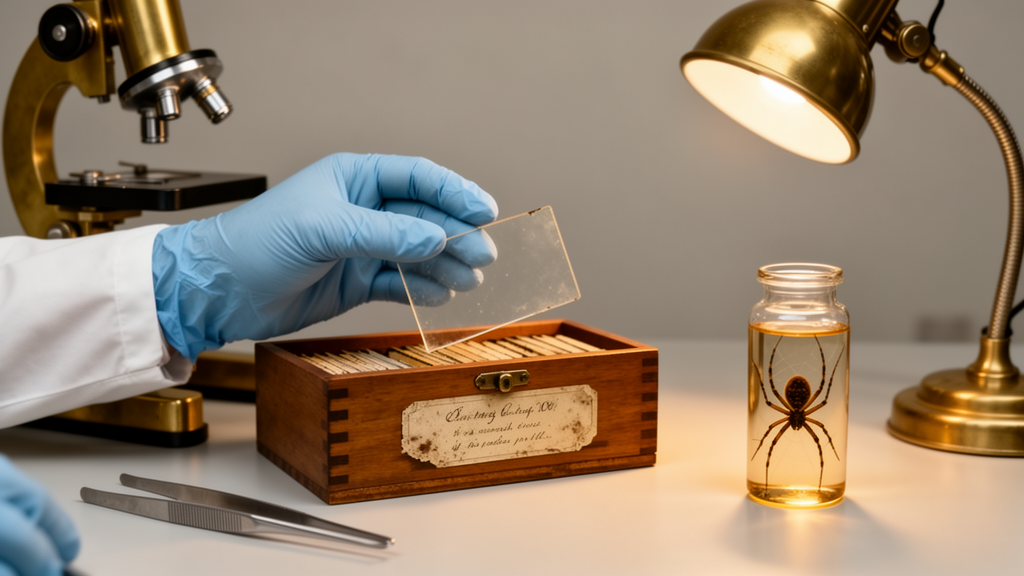
A spider described from Tbilisi more than a century after its collection, then quietly written off as a synonym, has been brought back from taxonomic limbo by a handful of century-old microscope slides. In a study published in the journal Caucasiana, arachnologists re-examined the forgotten type material of Araniella tbilisiensis, a small orb-weaver first named by the Georgian arachnologist Tamara Mcheidze in 1997, and concluded that the species is not only valid but also older than a closely related form described from Central Asia in 2020. The finding collapses one recently named species into another and restores a name that had spent years dismissed as a case of mistaken identity.
The story begins in 1921, when an unknown collector gathered four females and a single male of a small orb-weaving spider in Tbilisi, the capital of Georgia. Decades later, Mcheidze described the animal in her monograph on the spiders of Georgia under the name Araneus tbilisiensis, publishing the account in Georgian and accompanying it with figures of both sexes and a drawing of the female genitalia, the epigyne. In 1998, the Russian arachnologist Kirill Mikhailov transferred the species to the genus Araniella, a group of small, often greenish orb-weavers in the family Araneidae, on the basis of those illustrations.
For years, however, the species remained difficult to evaluate. The original drawings were of poor quality, and the Georgian language of the description was accessible to only a handful of researchers. An English translation of Mcheidze’s monograph, prepared by Stefan Otto and published in 2014, eventually opened the work to a wider audience, but the physical type specimens, the specimens on which the name is formally based, were believed to have been lost or damaged. Without type material, later authors could only guess at the species’ identity.
That uncertainty led to a consequential decision in 2020. A team of researchers, reviewing the Central Asian fauna, described a new species, Araniella villanii, from specimens collected in the mountains of eastern Kazakhstan, and at the same time treated A. tbilisiensis as a junior synonym of the widespread European species A. opisthographa. That synonymy, however, was made without any re-examination of Mcheidze’s type material, relying instead on superficially similar morphology and overlapping distribution ranges. In taxonomy, such judgments are provisional by nature, and the fate of both names hung on whether the lost types could ever be found.
They could. While working through the collection of permanent microslides assembled by Dmitry Evgenievich Kharitonov, Mcheidze’s mentor, at Perm State University, the authors of the new study discovered two female epigynes mounted on slides, together with a batch of slides containing female legs and body fragments and a male palp. The slides had been identified by Kharitonov himself as A. tbilisiensis, and the labels on one series of slides, covering the epigyne and various body parts of a single female, explicitly record that specimen’s membership in the type series. That female, collected in Tbilisi in 1921, is now designated as the lectotype, the single specimen that serves as the name-bearing reference for the species.
The rediscovery allowed the researchers to do what had been impossible for decades: compare the actual genitalia of the type specimen with those of its supposed relatives. Using a Zeiss Imager.A2 microscope fitted with a Panasonic GH5 digital camera, and stacking multiple images with CombineZM software to achieve depth of field, they photographed the epigyne of the lectotype in fine detail and took new images of the paratypes of A. villanii borrowed from the Zoological Museum of Moscow State University. The comparison focused on the copulatory structures, which in spiders are species-specific and often the most reliable basis for distinguishing closely related forms.
The results were unambiguous. The shape and arrangement of the copulatory ducts and seminal receptacles in the A. villanii paratypes show no differences from those of the A. tbilisiensis lectotype. The male palp from Kharitonov’s collection, though not part of the type series because it comes from a different year and locality, matches the description of A. villanii and comes from within its known distribution area. Taken together, the evidence led the authors to conclude that A. villanii, described only in 2020, is a junior synonym of A. tbilisiensis, a name that, despite its troubled history, predates it. The tentative synonymy of A. tbilisiensis with A. opisthographa, meanwhile, was shown to be incorrect, restoring the Georgian species to full validity.
The morphological diagnosis rests on subtle but consistent differences in the female genitalia. Mcheidze herself had distinguished her species from the related Araniella displicata by noting that the median plate of the epigyne is broader and overall shorter, and that a dark lateral fringe runs along the scapus, the protruding part of the epigyne. The new study adds further detail: in A. tbilisiensis the copulatory ducts are directed towards each other and are only half the width of the seminal receptacles, whereas in A. displicata the ducts point in opposite directions and are more than twice as narrow. The scapus of A. tbilisiensis is also narrower than the base of the epigyne, the reverse of the condition in A. displicata. The species additionally resembles A. proxima and A. opisthographa, but the differences from those congeners were documented in detail in the 2020 revision.
With the species revalidated, its known distribution expands dramatically. Beyond the type locality in Georgia, the synonymised A. villanii records place the species in eastern Kazakhstan, in the Tarbagatai mountain range, at elevations between roughly 1050 and 1250 metres, and additional material extends the range to Iran, India, Azerbaijan, and either Tajikistan or Uzbekistan, based on a male specimen from Kharitonov’s collection whose precise provenance lies between Khujand in Tajikistan and Humson in Uzbekistan. The pattern suggests a species distributed across the Caucasus and Central Asia, one whose true diversity had been obscured by the inaccessibility of its original description and the presumed loss of its types.
The study also uncovered a genuine surprise. Among Kharitonov’s slides was a female epigyne from the Guldara area of Uzbekistan’s Qashqadaryo Region, collected in 1942 and identified by Kharitonov as A. tbilisiensis. Close examination revealed that it differs from the revalidated species in several respects: the seminal receptacles sit close to each other, the lateral plates are more rounded, the scapus is narrower, with a width equal to that of the median plates, and the tip of the scapus is dome-shaped. These features do not match any known species of Araniella, and the specimen is therefore reported as an unidentified Araniella sp., a reminder that even well-studied collections may still hold species new to science. With 18 species currently recognised in the genus worldwide, and females of many congeners notoriously similar in appearance, the episode underscores how much of spider diversity in the Caucasus and Central Asia remains to be properly documented, and how the careful curation of historical collections can settle taxonomic debates decades in the making.
Subject of Research: Taxonomic revalidation and redescription of the orb-web spider Araniella tbilisiensis based on rediscovered type material
Article Title: A revalidation and redescription of the orb-web spider Araniella tbilisiensis ( Mcheidze 1997 ) ( Araneae : Araneidae )
Article References: Tiunov, A., & Ustinova, A. L. (2025). A revalidation and redescription of the orb-web spider Araniella tbilisiensis (Mcheidze 1997) (Araneae: Araneidae). Caucasiana, 4, 195-201. https://doi.org/10.3897/caucasiana.4.e173656
Image Credits: AI Generated
DOI: 10.3897/caucasiana.4.e173656
Keywords: Araniella tbilisiensis, Araniella villanii, orb-weaver spiders, taxonomy, Georgia, Central Asia, epigyne, lectotype, Araneidae, Mcheidze, Kharitonov collection, species synonymy
Cite Scienmag News
Ophelia Keating. (October 16, 2026). Lost Spider Slides Revive a Georgian Orb-Weaver and Erase a Younger Species Name. Scienmag. https://scienmag.com/lost-spider-slides-revive-a-georgian-orb-weaver-and-erase-a-younger-species-name/
Ophelia Keating. "Lost Spider Slides Revive a Georgian Orb-Weaver and Erase a Younger Species Name." Scienmag, 16 October 2026, https://scienmag.com/lost-spider-slides-revive-a-georgian-orb-weaver-and-erase-a-younger-species-name/. Accessed 16 October 2026.
Ophelia Keating. "Lost Spider Slides Revive a Georgian Orb-Weaver and Erase a Younger Species Name." Scienmag. October 16, 2026. https://scienmag.com/lost-spider-slides-revive-a-georgian-orb-weaver-and-erase-a-younger-species-name/


