


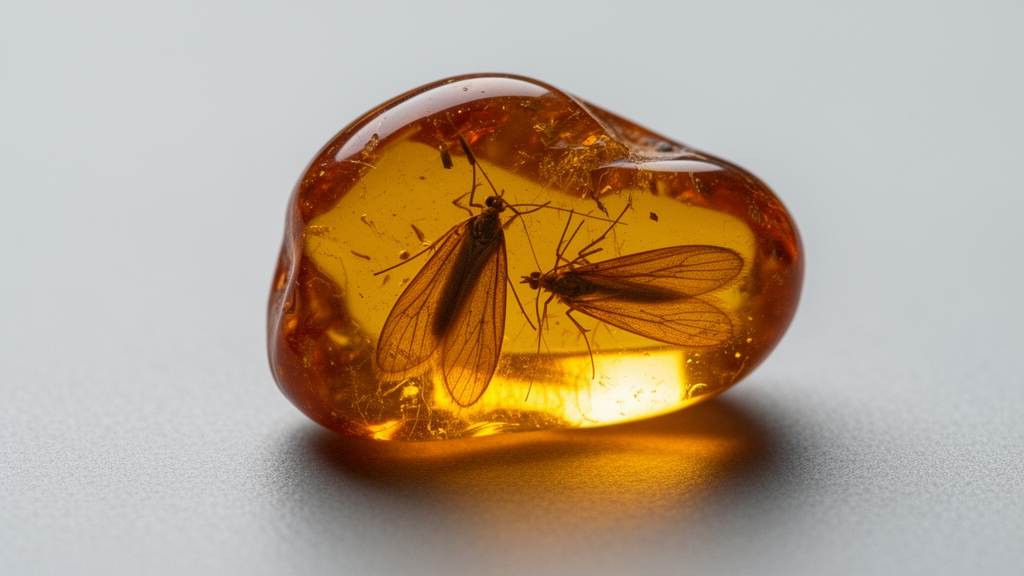
Deep inside a block of amber recovered decades ago from the open coal mine Goitsche near Bitterfeld in Saxony-Anhalt, Germany, two minute moths have been waiting for recognition. A new study published in the journal Zitteliana describes them as members of the superfamily Gelechioidea, marking the first record of this enormous group of Lepidoptera from Bitterfeld amber. Both species turn out to be so unusual that they cannot be placed in any known gelechioid family, prompting the establishment of two new genera: Barthelius pumilus gen. et sp. nov. and Krutzschius nanarius gen. et sp. nov., each left as family incertae sedis, meaning their family-level affiliation remains unresolved.
Research on butterflies and moths from Bitterfeld amber is still in a very early stage. Before this study, the order Lepidoptera was represented in the deposit by only six species from the primitive family Micropterigidae, four genera of which were formally established in 2019: Bitterfeldopterix, Klausnitzerellus, Saxomicropterix and Wichardius. Notably, none of these taxa is known from Baltic amber, which researchers interpret as further evidence for the unique and independent origin of Bitterfeld amber. The new gelechioid discoveries reinforce that picture of a distinct fossil assemblage with its own evolutionary history.
The specimens examined in the study came from material collected during the first sampling campaigns at the Goitsche mine, with early finds of Lepidoptera already documented in 1982. Much of this material is now housed in the amber collection of the Museum für Naturkunde in Berlin. During a recent inspection, unidentified minute moths with expanded wings, visible heads and genitalia attracted attention and were withdrawn for closer study. Tentative identification placed them in two families within Gelechioidea, a superfamily that today encompasses a substantial share of all described moth species, including many small, cryptically colored microlepidoptera.
Barthelius pumilus, whose generic name honors the late palaeobotanist and former Museum für Naturkunde director Manfred Barthel, is a male specimen with a wing length of just 2.25 millimeters and a body length of 2.1 millimeters, giving a wing expanse of approximately 5.0 millimeters. The species epithet derives from the Latin word for minute, a fitting tribute to its tiny size. With a wingspan of about 5 millimeters, the new genus belongs among the smallest members of the entire superfamily Gelechioidea, extant or fossil.
Several diagnostic characters support the assignment of Barthelius to Gelechioidea: heteroneurous wing venation, in which the forewing and hindwing venation patterns differ; up-curved labial palpi; absent maxillary palpi; and a scaled proboscis. The genus also possesses a long, dorso-ventrally depressed uncus with a sclerotized, triangular apex that bears some resemblance to genera of the family Gelechiidae, specifically the tribe Litini. However, the authors caution that the uncus is only partly visible, making the significance of this character uncertain. Crucially, the key synapomorphy of Gelechiidae, an angular hindwing with an emarginated termen below the apex, is absent, and the lanceolate hindwings, reduced venation and small size are all unusual for that family.
The forewing venation of Barthelius, with four radial veins, a single unbranched media, and both Cu1a and Cu1b present, resembles that of other gelechioid families such as Coleophoridae, Elachistidae and Cosmopterigidae. Unfortunately, the hindwing venation is hardly visible, with only one radial and one medial vein discernible, representing a strongly reduced state. In the absence of other derived, discernible characters, the genus cannot currently be assigned to any of the many gelechioid families. The holotype is nearly completely preserved except for a missing left hindleg and the tip of the right antenna, and a paratype from the collection of Goitzsche Bernstein GmbH supplements the type series.
The second new genus, Krutzschius, named for the palaeo-palynologist Wilfried Krutzsch, one of the first professional researchers of Bitterfeld amber, is represented by a male holotype, two male paratypes and a female paratype. The holotype is completely preserved, with the left wings moderately separated enough to allow venation study. Its wing length ranges from 2.2 to 2.4 millimeters, with a wing expanse of approximately 5.2 millimeters. The forewings are densely covered by scales that do not form a pattern, while the hindwings show scale coverage in the subcostal area, a detail captured in the study’s photographs.
Krutzschius shares the same core gelechioid characters as Barthelius, but its genitalia initially suggested a different affinity. The elongate valvae, a spine-like sacculus with a dorsally curved apex, and a paw-like tip of the uncus form a character pattern seen in many extant genera of the family Autostichidae. Yet the wings of Krutzschius nanarius are more lanceolate than in most autostichid genera, even though the forewing venation with four radial and three medial veins and the hindwing apical fork formed by R+RS and M1 agree with many members of that family. Because clear shared derived characters are lacking, the systematic position of Krutzschius within Gelechioidea also remains unresolved, although the new genus is clearly distinct from the named autostichid taxa known from Baltic amber.
Interestingly, the study notes that an unnamed species illustrated by the Polish lepidopterist Andrzej W. Skalski in 1977, which he believed belonged to the family Heliodinidae, shows a wing venation very similar to that of Krutzschius rather than to any heliodinid. That species has never been described, and without additional morphological information it cannot even be assigned to a family. The comparison hints that more gelechioid diversity may be hiding unrecognized in old amber collections, awaiting modern re-examination.
To provide broader taxonomic and biogeographical context, the study also describes two gelechioid species from Baltic amber. Symmoca hoffeinsorum sp. nov., named in honor of Christel and Hans Werner Hoffeins for their dedication to Baltic amber research, is a small male moth with a 5.1 millimeter wing length and clearly visible male genitalia consistent with extant Symmoca species. It is the first documented individual of the family Autostichidae in Baltic amber with such well-preserved genitalia, and it was described as new because comparisons with the original drawings of the fossil genus Symmocites revealed substantial differences in wing venation: Symmoca has five radial and three medial veins in the forewing, whereas Symmocites has only four radial and one medial vein. A second Baltic amber male was associated with Oegoconites borisjaki Kusnetzov, 1941, a species originally placed in Gelechiidae and later transferred to Oecophoridae. The authors argue that the current placement of Oegoconites in Autostichidae is apparently incorrect with respect to wing venation, and that the genus belongs to the depressariine complex of taxa, which spans several modern families. For now, Oegoconites remains in Autostichidae until new material and characters allow a formal transfer.
The superfamily Gelechioidea is represented in Baltic amber by a species-rich and diverse fossil record spanning many families, including Autostichidae, Coleophoridae, Cosmopterigidae, Blastobasidae, Elachistidae, Momphidae and Oecophoridae. Given that diversity, the authors expect a similar richness to emerge from Bitterfeld amber as research on its Lepidoptera intensifies. The new genera demonstrate that even tiny, easily overlooked inclusions can carry significant evolutionary information, and that the full story of moths preserved in the German amber deposits is only beginning to be told.
Subject of Research: First fossil record of Gelechioidea moths from Bitterfeld amber and new gelechioid species from Baltic amber
Article Title: First records of species of Gelechioidae from Bitterfeld amber ( Insecta , Lepidoptera ) and notes on two gelechioid species from Baltic amber
Article References: First records of species of Gelechioidae from Bitterfeld amber ( Insecta , Lepidoptera ) and notes on two gelechioid species from Baltic amber. (n.d.). https://doi.org/10.3897/zitteliana.99.165692
Image Credits: AI Generated
DOI: 10.3897/zitteliana.99.165692
Keywords: Bitterfeld amber, Baltic amber, Gelechioidea, Lepidoptera, fossil moths, new genera, paleontology, Autostichidae, Micropterigidae, taxonomy, Museum für Naturkunde Berlin, Eocene amber
Cite Scienmag News
Gavin Prescott. (October 16, 2026). Tiny moths trapped in Bitterfeld amber reveal first gelechioid fossils from the German deposit. Scienmag. https://scienmag.com/tiny-moths-trapped-in-bitterfeld-amber-reveal-first-gelechioid-fossils-from-the-german-deposit/
Gavin Prescott. "Tiny moths trapped in Bitterfeld amber reveal first gelechioid fossils from the German deposit." Scienmag, 16 October 2026, https://scienmag.com/tiny-moths-trapped-in-bitterfeld-amber-reveal-first-gelechioid-fossils-from-the-german-deposit/. Accessed 16 October 2026.
Gavin Prescott. "Tiny moths trapped in Bitterfeld amber reveal first gelechioid fossils from the German deposit." Scienmag. October 16, 2026. https://scienmag.com/tiny-moths-trapped-in-bitterfeld-amber-reveal-first-gelechioid-fossils-from-the-german-deposit/


