


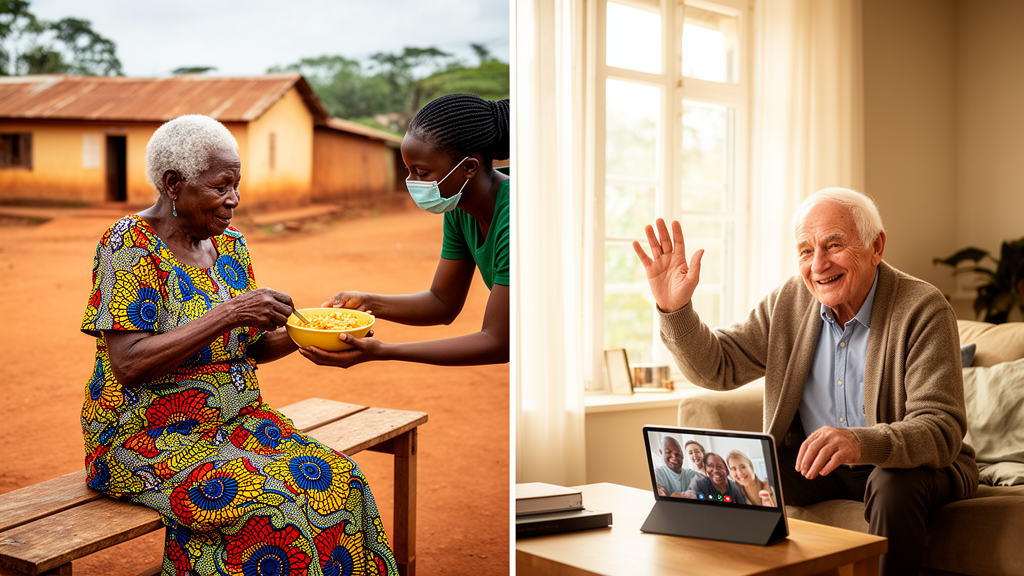
When COVID-19 swept across the globe in early 2020, no group faced graver danger than older adults. Age-related physiological vulnerabilities—diminished immune reserve, higher rates of chronic disease, and frailer respiratory systems—combined with forced social isolation to make people aged 65 and older the pandemic’s most exposed population. But the pandemic did not unfold identically everywhere. A new scoping review published in BMC Geriatrics by Clinton Kwemu Njakoi, Carine Njwengba Owajege, and Frankline Sevidzem Wirsiy offers one of the most detailed side-by-side comparisons yet of how two profoundly different nations protected—or failed to protect—their elders during the crisis: Cameroon, a lower-middle-income country in Central Africa, and the United States, the world’s largest high-income economy.
The study, conducted in strict accordance with the PRISMA-ScR reporting guidelines, systematically searched PubMed/MEDLINE, Scopus, and African Journals Online for peer-reviewed literature, legal acts, and official institutional frameworks published between January 2020 and February 2026. From this sweep, twenty-two unique sources met all predefined inclusion criteria. Rather than simply cataloguing what each country did, the researchers applied a structured SWOT analysis—examining strengths, weaknesses, opportunities, and threats—to distill the operational logic of each response. The result is a portrait of two systems that succeeded and failed in almost mirror-image ways.
Cameroon’s response, the authors found, drew its power from an unexpected reservoir: highly decentralized, resilient community and kinship networks. In a country where formal healthcare infrastructure is thin, extended families and neighborhood structures stepped into the breach, delivering information, food, and care to isolated elders. The government also moved quickly to provide immediate financial cushions, including a 20 percent expansion in state pensions that buffered older adults against the economic shock of lockdowns. These grassroots and fiscal measures formed the backbone of a mitigation strategy that, while modest in material terms, leveraged social capital that wealthier nations often struggle to mobilize.
Yet the same analysis laid bare the structural constraints that hobbled Cameroon’s efforts at every turn. Deep weaknesses in the healthcare system—chronic underfunding, shortages of personal protective equipment, and limited intensive care capacity—severely restricted what even the most resilient communities could achieve. Perhaps most striking was the human behavioral dimension: the review documented a 73 percent fear-driven clinical avoidance rate, meaning roughly three in four older adults who needed care stayed away from clinics and hospitals, often because they feared contracting the virus in healthcare settings or distrusted official messaging. Diagnostic capacity told a similar story of scarcity. At the height of the response, Cameroon conducted just 10.02 tests per 1,000 population—a figure so low that true infection levels remained largely invisible to policymakers trying to steer interventions.
Compounding these challenges, resource constraints were most acute precisely where vulnerability was greatest. Active conflict zones in parts of Cameroon disrupted supply chains, displaced older adults from their homes, and cut off access to even basic health services. In such settings, the pandemic was not a single crisis but a crisis layered atop existing humanitarian emergencies, and the review makes clear that no amount of community resilience could fully compensate for the absence of material supplies, testing infrastructure, and secure corridors for care delivery.
The United States presented a starkly different picture. Armed with massive technological capital, the country deployed real-time molecular surveillance networks that tracked viral variants and transmission patterns with a granularity unimaginable in most of the world. The rapid rollout of mRNA vaccines—developed at unprecedented speed using novel genetic-platform technology—produced what the review identifies as the single most consequential intervention of the entire pandemic for older adults: an estimated 92 percent of potential deaths among seniors were averted after vaccine implementation. Alongside vaccination, the United States massively expanded telehealth, with remote medical services ultimately serving 59 percent of isolated seniors, allowing continuity of chronic disease management, mental health support, and prescription renewals without exposing vulnerable patients to infection risk in waiting rooms.
But American technological prowess could not compensate for institutional failures closer to the ground. The review documents profound, catastrophic infection control breakdowns within long-term care facilities—nursing homes and assisted living centers that became epicenters of mortality, particularly in the pandemic’s early waves. Understaffing, inadequate personal protective equipment, and delayed isolation protocols allowed the virus to move through these congregate settings with devastating efficiency. The authors also highlight intense socio-political policy polarization, in which public health measures such as masking and vaccination became entangled in partisan identity, undermining consistent implementation across states. Deep-seated, institutionalized racial health inequities further meant that older adults from marginalized communities faced systematically worse access to testing, vaccination, and quality care despite living in one of the world’s wealthiest nations.
The comparative lesson the authors draw is deliberately uncomfortable for both rich and poor countries. High-income countries, they argue, can fail due to decentralization and polarization despite high GDP—technological capacity and money do not automatically translate into coherent protection for the most vulnerable. Lower-middle-income countries, meanwhile, can innovate remarkable forms of social resilience but remain strictly bottlenecked by material supply chains, diagnostic infrastructure, and pharmaceutical access. In other words, neither wealth nor community solidarity alone was sufficient; each system’s blind spots were the direct inverse of the other’s strengths.
This finding carries direct implications for how the world prepares for the next pandemic. The authors conclude that future global preparedness frameworks must systematically integrate targeted
Subject of Research: Comparative evaluation of COVID-19 public health interventions and management strategies for older adults in Cameroon and the United States using scoping review and SWOT analysis
Article Title: Comparative evaluation of COVID-19 public health interventions and management in older populations: a scoping review and swot analysis of Cameroon and the United States
Article References: Comparative evaluation of COVID-19 public health interventions and management in older populations: a scoping review and swot analysis of Cameroon and the United States. (n.d.). https://doi.org/10.1186/s12877-026-08467-7
Image Credits: AI Generated
DOI: 10.1186/s12877-026-08467-7
Keywords: COVID-19, older adults, Cameroon, United States, public health policy, SWOT analysis, health equity, pandemic preparedness, scoping review, geriatrics, global health, vaccine rollout
Cite Scienmag News
Kristina Jarvis. (October 16, 2026). How Cameroon and the United States Protected Their Elders During COVID-19: A Tale of Two Pandemics. Scienmag. https://scienmag.com/how-cameroon-and-the-united-states-protected-their-elders-during-covid-19-a-tale-of-two-pandemics/
Kristina Jarvis. "How Cameroon and the United States Protected Their Elders During COVID-19: A Tale of Two Pandemics." Scienmag, 16 October 2026, https://scienmag.com/how-cameroon-and-the-united-states-protected-their-elders-during-covid-19-a-tale-of-two-pandemics/. Accessed 16 October 2026.
Kristina Jarvis. "How Cameroon and the United States Protected Their Elders During COVID-19: A Tale of Two Pandemics." Scienmag. October 16, 2026. https://scienmag.com/how-cameroon-and-the-united-states-protected-their-elders-during-covid-19-a-tale-of-two-pandemics/


