


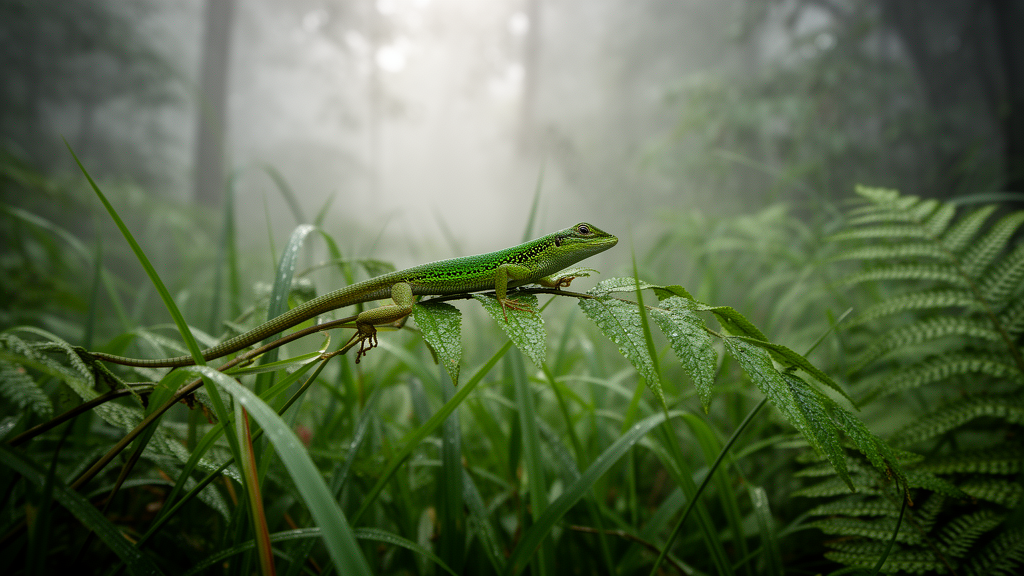
A slender grass lizard collected in the misty hills of Fangchenggang, in China’s Guangxi Zhuang Autonomous Region, has turned out to be something of a biological stowaway. Two specimens gathered during field surveys in 2025 have been identified as Takydromus kuehnei vietnamensis, a subspecies first described from northern Vietnam more than two decades ago and never before recorded on Chinese soil. The discovery, published in the journal Zoosystematics and Evolution, combines classic scale-counting taxonomy with modern DNA barcoding to redraw the map of one of Asia’s least-studied reptile lineages.
Asian grass lizards of the genus Takydromus are small, diurnal, egg-laying reptiles that dart through grass and shrub layers across East and Southeast Asia, from continental mainland forests to remote offshore islands. Twenty-six valid species are currently recognized worldwide, and sixteen of them occur in China, making the country a major hotspot for the group. Yet even in well-surveyed regions, the boundaries between species and subspecies remain murky, because many populations have been cataloged only at the species level without the finer morphological or genetic scrutiny needed to assign them to a particular subspecies.
That gap is precisely what the new study set out to close. Between May and October 2025, researchers captured three Takydromus specimens: two adults from Nasuo Town in Fangchenggang, Guangxi, and one from Ruyuan Yao Autonomous County in neighboring Guangdong Province. The Guangxi pair, an adult male and an adult female, were collected at low-elevation sites of 85 and 249 meters above sea level, while the Guangdong individual came from a hillside site at 833 meters. All three were fixed in ethanol and deposited in the zoological collection of Guangxi Normal University, where they became the raw material for a dual-pronged identification effort.
On the morphological front, the team examined nineteen external characters, from the number of supratemporal scales behind the eyes to the arrangement of ventral scale rows and the pattern of subdigital lamellae under the fourth toe. The two Fangchenggang lizards matched the diagnostic suite laid out in the original 1999 description of T. k. vietnamensis by Ziegler and Bischoff: the interparietal and occipital scales on top of the head are separated rather than touching, the supratemporal series is enlarged with a conspicuously expanded anterior scale, and the underside glows a distinctive cyan-green rather than the pale brownish-yellow seen in the nominate subspecies. Males also carry bold black flank blotches, while females show enlarged lower-flank scales and only faint markings.
Geography adds a compelling layer to the story. Nasuo Town and the subspecies’ type locality at the Ke Go Nature Reserve in Ha Tinh Province, Vietnam, both sit within the coastal zone of the Gulf of Tonkin, roughly 400 kilometers apart in a straight line. The terrain between them is continuous, with comparable elevational ranges and no prominent mountain barriers that would obviously block dispersal. In other words, the lizard’s presence in Guangxi is not a biological anomaly but exactly what one would expect if populations flowed freely across the Sino-Vietnamese border before political boundaries were ever drawn on a map.
To test that hypothesis genetically, the researchers extracted DNA from muscle tissue and amplified two mitochondrial markers, COI and Cyt b, using standard polymerase chain reaction protocols with published primer pairs. They then assembled a dataset of 44 samples spanning 1,819 base pairs, drawing on 38 sequences from GenBank alongside their three new specimens, and rooted the tree with the lacertid Eremias vermiculata as an outgroup. Phylogenetic reconstruction was carried out twice, once by maximum likelihood in IQ-TREE under the best-fit TVM+I+G model with 5,000 ultrafast bootstrap replicates, and once by Bayesian inference in MrBayes run for two million generations. Both methods produced topologies that agreed almost perfectly.
The verdict was unambiguous. The two Fangchenggang lizards formed a strongly supported monophyletic clade, with a Bayesian posterior probability of 1.00 and ultrafast bootstrap support of 100, and that clade sat as the sister lineage to T. k. kuehnei, the nominate subspecies found in Taiwan and southern mainland China. Uncorrected pairwise genetic distances between the Guangxi specimens and their closest relatives reached 6.4 to 7.9 percent for Cyt b and 8.2 to 11.5 percent for COI, figures that brush up against thresholds typically used to distinguish species within the genus. Across all eighteen congeners included in the comparison, divergence ranged as high as 22.4 percent for Cyt b and 24.7 percent for COI, underscoring how deeply differentiated this Vietnamese lineage truly is.
Despite that genetic depth, the authors stopped short of elevating T. k. vietnamensis to full species status, and their reasoning is a masterclass in cautious taxonomy. The morphological differences between the two subspecies are confined to continuous quantitative traits such as ventral coloration and head-scale proportions, with no fixed discrete characters that would justify a species-level split. The two lineages are geographically allopatric but connected by unbroken forest habitat across northern Vietnam, meaning no impassable barrier has historically prevented gene flow. And crucially, T. kuehnei as a whole remains a single well-defined monophyletic group; splitting the two clades into separate species would render the genus paraphyletic, a taxonomic no-no. Without nuclear genetic data or direct evidence of reproductive isolation, the subspecies rank stands.
The discovery also fills a glaring data vacuum. Before this study, no mitochondrial sequences existed for T. k. vietnamensis at all, meaning that every prior record from Vietnam, spanning Ha Tinh, Nghe An, Ninh Binh, Thanh Hoa, Bac Giang, Ha Giang, Son La, and Quang Binh provinces, rested entirely on morphological identification. The new COI and Cyt b sequences, now deposited in GenBank under accession numbers PZ869530, PZ869531, PZ869532, PZ879522, and PZ879523, provide the first molecular baseline for the taxon and open the door to future phylogeographic and conservation-genetic work across its entire range.
Ecologically, the two Guangxi lizards were found in secondary evergreen broad-leaved forest dense with shrubs, ferns, and vines, sharing the habitat with a cast of sympatric herpetofauna including the many-banded snake Ptyas multicincta, the oriental whip snake Ahaetulla prasina, the skink Sphenomorphus cryptotis, and two frog species, Odorrana graminea and Hylarana maosonensis. The finding extends the known distribution of T. k. vietnamensis northeastward into southern China and highlights how closely intertwined the biotas of the two countries remain. The authors call for intensified field surveys along the Sino-Vietnamese border and for multilocus nuclear analyses to pin down the precise boundary between the two subspecies, work that could ultimately determine whether this deep mitochondrial split eventually earns full species recognition.
Subject of Research: First record of the grass lizard subspecies Takydromus kuehnei vietnamensis in China based on morphological and mitochondrial DNA evidence
Article Title: Morphological and molecular evidence for the first occurrence of Takydromus kuehnei vietnamensis Ziegler & Bischoff, 1999 ( Squamata , Lacertidae ) in Guangxi, China
Article References: Morphological and molecular evidence for the first occurrence of Takydromus kuehnei vietnamensis Ziegler & Bischoff, 1999 ( Squamata , Lacertidae ) in Guangxi, China. (n.d.). https://doi.org/10.3897/zse.102.200057
Image Credits: AI Generated
Keywords: Takydromus kuehnei, grass lizards, Lacertidae, Guangxi, China, Vietnam, mitochondrial DNA, COI, Cyt b, phylogenetics, biogeography, new record
Cite Scienmag News
Juliet Wilcox. (October 16, 2026). Genetic Sleuthing Reveals a Vietnamese Grass Lizard Hiding in Southern China. Scienmag. https://scienmag.com/genetic-sleuthing-reveals-a-vietnamese-grass-lizard-hiding-in-southern-china/
Juliet Wilcox. "Genetic Sleuthing Reveals a Vietnamese Grass Lizard Hiding in Southern China." Scienmag, 16 October 2026, https://scienmag.com/genetic-sleuthing-reveals-a-vietnamese-grass-lizard-hiding-in-southern-china/. Accessed 16 October 2026.
Juliet Wilcox. "Genetic Sleuthing Reveals a Vietnamese Grass Lizard Hiding in Southern China." Scienmag. October 16, 2026. https://scienmag.com/genetic-sleuthing-reveals-a-vietnamese-grass-lizard-hiding-in-southern-china/


