


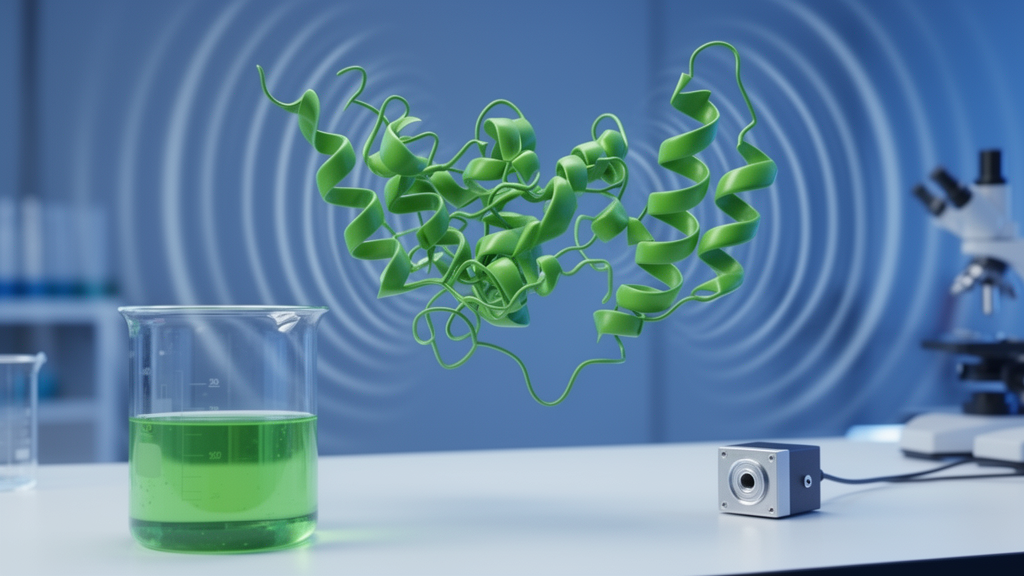
Plant proteins are the backbone of the booming alternative-food industry, yet most of them arrive at the factory floor with a stubborn handicap: their molecules are folded so tightly, and clumped so stubbornly, that they dissolve poorly, stabilize foams and emulsions weakly, and resist the digestive enzymes meant to break them down. A new review published in Frontiers in Soft Matter argues that the fix may come not from chemistry but from sound. Treating plant proteins with ultrasound, the authors show, can systematically re-engineer their structure across every scale that matters, from individual amino acid chains to the macroscopic texture of a burger or a plant-based yogurt.
The engine of this transformation is acoustic cavitation. When high-intensity sound waves pass through a protein suspension, they force microscopic bubbles to form, grow, and then collapse violently. Each collapse creates a fleeting hot spot of extreme temperature and pressure, accompanied by intense shear forces, shock waves, and microjets of liquid. These micro-events last only microseconds, but they deliver enough localized energy to pry apart the hydrogen bonds, hydrophobic interactions, electrostatic contacts, and disulfide linkages that hold a protein in its compact native shape. Crucially, because the energy is deposited in tiny, transient zones, the bulk of the liquid barely warms, making ultrasound a genuinely non-thermal technology that preserves heat-sensitive nutrients.
The review, authored by Gulcin Yildiz of Igdir University and Gökçen Yıldız of Bursa Technical University, frames ultrasound not as a mere processing aid but as a multiscale structural engineering tool. At the molecular level, cavitation partially unfolds protein chains, exposing functional groups that were previously buried inside. At the supramolecular level, large aggregates are shattered into smaller assemblies, and protein–protein interaction networks reorganize. At the colloidal scale, particle sizes shrink, surface charges shift, and dispersion stability improves. These levels are not independent; they form a continuous cascade in which energy input at the smallest scale ultimately determines whether a protein solution flows, gels, foams, or emulsifies at the largest.
The practical payoffs are striking. In soy protein, combining pH-shifting with ultrasonication produced nano-aggregates of roughly 22 nanometers and lifted solubility from a dismal 1.49 percent to 82.73 percent. Hemp protein isolates treated with ultrasound showed about a 3.7-fold increase in solubility, while lentil proteins gained up to roughly 90 percent more solubility after sonication or thermosonication. Faba bean proteins fragmented from aggregates of 370 nanometers down to 187 nanometers, reaching solubilities above 89 percent, and combining ultrasound with alkaline pH-shifting pushed faba bean solubility from around 12 percent to more than 95 percent. Even mung bean proteins underwent a dramatic micro-to-nano transition, with particles shrinking from 10.37 micrometers to 484 nanometers, improving solubility, emulsification, and oil-holding capacity in the process.
Not every protein responds the same way, however. The review emphasizes that plant protein isolates are heterogeneous mixtures of distinct fractions: soy contains 7S β-conglycinin and 11S glycinin, pea contains vicilin, legumin, and convicilin, and cereals contribute glutelins, prolamins, and albumin–globulin fractions, each with its own structural stability and susceptibility to cavitation. Rice protein, in particular, is a tough case. Its compact, rigid assemblies resist ultrasound-induced unfolding, and meaningful gains require synergistic treatments such as alkaline or thermal assistance. When ultrasound was combined with alkali treatment, rice protein solubility increased by up to roughly 230-fold, one of the largest enhancements reported, but ultrasound alone delivered only modest changes compared with the dramatic responses seen in legumes.
Perhaps the most important conceptual contribution of the review is the idea of an optimal cavitation window. Moderate ultrasound doses promote controlled unfolding, exposing hydrophobic and sulfhydryl groups in ways that enhance interfacial adsorption, gelation, and digestibility. Push past that window, however, and the same exposed hydrophobic regions begin to find each other, driving reaggregation and functional decline. The authors trace this non-linearity to a temporal race: cavitation bubbles collapse in microseconds, but proteins relax and refold over much longer timescales. When sufficient recovery time exists between cavitation pulses, proteins settle into favorable, functional conformations. Under prolonged or continuous sonication, proteins are perturbed again before they can relax, accumulating unfolding and hydrophobic exposure until uncontrolled aggregation wins.
The functional consequences ripple through every property food scientists care about. Emulsifying activity improved by roughly 1.5 to 1.7 times in hemp protein, and pea proteins formed nanoemulsions around 198 nanometers with improved oxidative stability. Lentil proteins stabilized high internal phase emulsions with smaller droplets and better rheological stability, while faba bean proteins produced oil-in-water emulsions with droplets below 0.4 micrometers, suitable as clean-label emulsifiers. Gelation benefited too: moderate cavitation fostered dense, elastic networks stabilized by hydrophobic interactions, hydrogen bonding, and disulfide linkages, raising gel hardness, water-holding capacity, and storage modulus in soy, chickpea, mung bean, and faba bean systems. Excessive sonication, by contrast, produced porous, weak gels with poor viscoelasticity.
Nutrition stands to gain as well. By loosening protein structure and exposing cleavage sites, ultrasound makes plant proteins more accessible to digestive enzymes, enhancing gastrointestinal hydrolysis and the release of bioactive peptides with antioxidant and antihypertensive properties. Rice protein digestibility reached approximately 96.9 percent under optimized ultrasound-assisted pretreatment, and chickpea proteins showed increased enzymatic accessibility along with improved antioxidant activity and gut microbiota modulation. Ultrasound also strengthens protein–biopolymer interactions: sonicated proteins form more stable complexes with polysaccharides such as pectin and inulin, and covalent conjugates with polyphenols such as curcumin and chlorogenic acid, opening routes to encapsulation systems and functional ingredients with enhanced antioxidant activity.
The technology also pays dividends upstream. Ultrasound-assisted extraction disrupts cell walls, improves mass transfer, and boosts solvent penetration into protein-rich plant matrices, cutting extraction time, solvent use, and energy consumption relative to conventional methods. Hemp seed protein extraction yields rose up to 2.1-fold, chickpea protein recovery increased by up to 47.28 percent when ultrasound was combined with pulsed electric fields, and pumpkin seed proteins showed the highest yields under alkaline extraction assisted by ultrasound. The review cautions, though, that excessive cavitation during extraction can trigger aggregation, oxidation, or loss of nutritional quality, so the same optimal-window logic applies to recovery processes as to functional modification.
Scaling all of this from the laboratory bench to the factory floor remains the central challenge. The authors identify persistent obstacles, including a lack of standardization of ultrasound parameters across different systems, incomplete understanding of energy efficiency and heat dissipation at industrial scale, matrix-dependent variability in product functionality, and limited real-time monitoring of structural transitions during processing. Scale-up often produces non-uniform energy distribution, undermining reproducibility. Their roadmap for the future includes integrating ultrasound with complementary technologies such as pulsed electric fields, cold plasma, and high-pressure processing; developing in situ monitoring tools that track unfolding and aggregation as it happens; deploying multiscale computational modeling alongside advanced spectroscopy; and designing continuous-flow ultrasound reactors with improved acoustic uniformity. If those pieces come together, the same sound waves that once seemed a niche laboratory trick could become the precision instrument that turns humble peas, beans, and seeds into the next generation of high-performance plant-based foods.
Subject of Research: Ultrasound-assisted multiscale structural modification of plant proteins and its effects on functionality
Article Title: Ultrasound-assisted multiscale structural engineering of plant proteins: mechanisms and structure–property relationships
Article References: Yildiz, G., & Yıldız, G. (2026). Ultrasound-assisted multiscale structural engineering of plant proteins: mechanisms and structure–property relationships. Frontiers in Soft Matter, 6, Article 1893101. https://doi.org/10.3389/frsfm.2026.1893101
Image Credits: AI Generated
DOI: 10.3389/frsfm.2026.1893101
Keywords: plant proteins, ultrasound, acoustic cavitation, food processing, solubility, emulsification, gelation, digestibility, soy protein, pea protein, sustainable food, non-thermal processing
Cite Scienmag News
Alan Morgan. (October 16, 2026). How Sound Waves Reshape Plant Proteins From Molecules to Meals. Scienmag. https://scienmag.com/how-sound-waves-reshape-plant-proteins-from-molecules-to-meals/
Alan Morgan. "How Sound Waves Reshape Plant Proteins From Molecules to Meals." Scienmag, 16 October 2026, https://scienmag.com/how-sound-waves-reshape-plant-proteins-from-molecules-to-meals/. Accessed 16 October 2026.
Alan Morgan. "How Sound Waves Reshape Plant Proteins From Molecules to Meals." Scienmag. October 16, 2026. https://scienmag.com/how-sound-waves-reshape-plant-proteins-from-molecules-to-meals/


