


Deep in the semi-arid landscapes of northern Tanzania, where the Eastern branch of the Great Rift Valley carves through the districts of Monduli and Babati, an international team of entomologists has completed one of the most detailed sandfly surveys the country has seen in over a decade. Their findings, published in African Invertebrates, document eight species of phlebotomine sandflies across six villages, including two proven vectors of visceral leishmaniasis and two species previously implicated in parasite transmission elsewhere in East Africa. The results paint a picture of a region where the ecological conditions for disease emergence may already be in place, even in areas not currently considered endemic.
Sandflies are tiny, hair-covered dipterans whose blood-feeding females are the sole natural vectors of Leishmania parasites, the protozoans responsible for a spectrum of diseases ranging from disfiguring cutaneous lesions to the potentially fatal visceral form known as kala-azar. Globally, leishmaniasis is endemic in nearly 100 countries, placing approximately 1.6 billion people at risk, with an estimated 12 million active infections. The disease ranks as the ninth-largest infectious disease burden worldwide, yet it disproportionately affects underserved populations with limited access to healthcare, diagnostics, and preventive tools. In East Africa, cutaneous, visceral, and post-kala-azar dermal leishmaniasis all occur, making the region a priority for vector surveillance.
Despite this burden, Tanzania has lacked current entomological data on its sandfly fauna. The only published survey over the past decade dates to 2013, leaving a critical gap in the information needed to assess disease risk and design control strategies. The new study, led by researchers working across the Arusha and Manyara Regions, aimed to fill this void by systematically documenting which sandfly species are present, where they occur, and what environmental factors drive their abundance.
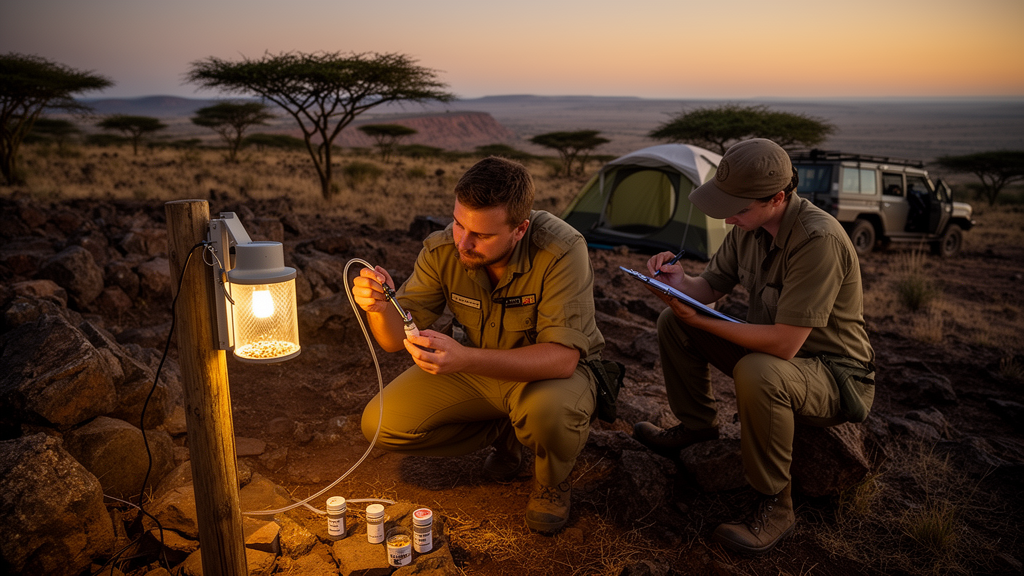
The research team selected one district from each region—Monduli in Arusha and Babati in Manyara—choosing two wards per district and six villages in total: Loto, Seloto, Magugu, Kigongoni, Migungani B, and Selela. Site selection was based on semi-arid conditions, proximity to protected areas, elevation, and patterns of human mobility. Sampling took place during the late wet season, from April to May 2022, using three complementary collection methods: CDC miniature light traps hung 0.3 metres above the ground and operated from 1800 to 0600 hours, castor-oil-coated sticky traps placed in diurnal resting spots such as termite hills, rock crevices, and house cracks, and manual aspiration during early morning and evening hours.
Over the course of the survey, the team collected 586 sandflies, comprising three genera and eight species. The overwhelming majority—97.78 percent—belonged to the genus Sergentomyia, with Sergentomyia antennata (49.49 percent) and Sergentomyia freetownensis (38.74 percent) dominating the catch. The remaining species included Se. schwetzi (4.61 percent), Se. bedfordi (3.75 percent), Se. adleri (1.19 percent), Grassomyia squamipleuris (0.68 percent), and, critically, two members of the genus Phlebotomus: Ph. martini (0.85 percent) and Ph. vansomerenae (0.68 percent). Both Phlebotomus species are recognised as competent vectors of visceral leishmaniasis in neighbouring Kenya, making their detection in the Tanzanian study area a significant finding for public health planning.
To understand what drives sandfly distributions, the researchers deployed a generalised linear model with a Poisson family to test the effects of habitat type, altitudinal range, average temperature, and average relative humidity on abundance. All four variables proved highly significant. Habitat type had the strongest effect (χ² = 71.6, df = 2, P < 0.001), with farmland hosting 295 specimens (50.34 percent of the total), peridomicile areas 252 (43 percent), and the human-wildlife interface just 39 (6.66 percent). The model showed that both peridomicile and the human-wildlife interface were significantly associated with reduced abundance relative to farmland, suggesting that agricultural areas—with their termite hills and rodent burrows—provide ideal breeding and resting conditions for these insects.
Altitude also played a decisive role. Mid-altitude sites (1000–1500 metres above sea level) yielded 451 specimens, low-altitude sites (<1000 metres) produced 133, and high-altitude areas (>1500 metres) yielded only two flies. The model confirmed that both low- and mid-altitude zones were significantly associated with increased abundance, while high-altitude areas—characterised by cooler temperatures and higher humidity—appear to impede sandfly persistence. Temperature and humidity themselves were significant predictors: across villages, temperatures ranged from 14.2°C to 28.1°C and relative humidity from 38 percent to 86 percent. Peak abundance occurred in Selela Village, where temperatures ranged from 23.2°C to 27.3°C and humidity from 51 to 64 percent, whereas Migungani B, with similar temperatures but higher humidity (69–82 percent), produced only two specimens.
Diversity patterns mirrored these abundance trends. Using the Shannon-Wiener index, the researchers found that farmland exhibited the highest diversity (H′ = 1.149), followed closely by peridomicile (H′ = 1.10), with the human-wildlife interface showing the lowest (H′ = 0.432). Among villages, Selela recorded the highest diversity (H′ = 1.127), followed by Kigongoni (H′ = 0.96) and Magugu (H′ = 0.428), while Migungani B, Loto, and Seloto each yielded only a single species and showed no measurable diversity. Jaccard’s similarity coefficients revealed that farmland and peridomicile communities were 75 percent similar, while mid- and low-altitude communities shared 75 percent of their species, suggesting that these environments support overlapping sandfly assemblages shaped by comparable microclimatic conditions.
The presence of Ph. martini and Ph. vansomerenae—proven vectors in Kenya—combined with the detection of Se. schwetzi and Gr. squamipleuris, species that have been found harbouring Leishmania donovani DNA in field-caught specimens in Kenya and Leishmania infantum in Senegal, raises concerns about the potential for transmission in areas currently considered non-endemic. Recent documentation of Leishmania amastigotes in rodents and lizards within the study area adds further weight to this concern. If a pathogenic parasite were introduced or already circulating, conditions appear favourable for outbreaks, particularly given the region’s tourism activity and human mobility patterns.
The researchers emphasise that their cross-sectional design, while providing valuable baseline data, cannot capture temporal variation in sandfly populations. They call for longitudinal studies to assess seasonal and spatial-temporal dynamics, alongside investigations into vectorial competence, bloodmeal sources, and biting patterns. For now, the identification of proven and suspected vector species in farmland and peridomicile settings—where farmers and residents are most likely to encounter them—provides critical information for health authorities and underscores the need for ongoing surveillance across Tanzania’s Rift Valley ecosystems.
Subject of Research: Ecology and distribution of phlebotomine sandfly vectors of leishmaniasis in Tanzania
Article Title: Occurrence and composition of Phlebotomine sandflies ( Diptera , Psychodidae ) in selected areas along the East Africa Great Rift Valley ecosystem, Tanzania
Article References: Samiji, A., Katakweba, A., Nzalawahe, J., & Mnyone, L. (2026). Occurrence and composition of Phlebotomine sandflies (Diptera, Psychodidae) in selected areas along the East Africa Great Rift Valley ecosystem, Tanzania. African Invertebrates, 67(1), 19-36. https://doi.org/10.3897/afrinvertebr.67.177295
Image Credits: AI Generated
DOI: 10.3897/AfrInvertebr.67.177295
Keywords: sandflies, leishmaniasis, Tanzania, Great Rift Valley, vector-borne disease, Phlebotomus, Sergentomyia, public health, entomology, East Africa, disease surveillance, tropical medicine
Cite Scienmag News
Phoebe Ingram. (October 16, 2026). Sandfly Survey Along Tanzania’s Great Rift Valley Reveals Leishmaniasis Vector Risk. Scienmag. https://scienmag.com/sandfly-survey-along-tanzanias-great-rift-valley-reveals-leishmaniasis-vector-risk/
Phoebe Ingram. "Sandfly Survey Along Tanzania’s Great Rift Valley Reveals Leishmaniasis Vector Risk." Scienmag, 16 October 2026, https://scienmag.com/sandfly-survey-along-tanzanias-great-rift-valley-reveals-leishmaniasis-vector-risk/. Accessed 16 October 2026.
Phoebe Ingram. "Sandfly Survey Along Tanzania’s Great Rift Valley Reveals Leishmaniasis Vector Risk." Scienmag. October 16, 2026. https://scienmag.com/sandfly-survey-along-tanzanias-great-rift-valley-reveals-leishmaniasis-vector-risk/


