


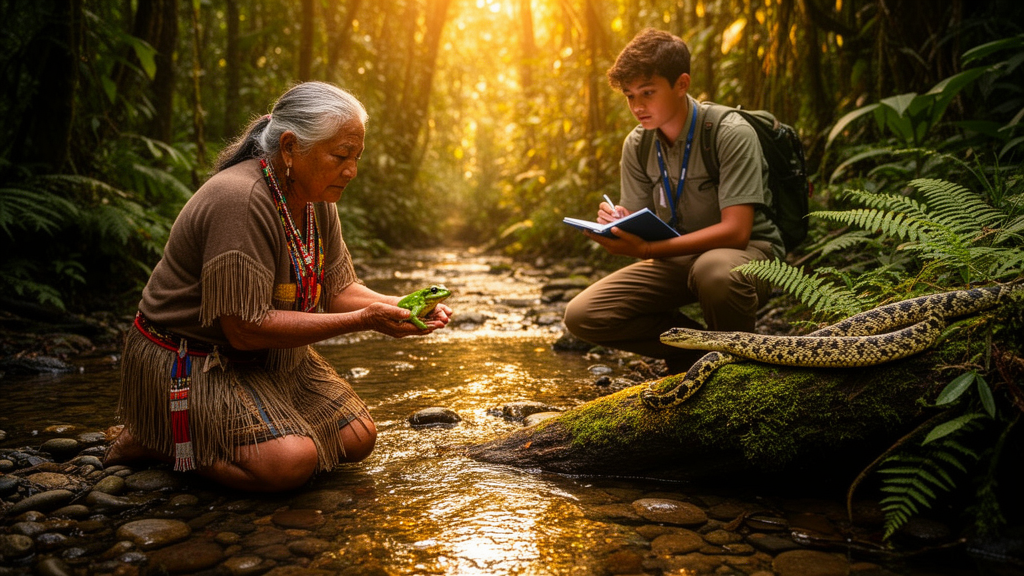
Amphibians and reptiles have long occupied a strange place in the human imagination: reviled in some traditions, revered in others, and almost always overlooked by mainstream conservation science. A new review published in Frontiers in Amphibian and Reptile Science argues that this neglect is not just a cultural blind spot but a scientific one, with real consequences for biodiversity. Drawing on literature in 19 languages, conversational interviews with South African traditional health practitioners and Indigenous hunters, and personal narratives from Indigenous knowledge custodians on five continents, an international team of researchers and community members makes the case that frogs, snakes, turtles, and crocodiles are simultaneously cultural symbols, ecological sentinels, and keystone species, and that a truly effective One Health framework must finally give them, and the peoples who know them best, a seat at the table.
One Health is an integrated approach that aims to balance the health of people, animals, and ecosystems, and it has gained enormous traction since the COVID-19 pandemic highlighted the entanglement of human, animal, and environmental wellbeing. Yet the authors identify two persistent shortcomings. First, herpetofauna are routinely left out of One Health research, partly because amphibians and reptiles are rarely treated as charismatic focal species and partly because the health implications of human-herptile and herptile-ecosystem interactions remain poorly quantified. Second, One Health is too often framed as an exclusively Western, systems-science concept, ignoring the fact that Indigenous and ancestral cultures have maintained precisely this kind of integrated relationship with the natural world for centuries. The new paper, led by Ashley Morgan of the University of Tennessee’s One Health Initiative and Fortunate Mafeta Phaka of North-West University in South Africa, sets out to correct both omissions at once.
The evidence base is unusually broad. The team reviewed 119 sources, including 61 journal articles and 34 books, in languages ranging from IsiZulu and SeTswana to Javanese, Lithuanian, and Irish Gaelic. They supplemented this with flexible conversational interviews conducted between November 2024 and March 2025 with 19 adult male participants in South Africa, and with autoethnographies, first-person accounts, from Indigenous co-authors including Jywateju Kayabi and Iauapuru Trumai of the Xingu Indigenous Territory in Brazil, situated between the Cerrado and the Amazon. The result is a mosaic of human-herptile relationships spanning southern African clans, Balinese temples, Hopi ceremonies, and Xingu body painting traditions.
Among the most striking findings is the depth of totemic kinship in southern Africa. For the Majola clans of the AmaXhosa, the Mole Snake (Pseudaspis cana) is not merely a symbol but a relative: clan members address one another by the snake’s IsiXhosa name as a term of respect and endearment. The Nile Crocodile (Crocodylus niloticus) serves as a totem for AmaZulu, BaPedi, BaSotho, and VaTsonga communities, while the BaPedi hold the tortoise sacred. Crucially, totemism carries practical conservation weight, because members of clans are culturally obliged to protect the herptiles considered members of their own kin group. Children grow up associating the totem’s name with their family, embedding stewardship obligations into identity itself, a mechanism that no protected-area designation can replicate.
Rain symbolism emerges as perhaps the most widespread cultural pattern. BaPedi communities read Nile Crocodile signs as portents of rain, the KhoiSan regard certain tortoise species as rain symbols, and frogs herald coming rains for the AmaZulu, VhaVhenda, and KhoiSan alike. Some traditions go further: VaTsonga lore holds that bullfrogs literally rain from the sky during heavy storms, and the AmaZulu tell a similar story about African Clawed Frogs while attributing lightning strikes to toads of the genus Sclerophrys. Frogs and monitor lizards and pythons are even used in rain-summoning rituals. On the other side of the planet, the Hopi of northeastern Arizona perform the biennial, 16-day Snake Dance, handling live rattlesnakes as messengers between the people and the rain spirits, a ceremony of reverence that reinforces both spiritual continuity and, implicitly, the protection of snake habitat in an arid landscape where water is life.
The Brazilian autoethnographies reveal how deeply herptiles are woven into body, story, and rite. Kayabi describes how the Kawaiwete people paint themselves with frog motifs using jenipapo and annatto dyes during festivals and political mobilizations, and how turtle shells become the spinning discs of cotton spindles and children’s rattles. Trumai accounts explain that the dark markings around an anaconda’s eyes, said to be its tears, inspire the sacred body paint worn by young men emerging from puberty seclusion, a rite that can last months or years. In one traditional story, a betrayed man tricks his unfaithful cousin into eating fish containing pieces of anaconda and lizard tail, transforming him into the giant snake whose descendants will one day surrender their spiritual strength to young warriors. These narratives do more than entertain; they encode ethics, ecological knowledge, and the rules governing who may use which animal symbols.
Europe’s ancestral traditions, though largely obscured by centuries of religious conversion and cultural assimilation, tell a parallel story. Stylized frog images appear on prehistoric pottery, and frogs were believed to guard springs and water sources. In pre-Christian Lithuania, the toad was sacred to Ragana, goddess of death and regeneration, and toad-with-lily motifs were carved into wooden tombstones called krikštai, with a strikingly similar motif found on a Neolithic statuette from Sesklo in Greece dating to around 6,000 BC. In Croatian and Czech villages, ritualized frog dances were performed into the 1970s to ensure the fertility of fields, cattle, and people, and Polish and Croatian words for frog, boginka and bogińa, literally mean goddess. Grass snakes, meanwhile, lived for centuries in close proximity to European farmers because manure heaps provided ideal egg incubation sites, earning the snakes a reputation as protectors of livestock and symbols of agricultural prosperity, a bond that collapsed with industrial farming and may now contribute to grass snake declines.
The paper’s ecological core lies in its treatment of herptiles as sentinels and ecosystem engineers. Because amphibians have permeable skin and complex life cycles spanning water and land, they are exquisitely sensitive to environmental change, and Indigenous communities have long read them this way. The VhaVhenda of South Africa regard frogs and turtles as extensions of sacred freshwater systems, monitoring their presence as indicators of wetland health. In British Columbia, Indigenous Peoples reported declines in the Oregon spotted frog ahead of formal scientific recognition, because episodic population dips escaped standardized surveys but not long-term local observation. In Mexico, Nahua farmers use the presence of certain snakes and lizards to assess soil moisture and fertility, and Maya communities maintain integrated multi-trophic aquaculture systems, with canals at Edzná still supporting herptile biodiversity today. In Mexico City’s Xochimilco, the Chinampa Refugio project fuses Aztec-era chinampa farming with modern biofiltration to protect the critically endangered axolotl, an approach that has succeeded where captive breeding alone has faltered.
The evidence for collaboration is compelling. A recent study pairing Laurentian University researchers with Shawanaga and Magnetawan First Nations in Ontario found that reptiles and amphibians accounted for 87 percent of wildlife mortalities along railways bisecting traditional territories, including seven species at risk. In Oaxaca, Mexico, the state with the largest Indigenous and Community Conservation Area at nearly 1,300 square kilometers, Indigenous-led sustainable land management has expanded species ranges and even led to the rediscovery of the Brokencollar Graceful Brown Snake, undetected for more than 50 years. Among the Cherokee, cultural valuation of the gopher tortoise as a keystone species sustains prescribed burning and burrow monitoring that benefit dozens of commensal animals. And in the Netherlands, conservationists are deliberately reinstating the traditional manure heap, with more than 80 citizen-science working groups reporting over 300,000 grass snake eggs since 2016, a modern echo of an ancient human-reptile partnership.
The authors are candid about limits: their synthesis covers a subset of communities and simplifies a far more complex mosaic of Indigenous nations and languages, and the patterns should be read as illustrative rather than a unified Indigenous perspective. But the central argument stands. Negative folklore, such as snakes killed on sight as bad omens or geckos exterminated from homes, drives persecution, while reverence and taboo can act as de facto protections for sacred forests and temple serpents. Bridging these worldviews, the authors contend, requires an One Health paradigm that treats Indigenous Ways of Knowing not as decorative add-ons but as co-equal knowledge systems, in what philosopher Isabelle Stengers calls an ecology of practices where different ways of knowing coexist without one dominating. As Kayabi observes, in the past frogs and toads spoke with humans, but people no longer understand the language of animals. Perhaps, the paper suggests, herptiles are still communicating their significance, and calling for their own conservation, in other ways, if only we learn to listen.
Subject of Research: Integrating Indigenous and ancestral knowledge of amphibians and reptiles into One Health conservation
Article Title: Culture and conservation: a One Health approach to Indigenous and ancestral herptile knowledge
Article References: Culture and conservation: a One Health approach to Indigenous and ancestral herptile knowledge. (n.d.). https://doi.org/10.3389/famrs.2026.1766675
Image Credits: AI Generated
DOI: 10.3389/famrs.2026.1766675
Keywords: One Health, herpetofauna, Indigenous knowledge, ethnoherpetology, conservation, totemism, amphibians, reptiles, traditional ecological knowledge, biodiversity, cultural heritage, ecosystem sentinels
Cite Scienmag News
Margaret Porter. (October 16, 2026). Frogs, snakes and sacred knowledge: Indigenous wisdom reshapes One Health conservation. Scienmag. https://scienmag.com/frogs-snakes-and-sacred-knowledge-indigenous-wisdom-reshapes-one-health-conservation/
Margaret Porter. "Frogs, snakes and sacred knowledge: Indigenous wisdom reshapes One Health conservation." Scienmag, 16 October 2026, https://scienmag.com/frogs-snakes-and-sacred-knowledge-indigenous-wisdom-reshapes-one-health-conservation/. Accessed 16 October 2026.
Margaret Porter. "Frogs, snakes and sacred knowledge: Indigenous wisdom reshapes One Health conservation." Scienmag. October 16, 2026. https://scienmag.com/frogs-snakes-and-sacred-knowledge-indigenous-wisdom-reshapes-one-health-conservation/


