


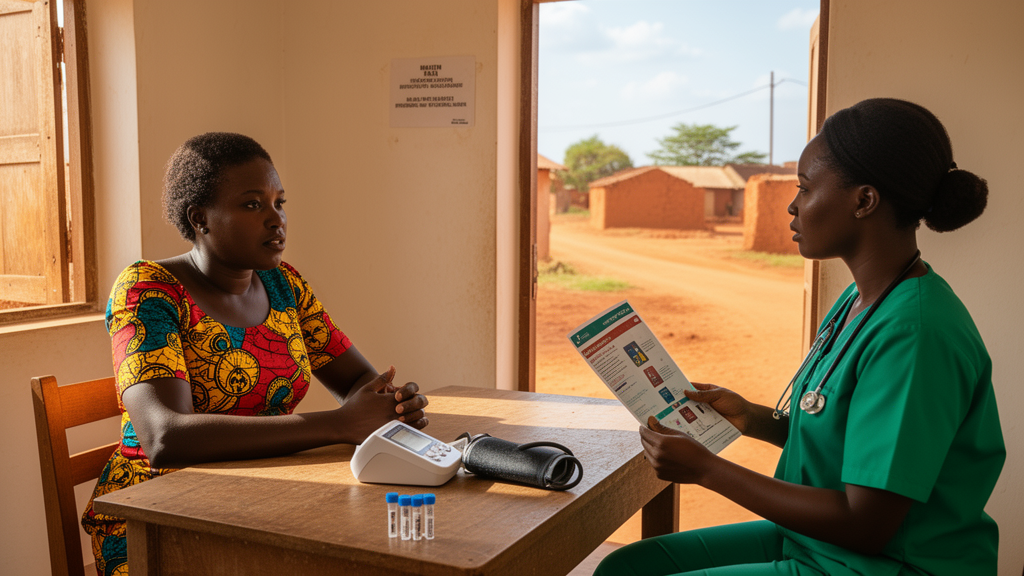
Women in Ghana who can refuse unwanted sex and negotiate condom use with their partners are roughly twice as likely to have been screened for breast and cervical cancer, according to a new national analysis, but the protective power of that personal agency appears to falter in rural areas where clinics are distant, costs are high, and awareness of screening remains thin. The study, published in Frontiers in Cancer Control and Society, draws on the 2022 Ghana Demographic and Health Survey and offers one of the most detailed pictures yet of how women’s empowerment and geography interact to shape cancer prevention in West Africa.
The research team, led by Benjamin Ansah Dortey of the Trauma and Specialist Hospital in Winneba and including investigators from the University of Ghana and C.K. Tedam University of Technology and Applied Sciences, analysed responses from a weighted sample of 8,044 women aged 15 to 49 years, surveyed across all sixteen regions of Ghana between October 2022 and January 2023. The team focused on women for whom the survey’s sexual autonomy questions were applicable, excluding those who had never had a husband or sexual partner and those with missing or ambiguous responses on key variables.
Sexual autonomy, as the researchers defined it, is a woman’s ability to negotiate sexual activity and refuse unwanted sex. The survey measured it with three items: whether a respondent can refuse sex, whether she can ask her partner to use a condom, and whether a wife is justified in asking her husband to use a condom if he has a sexually transmitted infection. Women scoring two or three on the composite index were classified as having sexual autonomy, while those scoring zero or one were not. By this measure, 79 percent of the women in the study possessed sexual autonomy, though the figure was markedly higher in urban areas, where 93.5 percent of women qualified, than in rural areas, where the proportion fell to 86.5 percent.
The scale of unmet screening need in Ghana is stark. The country has no national breast or cervical cancer screening programme, so screening is opportunistic and uptake is low. A further analysis of the same 2022 survey found that only 18.4 percent of women of reproductive age had ever been screened for breast cancer and just 5 percent for cervical cancer. In the current study, 20.9 percent of participants reported ever having had a breast examination for cancer, rising to 27.8 percent among urban women but falling to 13.6 percent among rural women. Cervical cancer screening was even rarer: 6.4 percent overall, with 9.1 percent of urban women and only 3.5 percent of rural women reporting ever having been tested.
The disease burden behind these numbers is severe. In 2022, breast cancer accounted for roughly 2.3 million cases and 666,103 deaths worldwide, while cervical cancer caused an estimated 662,301 cases and 348,874 deaths, with incidence and mortality disproportionately concentrated in low- and middle-income countries. Africa recorded 198,553 breast cancer cases with 91,252 deaths and 80,614 cervical cancer cases with 125,699 deaths that year, the high cervical mortality reflecting late-stage diagnoses and limited access to treatment. West Africa recorded the second-highest breast cancer incidence on the continent at 37.3 per 100,000 women and the highest mortality rate at 17.8 per 100,000. In Ghana specifically, breast cancer incidence climbed from 23.8 per 100,000 women in 2008 to 37.8 per 100,000 in 2018, and the disease accounts for 12.4 percent of all cancer deaths among Ghanaian women, with a case fatality rate of roughly 50 percent among the 4,645 women diagnosed in 2020. Cervical cancer, the second most common cancer among Ghanaian women, strikes an estimated 2,797 women annually, and approximately 60 percent of them die from the disease.
Against this backdrop, the statistical findings carry weight. After adjusting for age, education, wealth, religion, employment, region, contraceptive use, and media exposure, women with sexual autonomy had roughly twice the odds of having been screened for breast cancer compared with women without it, with an adjusted odds ratio of 2.10. For cervical cancer screening, the overall adjusted odds ratio was 1.95. When the researchers stratified the analysis by place of residence, a pattern emerged that they describe as the study’s central contribution. For breast cancer screening, sexual autonomy was associated with higher odds in both urban and rural settings, at 2.16 and 1.92 respectively, with the association somewhat stronger among urban women. For cervical cancer screening, however, sexual autonomy was a statistically significant predictor only in urban areas, with an adjusted odds ratio of 2.06, while the rural estimate of 1.66 did not reach statistical significance.
The researchers tested an interaction term between sexual autonomy and place of residence and found it statistically significant, formally justifying the stratified analysis. Agency theory offers a framework for interpreting the results: women with greater decision-making power are better able to initiate preventive health behaviours through increased self-efficacy, reduced dependence on partner permission, and improved communication with health providers. Prior studies support this pathway, showing that sexually autonomous women are more likely to use contraceptives, and a case-control study in Addis Ababa, Ethiopia, found that women with sexual autonomy were approximately three times more likely to screen for cervical cancer. The authors hypothesise that where sexual autonomy is lower, particularly in rural areas, its effect on preventive health behaviour may be attenuated by structural and social barriers, which could explain why the association disappeared for cervical screening in rural Ghana.
The study also identified a broader constellation of factors tied to screening uptake. The odds of breast cancer screening rose steadily with age, with women aged 45 to 49 showing adjusted odds of 4.58 compared with those aged 15 to 19. Higher education mattered enormously: women with higher education had 4.07 times the odds of breast cancer screening and 2.93 times the odds of cervical cancer screening compared with women with no education, and the education gradient was even steeper in rural areas, where women with higher education showed 5.53 times the odds of breast screening. Wealth followed a similar pattern, with women in the richest quintile showing 3.37 times the odds of breast screening and 3.58 times the odds of cervical screening relative to the poorest. Media exposure also played a role, but in strikingly different ways across settings: newspaper reading and television viewing predicted screening in urban areas, while radio listenership was the significant predictor in rural areas, likely reflecting higher rural radio penetration.
The authors are careful about the limits of their evidence. Both screening status and sexual autonomy were self-reported, opening the door to recall bias on screening and social desirability bias on autonomy responses. The composite autonomy index mixes items measuring individual behaviour with a normative item about justification, introducing some heterogeneity in the construct. The screening questions asked whether a woman had ever been screened, with no time limit, potentially capturing outdated behaviours, and the cross-sectional design precludes any causal inference. The sample was also restricted to women with complete and applicable data, which may introduce selection bias.
Nevertheless, the policy implications are clear. The authors argue that interventions to improve screening uptake should address sexual autonomy alongside location-specific barriers, particularly in rural areas where cervical cancer screening remains suboptimal. They recommend community-based health education, subsidisation of screening costs, deployment of mobile and outreach services, and integration of cancer screening into primary and antenatal care. The divergent media findings suggest radio-based community outreach for rural populations and mass media campaigns for urban ones. With Ghana’s cervical cancer incidence of 35.4 per 100,000 women far exceeding the Sustainable Development Goal target of below 4 per 100,000, and with a substantial minority of women still unable to refuse sex or insist on condom use, the study underscores that closing the rural screening gap will require tackling both the structures that limit access to care and the social norms that limit women’s power to seek it.
Subject of Research: The association between women's sexual autonomy and uptake of breast and cervical cancer screening in rural and urban Ghana
Article Title: Rural-urban differences and association of sexual autonomy with uptake of breast and cervical cancer screening services among women of reproductive age in Ghana
Article References: Dortey, B. A., Alor, S. K., Anaba, E. A., Ofori, C. A. E., Salifu, Y., Yanney, H. E., & Akazili, J. (2026). Rural-urban differences and association of sexual autonomy with uptake of breast and cervical cancer screening services among women of reproductive age in Ghana. Frontiers in Cancer Control and Society, 4, Article 1873354. https://doi.org/10.3389/fcacs.2026.1873354
Image Credits: AI Generated
DOI: 10.3389/fcacs.2026.1873354
Keywords: sexual autonomy, breast cancer screening, cervical cancer screening, Ghana, rural-urban disparities, women's health, Demographic and Health Survey, sub-Saharan Africa, health-seeking behaviour, cancer prevention, women's empowerment, health equity
Cite Scienmag News
Nathaniel Bowman. (October 16, 2026). Sexual Autonomy Doubles Cancer Screening Odds for Ghanaian Women, but Rural Gaps Persist. Scienmag. https://scienmag.com/sexual-autonomy-doubles-cancer-screening-odds-for-ghanaian-women-but-rural-gaps-persist/
Nathaniel Bowman. "Sexual Autonomy Doubles Cancer Screening Odds for Ghanaian Women, but Rural Gaps Persist." Scienmag, 16 October 2026, https://scienmag.com/sexual-autonomy-doubles-cancer-screening-odds-for-ghanaian-women-but-rural-gaps-persist/. Accessed 16 October 2026.
Nathaniel Bowman. "Sexual Autonomy Doubles Cancer Screening Odds for Ghanaian Women, but Rural Gaps Persist." Scienmag. October 16, 2026. https://scienmag.com/sexual-autonomy-doubles-cancer-screening-odds-for-ghanaian-women-but-rural-gaps-persist/


