


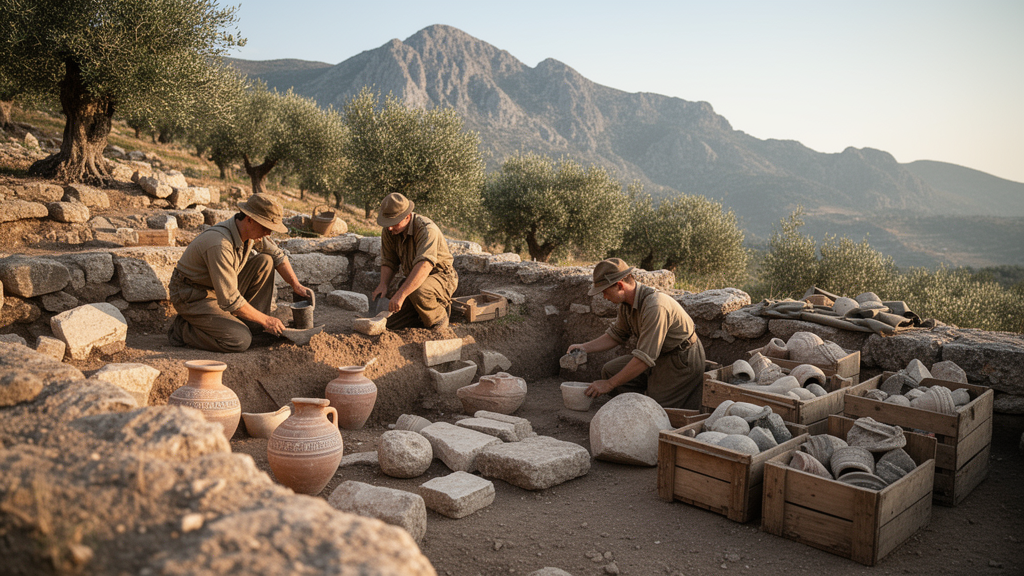
In the spring of 1942, while Nazi Germany’s war machine was grinding across Europe, a small group of botanists and zoologists from Berlin and Vienna boarded a military train at Vienna’s Südbahnhof and set off for the Greek island of Crete. Their journey, which lasted from 13 April to 29 July 1942, was no ordinary scientific expedition. It was organized and carried out by the German Wehrmacht, which provided transport, accommodation, armed escorts, rations, fuel and access to places that would otherwise have been unreachable. A new study published in the Annals of the Natural History Museum Vienna examines how this military occupation of an entire island became the decisive precondition for scientific success, revealing in unprecedented detail how collecting functioned as a scientific, social and political activity in wartime.
The expedition was led by the Berlin plant geneticist Hans Stubbe of the Kaiser Wilhelm Institute for Biology in Berlin-Dahlem, who had already conducted a collecting trip to the Balkans in 1941. Stubbe’s ambitions were tied to the planned founding of a dedicated Kaiser Wilhelm Institute for Crop Plant Research, which would eventually be established in Vienna in 1943. His collecting trips were meant to legitimize that institute, and they were framed in explicitly economic terms. In a March 1942 application to the German Research Foundation, Stubbe stated that the goal was to collect wild forms of crop plants of decisive importance for breeding, particularly in the German East, tying the expedition directly to the agricultural economics of the Nazi war of annihilation against the Soviet Union.
The scientific paradigm behind these efforts traced back to the Soviet geneticist Nikolai Vavilov, whose theory of centers of origin identified the Mediterranean as a key region for the wild ancestors of cultivated plants. Plant breeding researchers hoped that wild and primitive forms, with their resistance to pests and drought, could provide the genetic foundations for raising agricultural productivity in an autarkic wartime economy. Stubbe’s 1941 Balkan expedition, funded with 10,000 Reichsmark by the Reich Research Council just days after its application, had already yielded more than 2,000 seed samples and 2,000 herbarium specimens, collected by a nineteen-person team formally subordinated to the military and traveling with three cars and a truck.
On the Austrian side, the driving force was the zoologist Otto Wettstein, curator of the herpetological collection at the Natural History Museum Vienna. Wettstein had long pursued research on the Aegean islands, and after the German occupation of Greece in April 1941 he immediately recognized the military situation as a unique scientific resource. In May 1941 he applied for a collecting trip to three Aegean islands to shoot wild goats, noting that under normal circumstances collecting permits for these protected animals were impossible to obtain and that the occupation offered an opportunity that might never come again. Although Viennese authorities rejected that application as premature, Wettstein persisted, and by early 1942 he had secured a place on the Crete expedition, bringing with him two colleagues from the Vienna museum: the botanist Karl Heinz Rechinger and the ornithologist Günther Niethammer, who had previously served as a guard at the Auschwitz concentration camp and joined the expedition seconded from the SS.
The expedition team was formally integrated into the Wehrmacht for the duration of the trip. Some participants, like Wettstein, held the rank of war administration councillor only during the journey, while others, like Rechinger, were seconded from their existing military units. The group split into two parties: one, including Wettstein, Rechinger and Stubbe, traveled to Crete, while a second group worked on the Peloponnese. On Crete the team, which Stubbe called the Biological Research Detachment, was placed under the staff of the fortress commander, General Alexander Andrae, who provided vehicles, soldiers as helpers, and even a confiscated villa near Chania as accommodation. That villa, Bella Campagna, had belonged to the Greek olive magnate Alexander Manos, who was denounced as pro-British and lost his estate and a private library of 3,000 volumes.
The researchers’ travel diaries reveal how thoroughly the military infrastructure shaped their work. Wettstein marveled at the profligate use of aviation fuel when the group was flown 160 kilometers across the island because a bus lacked petrol, and he noted that the soldiers accompanying the detachment were indispensable: without the preparator Bernhard Mihan, he wrote, his yield would have been only half as large. The team also benefited directly from the brutality of the occupation. In April 1942 Wettstein recorded that near the village of Fournes, where a settlement had been blown up and its male population shot as reprisal for resistance, the military had confiscated the orange groves of the executed inhabitants, and the researchers filled an enormous sack with fruit. The executions referenced were part of German reprisals that would later be classified as war crimes under international law.
The Greek population itself also assisted the researchers, sometimes willingly, sometimes under the implicit duress of armed escorts. Local civilians drove the pack animals, up to fifteen donkeys and horses at a time, that carried the team into otherwise inaccessible mountain regions. Children guided the botanists through the mountains and carried more than the adults. A pharmacist in Sitia gave Wettstein an exceptionally rare giant scorpion as a gift, and a Greek doctor brought the team a snake he considered special. Yet the researchers’ diaries also document the famine gripping Greece, with Rechinger recording people begging for bread and lying unconscious or dead on the streets of Saloniki, and noting that local helpers refused money and accepted only bread, cigarettes or canned goods as payment, because the occupation economy had rendered currency nearly worthless.
The expedition’s scientific output was substantial. Rechinger collected 3,427 herbarium specimens and reported 80 new plant species, 42 of them new to Crete. Wettstein returned to Vienna with twelve crates of material, including 77 mammals, 161 birds, roughly 300 amphibians and reptiles, and around 1,000 each of arthropods and snails. His later publications described numerous new subspecies, including a gecko he named after the expedition leader, and his 1953 herpetological masterpiece on the Aegean drew heavily on the 1942 collections. By August 1944, fourteen scientific articles based on the expedition had been written, nine of them already published, more than half concerning Crete. The expedition also cemented research networks that persisted well beyond 1945 and advanced the careers of its participants, most notably Rechinger, who became director of the Vienna museum, and Wettstein, whose Aegean research was crowned by the Cretan material.
Yet the expedition also exposed the limits of what military power could deliver for science. The team’s most coveted prize, the wild goats of Crete, proved elusive. Although the Wehrmacht High Command had explicitly lifted its own protection order to allow the researchers to shoot Bezoar goats for German museums, General Andrae refused to permit further killings, telling the zoologists they could observe the animals as much as they liked but not shoot them. Wettstein fumed in his diary that the hunt had completely failed. The team then drafted a memorandum proposing conservation measures for the remaining 80 to 100 wild goats, but framed them in the racial-political language of the regime, warning against the bastardization of the wild stock with feral domestic goats and demanding German control of hunting protection, while denouncing a local family for allegedly possessing hidden weapons.
The study shows that the military occupation of a territory was not merely a backdrop but a constitutive condition for scientific success. The researchers, formally part of the occupying apparatus, could take without asking, receive gifts without payment, shoot animals in populated areas, and demand support from a population suffering under occupation, famine and reprisals. They witnessed German war crimes, including the destruction of villages and the execution of civilians, and in at least one instance they themselves acted with military police authority, disarming and detaining a group that turned out to be a German special unit. The expedition, the author concludes, was the continuation of a long research tradition by other means, one that allowed German and Austrian scientists to maintain their dominant position in the study of Cretan flora and fauna precisely because the Nazi war machine had opened the island to them.
Subject of Research: A 1942 German Wehrmacht-backed botanical and zoological collecting expedition to Nazi-occupied Crete and the Peloponnese and its scientific and political consequences
Article Title: Die Fortsetzung des Sammelns mit anderen Mitteln. Aufsammeln im Rahmen der Deutschen Wehrmachtsexpedition nach Kreta 1942
Article References: Mayer, T. (2026). Die Fortsetzung des Sammelns mit anderen Mitteln. Aufsammeln im Rahmen der Deutschen Wehrmachtsexpedition nach Kreta 1942. Annals of the Natural History Museum Vienna, 127, 39-68. https://doi.org/10.3897/anhmw.166676
Image Credits: AI Generated
DOI: 10.3897/anhmw.166676
Keywords: history of science, Crete 1942, Wehrmacht expedition, Nazi occupation, museum collections, botany, zoology, Otto Wettstein, Karl Heinz Rechinger, Hans Stubbe, wild goats, provenance research
Cite Scienmag News
Alan Morgan. (October 16, 2026). How Nazi-Occupied Crete Became a Scientific Goldmine for Berlin and Vienna. Scienmag. https://scienmag.com/how-nazi-occupied-crete-became-a-scientific-goldmine-for-berlin-and-vienna/
Alan Morgan. "How Nazi-Occupied Crete Became a Scientific Goldmine for Berlin and Vienna." Scienmag, 16 October 2026, https://scienmag.com/how-nazi-occupied-crete-became-a-scientific-goldmine-for-berlin-and-vienna/. Accessed 16 October 2026.
Alan Morgan. "How Nazi-Occupied Crete Became a Scientific Goldmine for Berlin and Vienna." Scienmag. October 16, 2026. https://scienmag.com/how-nazi-occupied-crete-became-a-scientific-goldmine-for-berlin-and-vienna/


