


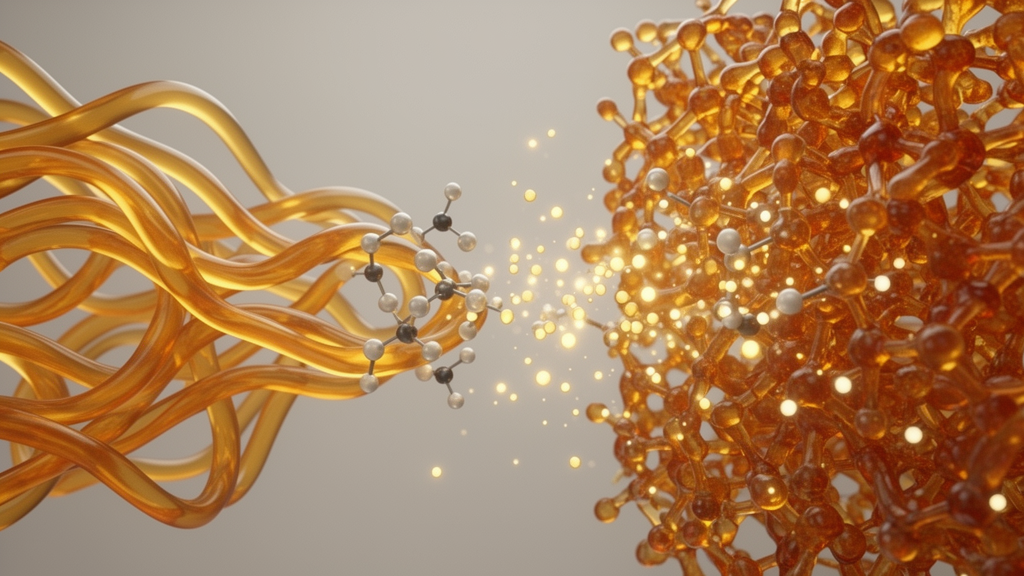
Vitrimers have quietly become one of the most tantalizing materials in modern polymer science. Since their introduction in 2011, these covalent network polymers have promised something that once seemed contradictory: plastics that behave like thermosets—tough, stable, heat resistant—yet can be reprocessed and reshaped like thermoplastics. The secret lies in dynamic covalent bonds that can exchange partners over time, allowing the network to flow without ever truly melting. But vitrimers have also harbored a deep puzzle that has frustrated theorists and experimentalists alike: their viscosity and their structural relaxation, which are tightly linked in ordinary glass-forming liquids, can become almost entirely decoupled in these materials. A new study published in Nature Physics by Makayla R. Branham-Ferrari and David S. Simmons at the University of South Florida, together with Shinian Cheng and Alexei P. Sokolov at the University of Tennessee and Oak Ridge National Laboratory, now offers a compelling explanation for this anomaly, and in doing so lays a foundation for the rational design of next-generation recyclable plastics.
The heart of the mystery lies in a strange combination of behaviors. In typical glass-forming liquids, viscosity follows the structural relaxation time: as the material approaches its glass transition, both quantities grow in a super-Arrhenius fashion, meaning their temperature dependence becomes steeper than a simple exponential activation law. Vitrimers break this rule. Their viscosity often displays clean Arrhenius behavior—a straight-line exponential dependence on inverse temperature—even while the underlying segmental dynamics of the polymer chains remain stubbornly super-Arrhenius. This decoupling is not a minor curiosity. It is precisely what makes vitrimers attractive for applications: the Arrhenius viscosity means the material can be processed at manageable temperatures while retaining glassy, high-performance mechanical properties at service temperatures. Understanding where this decoupling comes from has therefore been a central question in the field.
The research team approached the problem through a combination of molecular dynamics simulations and experiments, and their central insight is elegantly simple once stated: vitrimer relaxation is a race between chemistry and motion. In their framework, two timescales compete. The first is the timescale for bond exchange—the chemical reaction through which a dynamic covalent bond breaks and reforms with a new partner. The second is the timescale for segmental diffusion—the physical process by which a polymer segment moves far enough to bring new reaction partners into contact. Which of these processes is slower determines how the network relaxes, and the competition between them generates the anomalous dynamics that have puzzled researchers for over a decade.
A crucial conceptual step in the work is the identification of two distinct types of transient networks, classified according to the ratio of the atomic displacement required for a bond exchange reaction to the displacement required to relax a polymer segment. In some vitrimer chemistries, bond exchange demands only subsegmental motion—a local rearrangement of atoms that does not require the surrounding chain segment to move appreciably. In others, the reaction requires displacements comparable to or larger than those needed for segmental relaxation. This distinction, seemingly subtle, turns out to govern the entire relaxation landscape of the material.
When bond exchange requires only subsegmental motion, the network relaxation becomes governed by the competition between the chemical exchange reaction and segmental diffusion. If diffusion is fast relative to the reaction, every reactive encounter finds fresh partners and the network relaxes at the chemical rate. But as temperature drops and segmental motion slows dramatically—slowing super-Arrhenius fashion—the supply of new reaction partners becomes the bottleneck. The network can no longer relax faster than segments can diffuse to one another, and relaxation becomes diffusion-limited. This crossover between reaction-limited and diffusion-limited regimes is, according to the authors, the origin of the commonly observed transition between Arrhenius and super-Arrhenius behavior in vitrimer viscosity. At high temperatures, chemistry controls the pace and viscosity follows an Arrhenius law set by the bond exchange activation energy. At low temperatures, diffusion takes over, and the viscosity inherits the steep super-Arrhenius temperature dependence of segmental dynamics.
This mechanism also explains the signature network–segment decoupling. Because the network can relax through bond exchanges that require only local atomic motion, the topological rearrangements that control flow can proceed even when large-scale segmental motion has nearly frozen. The viscosity, which reflects network relaxation, thus becomes governed by a different timescale than the structural relaxation measured by techniques probing segmental dynamics, such as dielectric spectroscopy. The decoupling is not an exotic failure of conventional glass physics but a natural consequence of two coupled processes operating on different length scales.
The experimental side of the study, led by Cheng under Sokolov’s supervision, provides direct evidence for this picture. Using dielectric spectroscopy on vitrimer materials, the team probed both the bond exchange dynamics and the segmental relaxation across a range of temperatures. The measurements revealed the predicted crossover behavior and confirmed that the relaxation dynamics could be quantitatively described by a reaction–diffusion competition model. Notably, this work builds on the group’s earlier finding, published in Matter, that an unexpectedly large entropic barrier controls bond rearrangements in vitrimers—a result that highlighted how the geometry and flexibility of the exchange reaction, not just its energetic cost, shape the dynamics.
On the simulation side, Branham-Ferrari performed and analyzed molecular dynamics simulations of model vitrimer networks, using efficient simulation methods developed to study supercooled liquids and glass-forming materials. The simulations allowed the team to test the reaction–diffusion competition model directly, examining how bond relaxation depends on the relative rates of chemical exchange and segmental diffusion, and comparing the predicted crossover behavior against experimental data. The agreement between simulation and experiment across different chemistries suggests that the mechanism is not an artifact of any particular bond exchange motif but a general feature of associative covalent networks in which bond exchange requires subsegmental motion.
The implications extend well beyond fundamental understanding. The framework provides materials designers with a concrete set of levers: by tuning the activation energy and steric requirements of the bond exchange reaction, or by modifying the segmental dynamics of the polymer backbone, chemists can deliberately position a vitrimer within the reaction-limited or diffusion-limited regime and control where the Arrhenius-to-super-Arrhenius crossover occurs. This opens a path toward rationally engineered vitrimers with tailored processing windows—materials that flow readily at manufacturing temperatures but lock into rigid, durable networks at service temperatures. Such control is essential if vitrimers are to fulfill their promise as readily reprocessable high-performance plastics for aerospace, automotive, and consumer applications, where the environmental and economic costs of non-recyclable thermosets remain enormous.
The study also situates vitrimers within the broader physics of glass-forming matter. The decoupling phenomena observed in these covalent networks echo themes familiar from the study of supercooled liquids, where relaxation and transport can decouple near the glass transition, and from associating polymer systems, where sticky Rouse models have long described the interplay of bond dynamics and chain motion. What the new work adds is a unifying mechanistic principle: the ratio of the displacement scales for reaction and relaxation acts as a organizing parameter that determines which dynamical regime a vitrimer occupies. As the field moves toward designing ever more sophisticated dynamic covalent materials—from self-healing elastomers to recyclable composites—this reaction–diffusion competition framework offers both an explanatory lens and a predictive tool, transforming a decade of empirical observations into a coherent physical picture.
Subject of Research: Reaction–diffusion competition governing anomalous relaxation and viscosity decoupling in vitrimer polymer networks
Article Title: Reaction–diffusion competition drives anomalous relaxation of vitrimers
Article References: Branham-Ferrari, M. R., Cheng, S., Sokolov, A. P., & Simmons, D. S. (2026). Reaction–diffusion competition drives anomalous relaxation of vitrimers. Nature Physics. https://doi.org/10.1038/s41567-026-03468-0
Image Credits: AI Generated
DOI: 10.1038/s41567-026-03468-0
Keywords: vitrimers, dynamic covalent bonds, polymer networks, glass transition, reaction–diffusion, viscosity, structural relaxation, Arrhenius behavior, segmental dynamics, molecular dynamics simulations, recyclable plastics, dielectric spectroscopy
Cite Scienmag News
Bethany Barker. (October 16, 2026). Chemistry and diffusion race to control how recyclable vitrimer plastics relax. Scienmag. https://scienmag.com/chemistry-and-diffusion-race-to-control-how-recyclable-vitrimer-plastics-relax/
Bethany Barker. "Chemistry and diffusion race to control how recyclable vitrimer plastics relax." Scienmag, 16 October 2026, https://scienmag.com/chemistry-and-diffusion-race-to-control-how-recyclable-vitrimer-plastics-relax/. Accessed 16 October 2026.
Bethany Barker. "Chemistry and diffusion race to control how recyclable vitrimer plastics relax." Scienmag. October 16, 2026. https://scienmag.com/chemistry-and-diffusion-race-to-control-how-recyclable-vitrimer-plastics-relax/


