


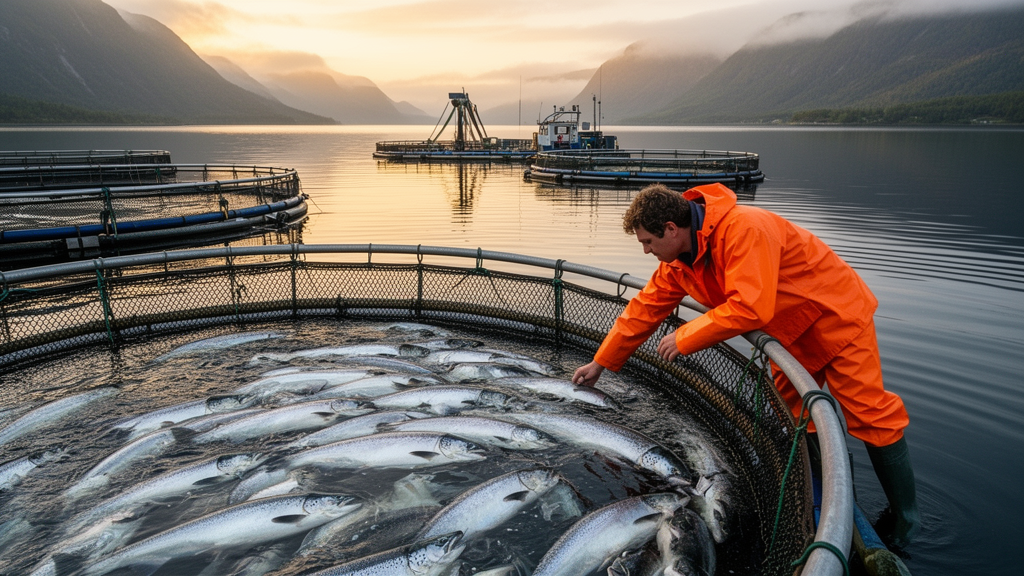
When routine screening flagged infectious salmon anemia virus at a commercial salmon farm in northern Norway in June 2021, the standard response would have been swift and final: cull every fish on the site. The virus that causes the disease, Isavirus salaris, is among the most feared pathogens in Atlantic salmon aquaculture, capable of wiping out entire populations and triggering cascading losses across neighboring farms. But the fish at the Salangslia site in Troms County had something most outbreak populations do not: they were fully vaccinated against the virus, having received the commercial vaccine ALPHA JECT micro 7 roughly 20 weeks before seawater transfer, and they showed almost no clinical signs when the diagnosis was confirmed. That unusual situation opened a door. The Norwegian Food Safety Authority granted a dispensation allowing production to continue under strict monitoring, and a team of researchers from the Norwegian Veterinary Institute, Pharmaq, and industry partners seized the opportunity to follow the infection through an entire production cycle, from diagnosis weeks after seawater transfer until the last fish was slaughtered in October 2022.
The study, published in Frontiers in Aquaculture, is the first to describe detailed surveillance using multiple sample matrices from fish in an ISA outbreak in a fully immunized population. Over more than a year, fish health experts visited the farm twice a month, and researchers collected samples from 2,821 fish at the sea site and another 840 at the slaughterhouse. The team analyzed swabs from skin and gills, heart and kidney tissues, blood for hematocrit measurements, and even water from the cages and from well boats used during delicing operations. The goal was to understand how the virus behaves in vaccinated fish under real field conditions, where the infection is not the only disease pressure and where husbandry stressors such as sea lice treatments shape the biological landscape.
The virus itself belongs to the family Orthomyxoviridae, the same family as influenza viruses, and exists in two phenotypic variants defined by the highly polymorphic region of gene segment 6. The non-pathogenic form, ISAV HPR0, circulates widely in Norwegian farmed salmon and is considered a benign resident of the production environment. The pathogenic form, ISAV HPRΔ, arises when HPR0 undergoes a deletion in the HPR combined with a mutation or insertion in the cleavage site of gene segment 5, transforming a quiet passenger into a killer. Primary outbreaks occur when this transition happens, and secondary outbreaks can then spread to nearby farms through live fish movements, vessel traffic, or passive transport in water currents. ISA was first detected in Norway in 1984 and peaked at 80 annual outbreaks in 1990 before biosecurity measures introduced between 1989 and 1991 brought the number down to between 10 and 25 outbreaks per year over the last decade.
At the Salangslia site, the fish had been vaccinated with a formulation containing the European ISAV genotype along with antigens against infectious pancreatic necrosis virus and several bacterial pathogens. According to the vaccine leaflet, immunity develops within 500 degree-days and lasts at least 7 months after vaccination, and vaccinated fish typically show reduced or absent clinical signs. However, they can still be infected, shed virus, and become asymptomatic carriers. The 754,825 Atlantic salmon transferred to seawater in May 2021 weighed approximately 270 grams each and were distributed across seven cages. Notably, the population had undergone an unusually rigorous sorting process at the hatchery, with approximately 150,000 smolts of inferior quality culled using a grading grid, meaning only 85 percent of the original fish were considered robust enough for seawater transfer.
The results paint a picture of a virus that persisted at low levels for months before becoming more detectable late in the production cycle. Of the 2,821 fish sampled at the sea site, 128 tested positive for ISAV by real-time RT-PCR. Only one of these detections, from a gill swab in November 2021, was confirmed as the non-pathogenic HPR0 variant; the rest were sequenced as HPRΔ. The number of positive individuals increased sharply from April 2022 onward, with the majority of detections occurring in cages that had tested positive at the start of the study and were located nearest to shore. By the end of the production cycle, ISAV HPRΔ had been detected in fish from all seven cages, up from four cages at the time of initial confirmation. Yet only five fish met the full Norwegian diagnostic criteria for clinical ISA, which require virus detection by PCR plus compatible histopathology and immunohistochemistry.
One of the most striking findings concerns the choice of sample matrix. Heart and kidney tissues are the recommended samples for ISAV detection under international standards, but the researchers found that skin swabs outperformed both heart tissue and gill swabs by a wide margin. Among the 128 ISAV-positive fish, skin swabs detected the virus in 73 percent of cases, gill swabs in 41 percent, and heart tissue in only 25 percent. The differences were statistically significant across all pairwise comparisons. Because swab samples likely reflect viral shedding through skin and mucosal surfaces rather than the infection status of individual fish, the authors suggest they may be particularly useful for early detection and non-lethal monitoring at the farm level. Any positive swab result would still need to be followed up with tissue sampling to confirm disease according to established criteria, but the finding points toward surveillance strategies that reduce the need to sacrifice healthy fish.
The study also identified hydropericardium, an accumulation of fluid in the sac surrounding the heart, as a highly specific predictor of ISA in moribund fish. Among 952 moribund fish with autopsy findings, only 13 showed hydropericardium, but the association with ISAV HPRΔ detection in heart tissue was dramatic, with an odds ratio of 51.7. Other autopsy findings such as skin ulcers, pale organs, and dark liver showed no significant association with viral detection. Anemia, traditionally considered a hallmark of ISA, was actually associated with lower odds of detecting the virus, likely because low hematocrit values in this population were driven by other conditions, including bacterial ulcers and mechanical injuries from delicing treatments, rather than by the virus itself.
The disease situation at the farm was complicated by a suite of other pathogens. Heart and skeletal muscle inflammation, parvicapsulosis, epitheliocystis, winter ulcers caused by Moritella viscosa, bacterial gill inflammation, and costiasis were all diagnosed during the study period. The site operated under a green aquaculture license requiring adult female sea lice levels below 0.25 per fish per cage, which necessitated seven thermal delicing treatments during the study period, well above the average of 3.82 treatments at 11 nearby farms. These treatments, while effective against lice, cause handling stress and mechanical injuries that can compromise fish health. Cumulative mortality reached 10.04 percent over the production cycle, but the researchers attribute this primarily to production-related factors rather than to ISA itself.
Environmental nucleic acid analysis, using water samples filtered through charged membranes to concentrate viral particles, yielded mixed results. Of 364 water samples collected at the farm, 98 tested positive for ISAV, but only 20 could be sequenced, and nearly all were the non-pathogenic HPR0 variant. Just one water sample, collected from a cage being emptied at the end of the study, contained HPRΔ. The authors suggest that virus shedding from this vaccinated population was low, or that viral particles were dispersed below detectable levels in the open sea cages. Water samples from well boats during delicing operations were more frequently positive, hinting that semi-enclosed systems where fish are concentrated may offer better opportunities for environmental surveillance than open cages.
The researchers acknowledge that the study design, conducted during a normal production cycle at a commercial farm, did not include a non-vaccinated control group, making it impossible to directly assess vaccine efficacy. The extensive pretransfer sorting of smolts, which is not standard industry practice, may also have reduced the observed prevalence of ISAV-positive fish. Nevertheless, the low number of clinically confirmed ISA cases despite widespread viral detection is consistent with a potential mitigating effect of vaccination, particularly in the earlier phases of production. The increase in viral detections toward the end of the cycle suggests that vaccine-induced immunity may have waned or been overwhelmed by the cumulative stress of delicing treatments and co-infections. The authors conclude that rigorous surveillance, particularly swabbing of moribund fish for early detection, combined with robust biosecurity measures remains critical for managing ISA risk, and that non-lethal sampling strategies aligned with the principles of replacement, reduction, and refinement in animal research deserve a central place in future disease control programs.
Subject of Research: Infection dynamics and surveillance of infectious salmon anemia virus in vaccinated Atlantic salmon under field conditions
Article Title: Infectious salmon anemia in vaccinated Atlantic salmon: a field case study
Article References: Patel, S. J., Dale, O. B., Fjellsøy, K. R., Bekkeli, K. E., Breck, O., Bendiktsen, R., Bornø, G., Brun, E., Jørgensen, L. G., Hellberg, H., Larsen, S., Kvalvik, H., & Moldal, T. (2026). Infectious salmon anemia in vaccinated Atlantic salmon: a field case study. Frontiers in Aquaculture, 5, Article 1885657. https://doi.org/10.3389/faquc.2026.1885657
Image Credits: AI Generated
DOI: 10.3389/faquc.2026.1885657
Keywords: infectious salmon anemia, ISAV, Atlantic salmon, aquaculture, vaccination, fish health surveillance, PCR detection, skin swabs, hydropericardium, environmental nucleic acid, sea lice treatments, Norwegian Veterinary Institute
Cite Scienmag News
Kristina Jarvis. (October 16, 2026). Vaccinated Salmon Kept the Virus Quiet: A Rare Field Study Tracks Infectious Salmon Anemia Through a Full Production Cycle. Scienmag. https://scienmag.com/vaccinated-salmon-kept-the-virus-quiet-a-rare-field-study-tracks-infectious-salmon-anemia-through-a-full-production-cycle/
Kristina Jarvis. "Vaccinated Salmon Kept the Virus Quiet: A Rare Field Study Tracks Infectious Salmon Anemia Through a Full Production Cycle." Scienmag, 16 October 2026, https://scienmag.com/vaccinated-salmon-kept-the-virus-quiet-a-rare-field-study-tracks-infectious-salmon-anemia-through-a-full-production-cycle/. Accessed 16 October 2026.
Kristina Jarvis. "Vaccinated Salmon Kept the Virus Quiet: A Rare Field Study Tracks Infectious Salmon Anemia Through a Full Production Cycle." Scienmag. October 16, 2026. https://scienmag.com/vaccinated-salmon-kept-the-virus-quiet-a-rare-field-study-tracks-infectious-salmon-anemia-through-a-full-production-cycle/


