


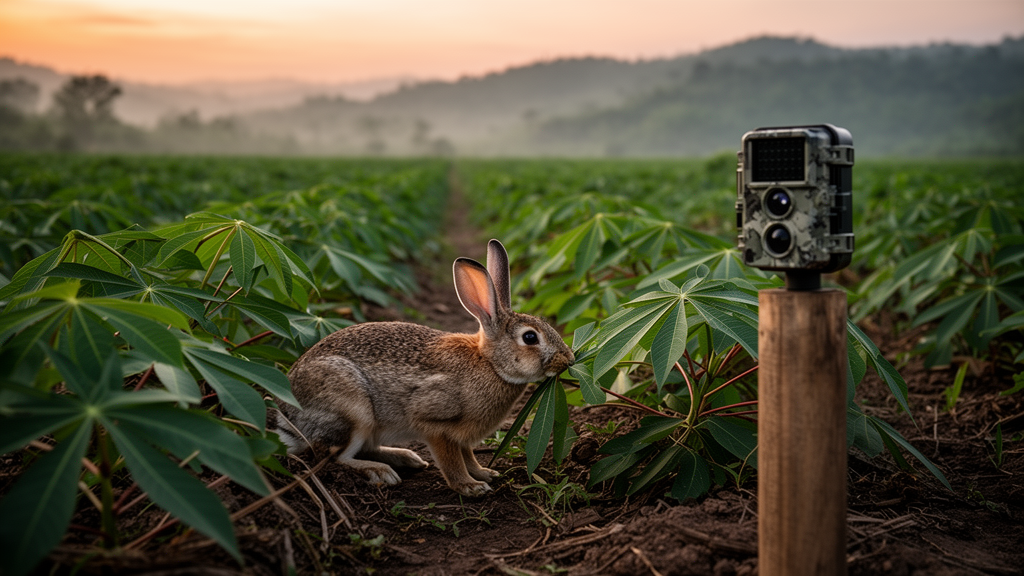
In the forested lowlands of eastern Honduras, farmers in the Miskitu community of Mavita had long blamed their crop losses on some imposing suspects: Baird’s tapirs, lowland pacas, and armadillos. But when researchers pointed solar-powered, motion-activated lights and camera traps at a ten-hectare cassava field, the true culprits turned out to be far smaller and far more numerous. Rabbits, not tapirs, were the most frequent visitors to the yucal, a finding that challenges local assumptions and could reshape how human-wildlife conflict is managed across the Honduran Mosquitia.
The study, published in Neotropical Biology and Conservation, deployed three camera traps along a forest-crop gradient from December 2024 to February 2025. Each camera was paired with a Sunforce solar LED motion light mounted roughly 1.5 to 2 meters above the ground, angled downward to illuminate the detection zone. The lights, which the researchers describe as silent technology, were triggered only when an animal passed, reducing continuous exposure and limiting the chance that wildlife would habituate to the glare. Cameras recorded ten-second videos with no delay between events, using infrared flash in blur-reduction mode to sharpen nighttime footage.
Over roughly ten weeks, the traps logged 27 independent interaction events involving seven mammal species. The Honduran rabbit (Sylvilagus hondurensis) dominated the record with 14 detections, followed by ocelots (Leopardus pardalis) with four, Central American agoutis (Dasyprocta punctata) with three, Virginia opossums and common opossums with two each, and single records of the jaguarundi (Herpailurus yagouaroundi) and Baird’s tapir (Tapirus bairdii). Notably absent were the pacas and armadillos that residents had fingered as prime raiders. No evidence of either species appeared in the footage.
The behavioral data proved as revealing as the species list. Researchers scored each encounter on a three-level ordinal scale: code 1 for a strong, fearful reaction with clear disturbance; code 2 for passage without triggering the light; and code 3 for passage with no observable reaction at all. Rabbits showed a mixed pattern, with six strong reactions, six no-activation events, and two unbothered passages. Ocelots, by contrast, mostly strolled past undeterred, registering weak or absent responses in three of four records. Agoutis behaved similarly, while both opossum species and the jaguarundi were only ever caught in no-activation moments, suggesting marginal or transit visits rather than deliberate crop foraging.
Tapirs, despite their fearsome reputation among local farmers, behaved quite differently. In both of their recorded visits, the animals reacted strongly to the lights, suggesting high sensitivity to the deterrent stimuli rather than intensive crop use. The sample size is small, the authors caution, but the pattern is striking: the species most often blamed for cassava losses may be among the most easily spooked by simple illumination. That matters because retaliatory hunting of tapirs, an Endangered species and the largest terrestrial mammal in the Neotropics, has been documented in Honduras, with one prior study reporting the killing of up to eight individuals near agricultural lands.
Statistical analyses reinforced the behavioral contrasts. A Kruskal-Wallis test found significant differences in behavioral codes across species groups, and post hoc comparisons showed that small cats tended toward weaker or absent reactions while rabbits exhibited stronger responses. An ordinal regression model, with an AIC of 49.66, revealed that time of day mattered too: weaker or absent responses became more likely later in the day, hinting that animals grow bolder, or less startled, as the night wears on. The model also confirmed that rabbits showed significantly lower behavioral codes than the reference category, meaning they reacted more intensely than other groups.
Temporal analysis added another layer of ecological nuance. Rao’s spacing test strongly rejected uniform activity across the 24-hour cycle, and Watson-Williams tests showed significant differences in mean activity times among species. Overlap estimates revealed near-total temporal segregation between agoutis and both small cats and tapirs, with overlap coefficients around 0.001. Moderate-to-high overlap emerged between rabbits and small cats, between small cats and opossums, and, intriguingly, between small cats and tapirs, suggesting that predators and prey, or at least species with similar schedules, share the same nocturnal windows at the forest edge.
The findings carry practical weight for conservation and food security alike. Misattributing crop damage to a single charismatic species, the authors argue, can trigger ineffective or ecologically harmful interventions and erode community trust. In Mavita, where cassava is a dietary staple and institutional support for conflict management is scarce, the Wildlife Conservation Society turned to light traps precisely because they offer a noninvasive way to document who is actually eating what, and when. The answer, in this case, redirected attention away from an Endangered tapir and toward a common rabbit.
Yet the study is candid about its limits. Sample sizes were uneven, with rabbits accounting for most records while tapirs, agoutis, and opossums were represented by only two or three observations each. The authors describe the work as exploratory and descriptive, calling for more extensive and systematically balanced sampling before light-based deterrents can be considered a fully reliable management tool. They also note that artificial lighting is not a neutral instrument: it can alter movement patterns and detection probabilities, meaning the devices themselves shape the behavior they are meant to observe.
The broader lesson, the researchers suggest, is that deterrent technology must be matched to the sensory biology and behavior of each target species. Reviews of nonlethal wildlife management show that intermittent lighting can deter large carnivores under some conditions, while automated lasers work mainly on birds, not mammals. Extrapolating results across species or regions without context-specific evidence risks failure. For Miskitu territories in the Honduran Caribbean Lowlands, the recommended path is a precautionary, stepwise approach: first diagnose the true culprits with noninvasive tools, then test mitigation measures with robust experimental designs, and consider buffer cassava plots at forest margins so wildlife can forage without devastating farmers’ fields. Coexistence, it turns out, may begin with simply knowing who is raiding the yucal.
Subject of Research: Noninvasive camera-trap monitoring of mammal crop-raiding at cassava fields in the Honduran Mosquitia
Article Title: From forest mosaics to yucales: noninvasive monitoring untangles mammal–crop interactions in eastern Honduras
Article References: From forest mosaics to yucales: noninvasive monitoring untangles mammal–crop interactions in eastern Honduras. (n.d.). https://doi.org/10.3897/neotropical.21.e187958
Image Credits: AI Generated
DOI: 10.3897/neotropical.21.e187958
Keywords: human-wildlife conflict, Baird's tapir, Sylvilagus hondurensis, cassava, camera traps, light deterrents, Honduras, Mosquitia, Miskitu, crop depredation, Neotropics, conservation
Cite Scienmag News
Margaret Porter. (October 16, 2026). Rabbits, Not Tapirs, Raid Honduran Cassava Fields, Camera Traps Reveal. Scienmag. https://scienmag.com/rabbits-not-tapirs-raid-honduran-cassava-fields-camera-traps-reveal/
Margaret Porter. "Rabbits, Not Tapirs, Raid Honduran Cassava Fields, Camera Traps Reveal." Scienmag, 16 October 2026, https://scienmag.com/rabbits-not-tapirs-raid-honduran-cassava-fields-camera-traps-reveal/. Accessed 16 October 2026.
Margaret Porter. "Rabbits, Not Tapirs, Raid Honduran Cassava Fields, Camera Traps Reveal." Scienmag. October 16, 2026. https://scienmag.com/rabbits-not-tapirs-raid-honduran-cassava-fields-camera-traps-reveal/


