


When you throw dinosaurs into the mix, sometimes you find that a rule simply isn’t.

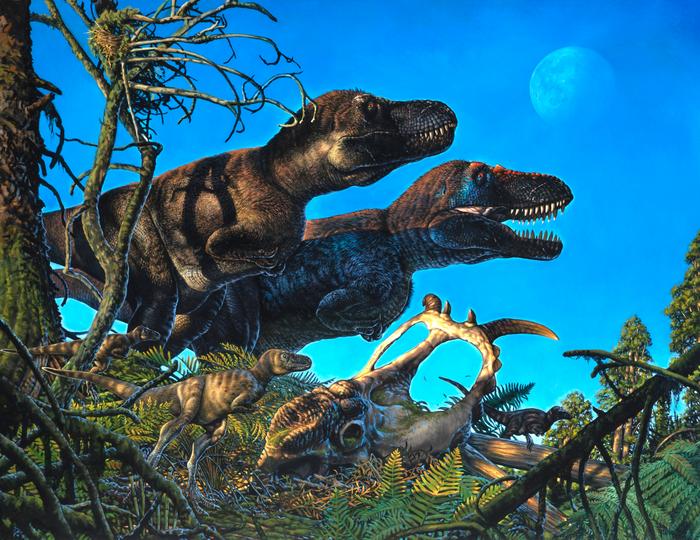
Credit: Art by James Havens
When you throw dinosaurs into the mix, sometimes you find that a rule simply isn’t.
A new study led by scientists at the University of Alaska Fairbanks and the University of Reading calls into question Bergmann’s rule, an 1800s-era scientific principle stating that animals in high-latitude, cooler climates tend to be larger than close relatives living in warmer climates.
The fossil record shows otherwise.
“Our study shows that the evolution of diverse body sizes in dinosaurs and mammals cannot be reduced to simply being a function of latitude or temperature,” said Lauren Wilson, a UAF graduate student and a lead author of a paper published today in the journal Nature Communications. “We found that Bergmann’s rule is only applicable to a subset of homeothermic animals (those that maintain stable body temperatures), and only when you consider temperature, ignoring all other climatic variables. This suggests that Bergmann’s ‘rule’ is really the exception rather than the rule.”
The study started as a simple question Wilson discussed with her undergraduate advisor: Does Bergmann’s rule apply to dinosaurs?
After evaluating hundreds of data points gleaned from the fossil record, the answer seemed a solid “no.”
The dataset included the northernmost dinosaurs known to scientists, those in Alaska’s Prince Creek Formation. They experienced freezing temperatures and snowfall. Despite this, the researchers found no notable increase in body size for any of the Arctic dinosaurs.
Next the researchers tried the same evaluation with modern mammals and birds, the descendants of prehistoric mammals and dinosaurs. The results were largely the same: Latitude was not a predictor of body size in modern bird and mammal species. There was a small relationship between the body size of modern birds and temperature, but the same was not the case for prehistoric birds.
The researchers say the study is a good example of how scientists can and should use the fossil record to test current-day scientific rules and hypotheses.
“The fossil record provides a window into completely different ecosystems and climate conditions, allowing us to assess the applicability of these ecological rules in a whole new way,” said Jacob Gardner, a postdoctoral researcher at the University of Reading and the other lead author of the paper.
Scientific rules should apply to fossil organisms in the same way they do modern organisms, said Pat Druckenmiller, director of the University of Alaska Museum of the North and one of the co-authors of the paper.
“You can’t understand modern ecosystems if you ignore their evolutionary roots,” he said. “You have to look to the past to understand how things became what they are today.”
ADDITIONAL INFORMATION: Read the paper in Nature Communications.
ADDITIONAL CONTACTS: Lauren Wilson, lnkeller@alaska.edu, 406-223-4762. Jacob Gardner, jacob.gardner@reading.ac.uk. Pat Druckenmiller, psdruckenmiller@alaska.edu, 907-474-6989. Chris Organ, Montana State University, organ@montana.edu.
NOTE TO EDITORS: An illustration is available on the UAF news website.
Journal
Nature Communications
Subject of Research
Animals
Article Title
Global latitudinal gradients and the evolution of body size in dinosaurs and mammals
Article Publication Date
5-Apr-2024
Cite Scienmag News
Violet Maxwell. (April 5, 2024). Dinosaur study challenges Bergmann’s rule. Scienmag. https://scienmag.com/dinosaur-study-challenges-bergmanns-rule/
Violet Maxwell. "Dinosaur study challenges Bergmann’s rule." Scienmag, 5 April 2024, https://scienmag.com/dinosaur-study-challenges-bergmanns-rule/. Accessed 3 September 2026.
Violet Maxwell. "Dinosaur study challenges Bergmann’s rule." Scienmag. April 5, 2024. https://scienmag.com/dinosaur-study-challenges-bergmanns-rule/

