


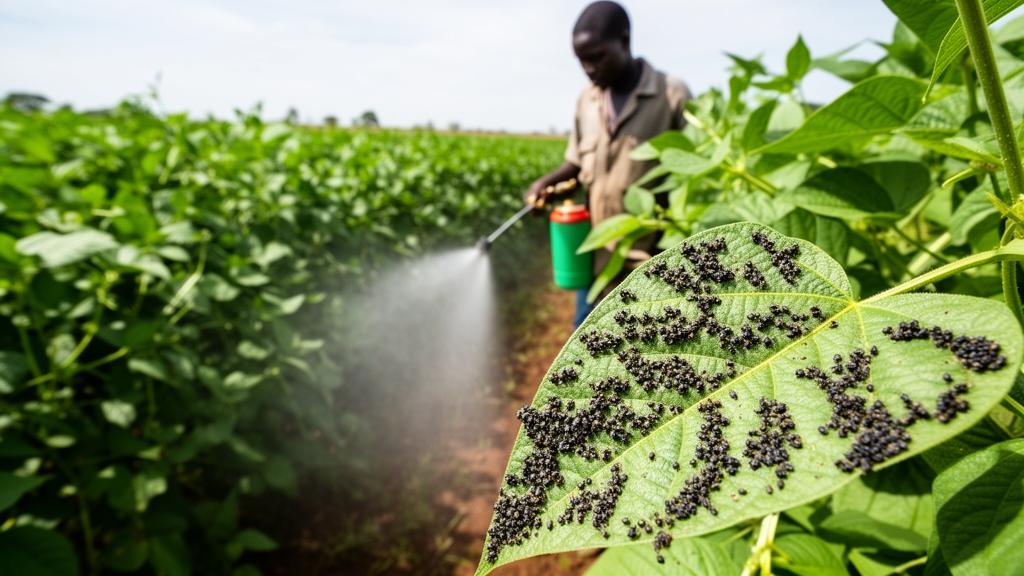
In thebean fields around Morogoro, Tanzania, a humble shrub with a long history of traditional use is emerging as a serious rival to synthetic insecticides. Researchers at Sokoine University of Agriculture have shown that crude leaf extracts of Tephrosia vogelii, a nitrogen-fixing legume sometimes known as fish-poison bean, can drive down infestations of the black bean aphid (Aphis fabae) as effectively as a commercial cypermethrin spray, while boosting common bean (Phaseolus vulgaris) yields by more than 80 percent compared with untreated plots. The findings, published in Frontiers in Agronomy, arrive at a moment when smallholder farmers across Sub-Saharan Africa are grappling with rising pest pressure, escalating input costs, and the well-documented ecological fallout of chemical pesticide overuse.
The black bean aphid is one of the most destructive pests of common beans in Africa, and its biology makes it a formidable adversary. The insects feed on phloem sap, directly siphoning sugars from the plant, while their sugary excretions of honeydew coat leaf surfaces and promote sooty mold growth that shades out photosynthesis. They also transmit economically significant plant viruses. Left unchecked, aphid infestations can slash yields by more than half, and the pests reproduce with startling speed, developing from first-instar nymph to reproductive adult in as little as 8 to 12 days, often without needing males at all. For the more than 100 million African households that rely on common beans as a critical source of protein, dietary fiber, and micronutrients, that kind of pest pressure is a direct threat to food security.
The Tanzanian team, led by Dominick Stephen Nana with colleagues Paulo John Lyimo and Ramadhani Omari Majubwa, began with a critical quality-control step that much botanical pesticide research skips. Tephrosia vogelii is not a chemically uniform plant. It exists as distinct chemotypes with very different insecticidal potentials, and the most potent of these, chemotype 1, cannot be reliably distinguished from its weaker relatives by appearance alone. The researchers collected young, tender leaves from plants displaying white flowers, a morphological trait previously linked to the elite chemotype, then confirmed their suspicion using liquid chromatography mass spectrometry. The LC-MS analysis revealed a dominant rotenone peak at a retention time of 10.96 minutes with a relative intensity of 95 percent, indicating large abundances of the key bioactive rotenoid, along with five other compounds: deguelin, glycetein, 6,4-dimethoxy-7-hydroxyisoflavone, isoquercitin, and quercetin.
With chemotype 1 identity secured, the team moved to a rigorously designed field experiment in Morogoro, a region of mountainous vegetation and miombo woodland receiving 600 to 1200 millimeters of rain annually. Leaves were crushed and soaked in dichloromethane for 48 hours, and the resulting extract was diluted into eight concentrations ranging from 2 percent to 10.2 percent weight per volume. These were sprayed weekly for four weeks in a randomized complete block design with three replications, alongside cypermethrin 10 percent EC as a positive control and plain water as a negative control. Applications were deliberately timed for early morning or late evening to protect the light-sensitive bioactive compounds from photodegradation, a practical detail that matters enormously for farmers who would use the extract themselves.
The results were striking. Four weeks after the final spray, plots treated with the 10.2 percent extract harbored an average of just 2.33 aphids per plant, compared with 67.0 aphids per plant in the water-only control, a statistically significant difference. Across the trial, the strongest extract achieved an 84 percent reduction in aphid population relative to control, edging remarkably close to the synthetic insecticide’s 93 percent. Leaf damage told a parallel story: the 8 percent extract produced the lowest damage score of 0.7 on a 0-to-4 severity scale at week four, versus 2.3 in untreated plots, where leaves were curled, wrinkled, and blackened with sooty mold. The researchers note that the extracts appear to possess repellent properties as well, which may have contributed to the steady decline in aphid numbers across the sampling period.
Perhaps most compelling for farmers is what happened to the harvest. Treated plots significantly out-yielded controls across every measured parameter, including pod weight, pods per plant, seeds per pod, and hundred-seed weight. The 10.2 percent extract delivered a grain yield of 736.3 kilograms per hectare, a figure statistically indistinguishable from the synthetic insecticide treatment’s 763 kilograms per hectare, while the untreated control limped along at just 401.4 kilograms per hectare. Regression analysis reinforced the causal chain: aphid population density and leaf damage were positively correlated with a coefficient of determination of 0.69, and leaf damage showed a strong negative relationship with yield, with the fitted line explaining roughly 80 percent of the variation. In plain terms, every increment of aphid-driven leaf injury translated directly into lost grain.
The researchers are careful about attribution. Although Tephrosia vogelii is well known as a nitrogen-fixing shrub that enriches soils with biomass, this study applied the extract as a foliar spray rather than a soil amendment, so the yield gains are best explained by reduced pest damage rather than any fertilizing effect. The authors also acknowledge that environmental conditions may have assisted the treatment effects, since heavy rainfall can physically knock aphids off host plants and cooler temperatures slow their reproduction. Still, the consistent superiority of all treated plots over controls across four weekly sampling rounds, combined with the dose-response pattern, points firmly to genuine insecticidal activity rooted in the plant’s chemistry.
That chemistry is the real story here. Rotenone and deguelin are isoflavonoid rotenoids that interfere with cellular respiration in insects, while flavonoids such as quercetin add complementary toxic and repellent effects. Because these compounds work through multiple modes of action, they may also slow the development of resistance, a growing problem with synthetic pesticides that has been documented worldwide. Previous work by some of the same researchers and by collaborators across East Africa has shown that chemotype variation dramatically influences field performance, which is why the LC-MS confirmation step in this study carries such weight. Farmers who unknowingly plant or harvest a weak chemotype could see poor results and abandon botanical pest control altogether, a barrier the authors hope transparent identification methods will overcome.
The economic logic is equally persuasive. Tephrosia vogelii grows readily across the region, can be processed with simple techniques suitable for small-scale farmers, and requires no purchase of imported chemicals. In remote areas where agriculture is both the primary source of revenue and the backbone of food security, the affordability gap for synthetic pesticides is often the deciding factor, and a locally grown alternative that performs comparably to cypermethrin could reshape pest management practice. The authors emphasize that the extracts fit naturally into integrated pest management frameworks and could become the basis for developing and commercializing botanical pesticide products in Tanzania and beyond.
Cautions remain before widescale adoption. The team recommends larger trials spanning multiple locations and seasons, work on formulation stability, assessment of phytotoxicity and effects on non-target organisms, persistence studies, economic analysis, and optimization of application rates. They also call for further investigation of reliable field indicators for chemotype 1 and for long-term ecological monitoring of the extracts. But the central conclusion stands on solid data: chemotype 1 leaf extracts of Tephrosia vogelii suppressed black bean aphids, reduced leaf damage, and lifted common bean yields to near the level of a leading synthetic insecticide, using nothing more than a plant that farmers can grow themselves. As pressure mounts to reduce the human and environmental costs of chemical pest control, this old fish-poison plant may prove to be one of Africa’s most valuable new crop protection tools.
Subject of Research: Botanical pest control of the black bean aphid on common beans using Tephrosia vogelii leaf extracts
Article Title: Field efficacy of Tephrosia vogelii leaf extracts against Aphis fabae Scopoli (Hemiptera: aphididae) on common bean (Phaseolus vulgaris)
Article References: Nana, D. S., Lyimo, P. J., & Majubwa, R. O. (2026). Field efficacy of Tephrosia vogelii leaf extracts against Aphis fabae Scopoli (Hemiptera: aphididae) on common bean (Phaseolus vulgaris). Frontiers in Agronomy, 8, Article 1900866. https://doi.org/10.3389/fagro.2026.1900866
Image Credits: AI Generated
DOI: 10.3389/fagro.2026.1900866
Keywords: Tephrosia vogelii, Aphis fabae, common bean, botanical pesticide, rotenone, chemotype 1, LC-MS, integrated pest management, Tanzania, smallholder farmers, food security, grain yield
Cite Scienmag News
Alan Morgan. (October 16, 2026). Fish-Poison Plant Extract Crushes Bean Aphids in Tanzanian Field Trial. Scienmag. https://scienmag.com/fish-poison-plant-extract-crushes-bean-aphids-in-tanzanian-field-trial/
Alan Morgan. "Fish-Poison Plant Extract Crushes Bean Aphids in Tanzanian Field Trial." Scienmag, 16 October 2026, https://scienmag.com/fish-poison-plant-extract-crushes-bean-aphids-in-tanzanian-field-trial/. Accessed 16 October 2026.
Alan Morgan. "Fish-Poison Plant Extract Crushes Bean Aphids in Tanzanian Field Trial." Scienmag. October 16, 2026. https://scienmag.com/fish-poison-plant-extract-crushes-bean-aphids-in-tanzanian-field-trial/


