


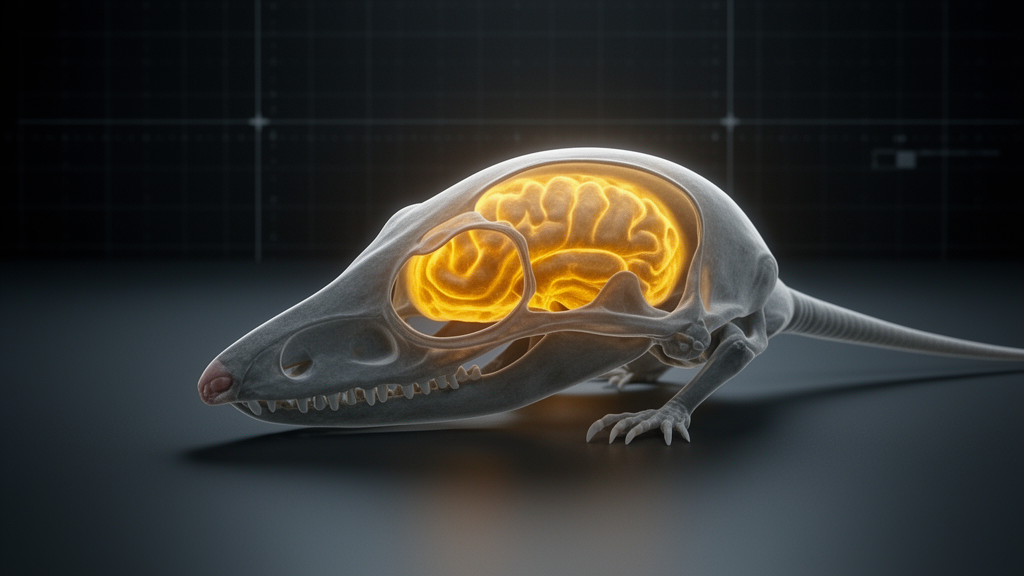
For decades, paleontologists have pieced together the story of how mammalian brains grew from modest ancestral beginnings into the sprawling, folded organs that power modern mammals. Now, a new CT-based study of a tiny rodent-like mammal from the age of dinosaurs is forcing a rethink of one chapter in that narrative. Researchers Thomas Macrini of St. Mary’s University and Timothy Rowe of the University of Texas at Austin extracted a digital cranial endocast from a high-resolution X-ray computed tomography scan of a skull of Kryptobaatar dashzevegi, a multituberculate mammal that lived in what is now Mongolia during the Late Cretaceous. Their measurements reveal that this animal’s brain was considerably smaller than a previous estimate based on a natural endocast, with major implications for how scientists calculate relative brain size in early mammals.
Kryptobaatar dashzevegi is arguably the best-known and most carefully studied species of multituberculate, an ancient group of mammals that thrived for more than 100 million years before eventually going extinct. The skull examined in the new study, specimen PSS-MAE 101, was collected from the Upper Cretaceous Djadokhta Formation at Ukhaa Tolgod, Mongolia, by a joint expedition of the Mongolian Academy of Sciences and the American Museum of Natural History. The skull is nearly complete with relatively little distortion and measures just 26.0 millimeters from the tip of the snout to the occiput. The sphenoid complex is completely fused in this and other examined specimens, indicating that they were skeletally mature adults.
The specimen was scanned at the University of Texas High-Resolution X-ray Computed Tomography Facility in Austin. The skull was scanned in its entirety at 140 kilovolts in the coronal plane, producing 364 digital slices with dimensions of 512 by 512 pixels. The slice thickness is 0.11 millimeters, with an interslice spacing of 0.08 millimeters, creating an overlap of 0.03 millimeters between consecutive slices. The field of reconstruction for the two-dimensional slices is 21.5 millimeters, and the voxel dimensions in the X and Y planes were calculated at 0.04199 millimeters per pixel. Using the program VGStudioMax, the researchers digitally isolated the endocast from the skull, following established protocols for extracting digital endocasts from CT imagery.
The digital endocast shows qualitative and quantitative differences from a previously published description of a natural endocast of Kryptobaatar dashzevegi, specimen GI PST 8-2, described by Zofia Kielan-Jaworowska and T. E. Lancaster in 2004. In general, the natural and digital endocasts are very similar in morphology, but some anatomical features such as the circular fissure, median sulcus, and superior sagittal sinus are more defined on the natural endocast. These discrepancies are attributed to differences in preservation quality between the two specimens rather than any artifact of the scanning process or digital extraction.
The most striking differences between the two endocasts are in overall size estimates. The measured endocranial volume of the digital endocast of PSS-MAE 101 is 0.34 milliliters, which differs dramatically from the estimate of 0.84 milliliters for the natural endocast of GI PST 8-2. The discrepancy can be attributed to differences in the size of the two individuals and in the techniques used to obtain the values. The skull of PSS-MAE 101 is approximately 76 percent the length of the skull of GI PST 8-2, measuring 26 versus 34 millimeters respectively. The anteroposterior length of the endocast of PSS-MAE 101 was measured as 1.5 centimeters, whereas the length of the endocast of GI PST 8-2 is reported as 1.7 centimeters, approximately 13 percent longer.
The previous estimate for the natural endocast was obtained using an equation representing the formula for calculating 25 percent of the volume of a cylinder, with length, width, and height of the endocast as inputs. Olfactory bulb volume was estimated separately and then added to the rest of the endocast to obtain the whole endocast estimate of 0.84 milliliters. When the researchers applied the same partial-cylinder approach to the digital endocast of PSS-MAE 101, they obtained an estimate of 0.95 milliliters. The EV estimate for the natural endocast is 147 percent larger than the EV value measured for the digital endocast. Adjusting for the difference in size between the two specimens, the estimated EV for the natural endocast is 0.64 milliliters, which is 53 percent greater than the measured EV of the digital endocast. This great a difference is not likely a result of individual variation based on comparisons with extant mammals, nor is it likely a result of ontogenetic variation.
To contextualize the new brain volume measurement, the researchers estimated body mass for PSS-MAE 101 using 14 different metrics from the dentition and the humerus, based on ordinary least squares linear regressions from an analysis of body masses in small mammals. Body mass estimates range from 26.807 to 96.595 grams, with a mean of 55.013 grams. The average mass estimate compares favorably with the body mass estimate of 62.9 grams for the clearly larger specimen GI PST 8-2. Using the measured EV of the digital endocast and the average body mass estimate, the researchers calculated an encephalization quotient of 0.32 for Kryptobaatar using the equation of Eisenberg from 1981. Depending on which body mass estimate is used, the EQ ranges from 0.13 to 0.54. An EQ of 0.71 is obtained using the same equation with the previous EV estimate of the natural endocast.
The new EQ of 0.32 is significantly lower than those estimated for two other multituberculates, Ptilodus at 0.62 and Chulsanbaatar at 0.54 to 0.56. However, for both of those taxa, complete endocasts were not available to measure EV directly, and instead, models of the endocasts were constructed based on exposed dorsal surfaces, with volumes measured using displacement of water. It is unclear how the sides and ventral surfaces of those endocasts were reconstructed, so it is likely that the previously reported EQs for Chulsanbaatar and Ptilodus are also inflated. Comparing the new EQ with values calculated for other key fossil mammals with EV values measured from CT data reveals that the stem mammal Hadrocodium wui has an EQ well above that of Kryptobaatar at 0.49, while Morganucodon has an identical EQ of 0.32. The stem therian Vincelestes neuquenianus has an EQ of 0.37, and the stem marsupial Pucadelphys andinus has an identical EQ of 0.32.
If the EQ of Hadrocodium is taken as a proxy for the EQ of the ancestral crown mammal, then Kryptobaatar has a significantly lower EQ than the presumed ancestral baseline for Mammalia. This suggests a dip in relative brain size for multituberculates compared to what has been inferred for the base of crown Mammalia. The lack of a clearly defined phylogenetic position for multituberculates within Mammalia and disagreement on the precise taxonomic composition of the group raise questions about whether Multituberculata is monophyletic, both of which hamper the ability to calculate phylogenetic encephalization quotients for the group. For now, using the generalized equations of Jerison and Eisenberg remains the only option for calculating multituberculate EQs.
The researchers conclude that methodological discrepancies and shortcomings with older estimates of EV using analog techniques, along with inconsistent estimates of body mass and the lack of accounting for phylogenetic effects on EQ, warrant a reexamination of relative brain sizes for Mesozoic mammals and their closest extinct relatives. The new data from the digital endocast of Kryptobaatar dashzevegi represent a significant step forward in that effort, demonstrating just how much difference modern imaging technology can make when measuring the brains of animals that died out more than 66 million years ago.
Subject of Research: Paleoneurology of the Cretaceous multituberculate Kryptobaatar dashzevegi
Article Title: New quantitative data from a digital cranial endocast of Kryptobaatar dashzevegi (Multituberculata, Mammalia) and a new estimate of body mass
Article References: Macrini, T. E., & Rowe, T. (2026). New quantitative data from a digital cranial endocast of Kryptobaatar dashzevegi (Multituberculata, Mammalia) and a new estimate of body mass. Frontiers in Mammal Science, 5, Article 1913320. https://doi.org/10.3389/fmamm.2026.1913320
Image Credits: AI Generated
DOI: 10.3389/fmamm.2026.1913320
Keywords: Kryptobaatar, multituberculata, brain evolution, computed tomography, encephalization quotient, paleontology, Cretaceous, Mongolia, quantitative, data, digital, cranial
Cite Scienmag News
Cassandra Pierce. (October 16, 2026). CT Scan of a Tiny Cretaceous Mammal Slashes Its Brain Size Estimate. Scienmag. https://scienmag.com/ct-scan-of-a-tiny-cretaceous-mammal-slashes-its-brain-size-estimate/
Cassandra Pierce. "CT Scan of a Tiny Cretaceous Mammal Slashes Its Brain Size Estimate." Scienmag, 16 October 2026, https://scienmag.com/ct-scan-of-a-tiny-cretaceous-mammal-slashes-its-brain-size-estimate/. Accessed 16 October 2026.
Cassandra Pierce. "CT Scan of a Tiny Cretaceous Mammal Slashes Its Brain Size Estimate." Scienmag. October 16, 2026. https://scienmag.com/ct-scan-of-a-tiny-cretaceous-mammal-slashes-its-brain-size-estimate/


