


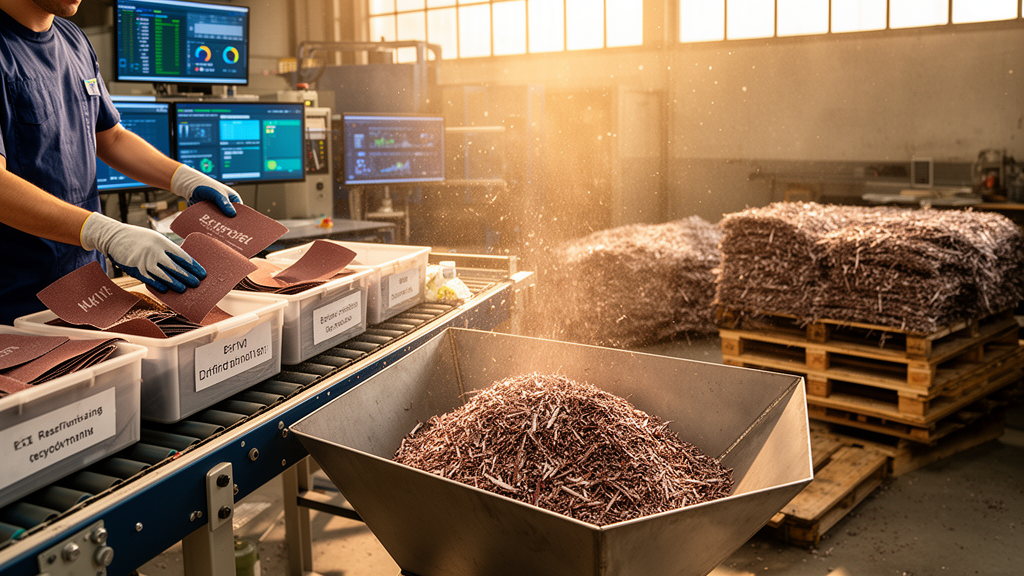
Every year, factories, workshops and construction sites around the world wear out enormous quantities of coated abrasives—the sandpaper-like products used to grind, polish and condition surfaces. These products are deliberately short-lived: their abrasive grains dull quickly and are discarded, often within days or weeks of purchase. Because they combine several materials in a single thin sheet, they have long been considered nearly impossible to recycle economically. A new industrial case study published in Discover Sustainability argues that the missing ingredient is not technology alone, but data.
The research, led by Jessica Tuuf of Åbo Akademi University in Vaasa, Finland, together with colleagues from the university’s energy and information technology faculties and the Finnish abrasives manufacturer Mirka Ltd, examines what it would actually take to bring end-of-life coated abrasives back into the material loop at industrial scale. The work forms part of the Data-driven Sustainability Management project, financed by Business Finland through the Mirka Shape Ecosystem, an initiative aimed at producing verifiable sustainability metrics using data-driven models.
Coated abrasives are technically challenging waste. A typical product layers abrasive grains—often aluminium oxide, silicon carbide or ceramic materials—onto a backing of paper, cloth or polymer film, held together with adhesive resins. This multi-material construction means that no single recycling stream can process the waste directly. At the same time, the products are consumed in such volumes worldwide that even partial recovery of their valuable abrasive grains could meaningfully reduce demand for virgin raw materials, many of which are energy-intensive to produce.
The authors frame the problem within the European Union’s ambition to become a carbon-neutral continent by 2050, which has accelerated pressure on manufacturing sectors to cut waste and increase recycling. In the hierarchy of circular economy strategies, waste reduction comes first, and the study acknowledges that extending product life is the preferred option for coated abrasives. But because these products are consumed by design, the researchers argue that a complementary strategy—an organised system for handling spent abrasives—would carry a distinct advantage over simply sending them to landfill or incineration.
What distinguishes the study is its focus on prerequisites rather than process chemistry. While the technical aspects of recycling abrasive products have been explored to some extent in prior research, the large-scale return of end-of-life abrasives has never been systematically examined. The Finnish team therefore mapped the conditions that would need to be in place: reverse logistics capable of collecting dispersed waste from thousands of user sites, waste management frameworks that classify the material correctly, corporate strategies that commit to circular targets, and—critically—data governance that makes material flows visible and verifiable.
Data emerges as the connective tissue of the proposed system. Without reliable information about where spent abrasives originate, in what quantities, and with what composition, take-back schemes cannot be planned economically, and recyclers cannot certify the recovered grain quality. The study positions data governance alongside legislation and waste management as a crucial factor determining whether circular transitions in the sector succeed or stall. This aligns with a broader shift in industrial sustainability thinking, in which digital product information and traceability are treated as infrastructure on a par with physical collection networks.
Legislation adds another layer of complexity. Waste regulations determine whether used abrasives are classified as hazardous or non-hazardous, which in turn dictates how they can be transported, stored and processed. The study discusses how regulatory frameworks shape the economics of any recovery model, and how evolving EU policy on waste and circularity could either enable or constrain take-back systems. For manufacturers, anticipating these legal conditions is as important as perfecting the recycling process itself.
On the basis of the case study, the authors advance both material flow models and recycling concepts for the sector, and propose several alternative models for the future recovery of end-of-life coated abrasives. These range from concepts in which used products are returned through organised channels to those in which data collected during product use informs downstream handling decisions. The researchers emphasise that recovering abrasive grains could directly reduce the demand for virgin raw materials, closing the loop on one of the most resource-intensive inputs in surface-finishing manufacturing.
The collaboration between academia and industry is central to the study’s credibility. By working within Mirka’s ecosystem, the researchers could ground their models in a real production and distribution environment rather than in idealised assumptions, an approach increasingly favoured in circular economy research where the gap between pilot concepts and industrial reality is notoriously wide. The involvement of Åbo Akademi University’s information technology group alongside its energy technology specialists also reflects the study’s core thesis: that sustainability transitions are as much computational and organisational problems as they are materials problems.
For a product category as unglamorous as sandpaper, the stakes are surprisingly high. Coated abrasives are used in nearly every manufacturing chain, from automotive body shops to furniture workshops to semiconductor polishing, and their cumulative material footprint is substantial. If the data-governed take-back models outlined in the study prove viable, a product that has always been defined by its disposal could become an example of how digital information unlocks circularity in even the most fragmentary waste streams. The research directly supports the European Union’s objectives for advancing the circular economy, and it offers a template that other multi-material, short-lived product sectors—from filters to packaging—may soon find difficult to ignore.
Subject of Research: Data governance and circular economy models for recycling end-of-life coated abrasives
Article Title: Data as an enabler of circular transitions in the coated abrasives industry
Article References: Tuuf, J., Hellman, F., Frände, N., Härmälä, P., Risku, C., Björklund-Sänkiaho, M., Björkqvist, J., & Lundell, A. (2026). Data as an enabler of circular transitions in the coated abrasives industry. Discover Sustainability. https://doi.org/10.1007/s43621-026-04966-0
Image Credits: AI Generated
DOI: 10.1007/s43621-026-04966-0
Keywords: coated abrasives, circular economy, recycling, data governance, end-of-life products, take-back systems, industrial sustainability, waste management, material flow models, European Union, manufacturing, sustainability
Cite Scienmag News
Blake Davidson. (October 16, 2026). How Data Could Turn Sandpaper Waste Into a Circular Success Story. Scienmag. https://scienmag.com/how-data-could-turn-sandpaper-waste-into-a-circular-success-story/
Blake Davidson. "How Data Could Turn Sandpaper Waste Into a Circular Success Story." Scienmag, 16 October 2026, https://scienmag.com/how-data-could-turn-sandpaper-waste-into-a-circular-success-story/. Accessed 16 October 2026.
Blake Davidson. "How Data Could Turn Sandpaper Waste Into a Circular Success Story." Scienmag. October 16, 2026. https://scienmag.com/how-data-could-turn-sandpaper-waste-into-a-circular-success-story/


