


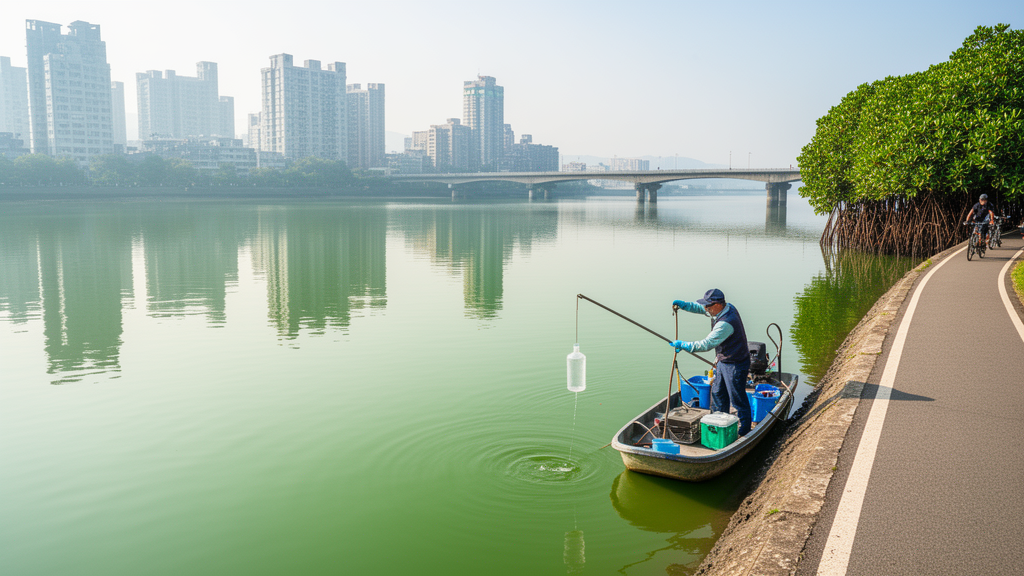
The Danshui River drains the Taipei basin, one of the most densely settled regions on Earth, and for two decades it has been the stage for one of Asia’s most sustained urban river restoration programs. Households were connected to public sewers, black water was intercepted before it reached the storm drains, and constructed wetlands were built within the river levees to polish what the sewer network could not yet capture. A new analysis of the river’s water quality from 2010 to 2026, published in Frontiers in Ecology and Evolution, now delivers a verdict that is both triumphant and unsettling: the chemical battle for the Danshui has largely been won, but a microbial counter-trend is quietly rewriting the river’s agenda.
Wei-Ta Fang of National Taiwan Normal University, Yu-Kai Lin of the University of Taipei, and Bai-You Cheng of National Formosa University assembled a continuous monthly record of 1,921 samples from 11 monitoring stations operated by Taiwan’s Ministry of Environment. Their design was deliberately convergent. Rather than lean on a single statistical test, they deployed the Mann–Kendall and seasonal Mann–Kendall tests, a variance-corrected modified version that guards against serial correlation, Theil–Sen slope estimators, the Pettitt and sequential Mann–Kendall change-point tests, Innovative Trend Analysis, and a synchronized-permutation Monte Carlo procedure for testing what statisticians call field significance. That last test matters because running 77 station-by-variable hypothesis tests at once means roughly four would appear significant by chance alone; the Monte Carlo procedure asks whether the observed count of significant stations exceeds what a trend-free river would produce.
The headline chemical results are unambiguous. Suspended solids declined significantly at 9 of the 11 stations, ammonia nitrogen at 8, and five-day biochemical oxygen demand at 6, and each of these declines is field-significant with Monte Carlo p-values at or below 0.006. The composite River Pollution Index, Taiwan’s standard measure of organic river pollution, fell significantly at 10 of 11 stations and rose at none. Between the early sub-period of 2010 to 2012 and the late sub-period of 2023 to 2025, the basin-mean index dropped from 3.83 to 3.20, and the fraction of samples classed as severely polluted collapsed from 11.1 percent to 2.5 percent. The Keelung River, historically the basin’s dirtiest tributary, improved most dramatically, with all six of its stations showing strongly significant declines in the index, suspended solids, and ammonia.
The improvement is not an artifact of the monitoring network’s own history. Two stations were retired in 2022 and one was added the same year, so the researchers re-tested every headline trend on the eight stations with unbroken 2010–2026 records. The picture held: ammonia declined at all eight, suspended solids and the pollution index at seven of the eight, and the coliform group still rose at five. The seasonal Mann–Kendall test, which strips out the pronounced within-year cycle of urban river quality, returned concordant results, and the modified test preserved the sign of every trend, so neither seasonality nor serial correlation manufactured the signals.
Timing proved equally revealing. The Pettitt test placed a shared change-point at 2021 for dissolved oxygen, biochemical oxygen demand, ammonia, and the pollution index, while suspended solids changed earlier, in 2015. Innovative Trend Analysis added a crucial detail: for ammonia, the gap below the 1:1 line widened toward the highest values, meaning the most ammonia-rich samples fell proportionally more than the cleaner ones. That is the statistical fingerprint of a concentrated wastewater source being removed rather than a load merely diluted, and it fits the record of household sewer connection, which by 2024 had reached 88 percent of Taipei City’s population and 72 percent of New Taipei City’s.
Dissolved oxygen, however, tells a more sobering story. It rose significantly at only two stations, and the Monte Carlo field-significance test found that count indistinguishable from chance, with a p-value of 0.11. The reason is partly climatic. Water temperature at the fixed stations rose significantly over the record at 0.15 degrees Celsius per year, and because oxygen solubility falls as water warms, a dissolved-oxygen concentration that merely held level represents oxygen conditions that resisted a warming headwind rather than stagnating. The mid-series oxygen trough around 2019 to 2020 coincided with the most severe drought Taiwan had seen in 56 years, a typhoon-free dry spell that weakened both dilution and reaeration in the tidal reaches.
Against this chemical improvement, one variable ran the other way. The coliform group, the standard fecal-indicator bacteria, rose significantly at 7 of 11 stations and fell significantly at none. Unlike the coherent 2020–2021 chemical shift, the per-station coliform change-points scattered across 2013 to 2024 rather than clustering, so the microbial signal has no single basin-wide onset. The basin geometric-mean coliform concentration climbed from about 79,000 colony-forming units per 100 milliliters over 2010 to 2022 to roughly 160,000 in 2023 to 2024. Crucially, basin coliform showed no association with monthly rainfall, which argues against diffuse runoff-driven contamination and points toward continuous point-source discharge.
The treatment-plant records make the mechanism concrete. The Bali plant, treating some 1.3 million cubic meters per day at primary level, saw its effluent-coliform log-removal collapse from roughly 4.0 in 2022 and 2023 to about 1.5 after 2024, its effluent geometric mean climbing some 200-fold to between 100,000 and one million colony-forming units per 100 milliliters. Because influent counts were roughly stable, the collapse reflects a real loss of disinfection performance rather than a change in measurement scale. The contrast with the Dihua reclamation plant, which disinfects and held its effluent near 500 colony-forming units per 100 milliliters, shows the missing ingredient is disinfection, not treatment as such. The researchers also tested and rejected a wildlife explanation: although the basin’s wetlands hold nationally important waterbird assemblages, a deliberately generous estimate puts the entire standing flock two to three orders of magnitude below the Bali plant’s daily fecal load.
The comparison with the earlier 1993–2010 assessment of the same basin sharpens the finding. Ammonia and biochemical oxygen demand fell in both periods, confirming a sustained two-decade retreat of nutrient and organic pollution. But two reversals stand out. Dissolved oxygen, which rose at 84.6 percent of stations through 2010 as the wetlands and sewers came online, now shows no field-significant trend, suggesting the earlier oxygen recovery has largely run its course. And the fecal reversal is the most consequential: E. coli fell at 69.2 percent of stations through 2010, in step with the spread of sewerage, yet the coliform group now rises at a majority of stations. The microbial gains of the sewer-connection era have stalled or turned.
The Danshui is not an exception to a global pattern but an early, well-instrumented example of it. China’s national monitoring network recorded chemical oxygen demand falling steeply between 2003 and 2017 as discharges were cut; half a century of Clean Water Act investment in the United States lowered pollution concentrations substantially, yet more than half of American river miles still violate a standard; and British rivers show the same divided story of improving sanitary quality downstream of towns alongside unresolved overflows and emerging contaminants. What unites these cases with the Danshui is a sequence rather than a level: interception and conventional secondary treatment remove the oxygen-demanding and nutrient load first, and the residual problem migrates to constituents the same treatment does not remove. Taiwan’s official River Pollution Index, built from dissolved oxygen, biochemical oxygen demand, suspended solids, and ammonia, carries no microbial term, so the measure that steers policy registers the basin as improving while its fecal risk rises. The researchers’ conclusion is direct: having largely won against organic, solid, and nutrient pollution, the next phase of Danshui management must add disinfection to the major municipal discharges and routinely reconcile the bacterial monitoring record against changes in laboratory method and contractor, so that a genuine environmental signal is not confused with an analytical one.
Subject of Research: River water-quality trends and change-points in the Danshui River basin, metropolitan Taipei, 2010–2026
Article Title: Multi-method non-parametric assessment of river water-quality trends and change-points in the Danshui River basin, metropolitan Taipei (2010–2026)
Article References: Fang, W.-T., Lin, Y.-K., & Cheng, B.-Y. (2026). Multi-method non-parametric assessment of river water-quality trends and change-points in the Danshui River basin, metropolitan Taipei (2010–2026). Frontiers in Ecology and Evolution, 14, Article 1944738. https://doi.org/10.3389/fevo.2026.1944738
Image Credits: AI Generated
DOI: 10.3389/fevo.2026.1944738
Keywords: Danshui River, Taipei, water quality, coliform, constructed wetlands, Mann-Kendall, change-point, wastewater treatment, field significance, River Pollution Index, Multi-method, non-parametric
Cite Scienmag News
Drew Townsend. (October 16, 2026). Taipei’s Danshui River Gets Cleaner, But Fecal Bacteria Tell a Different Story. Scienmag. https://scienmag.com/taipeis-danshui-river-gets-cleaner-but-fecal-bacteria-tell-a-different-story/
Drew Townsend. "Taipei’s Danshui River Gets Cleaner, But Fecal Bacteria Tell a Different Story." Scienmag, 16 October 2026, https://scienmag.com/taipeis-danshui-river-gets-cleaner-but-fecal-bacteria-tell-a-different-story/. Accessed 16 October 2026.
Drew Townsend. "Taipei’s Danshui River Gets Cleaner, But Fecal Bacteria Tell a Different Story." Scienmag. October 16, 2026. https://scienmag.com/taipeis-danshui-river-gets-cleaner-but-fecal-bacteria-tell-a-different-story/


