


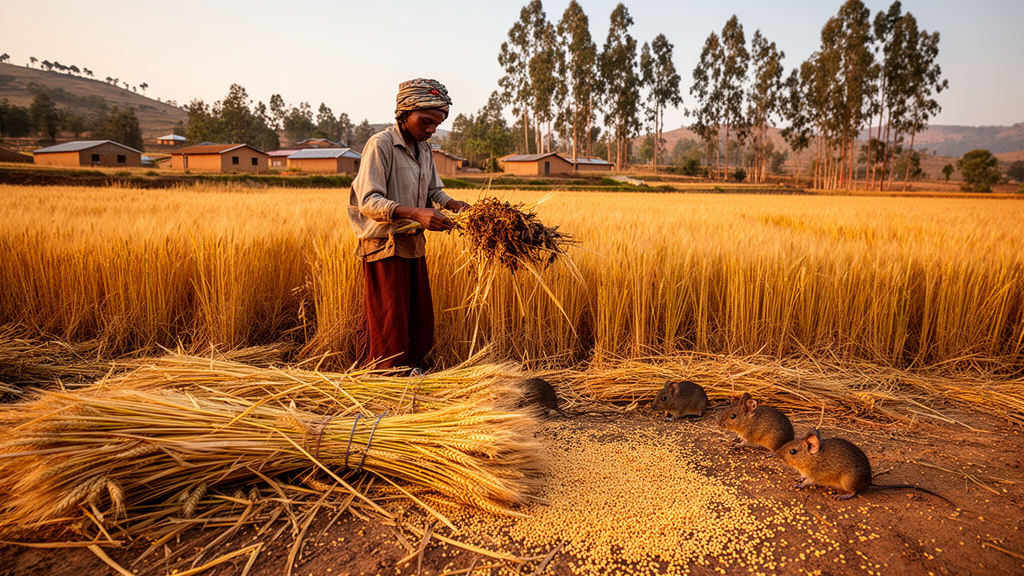
In the highland farming communities of East Gojjam, Ethiopia, an invisible thief takes a bite out of nearly every harvest. New research drawing on interviews with 384 smallholder farmers across four rural kebeles reveals that rodents alone strip an average of 231.7 kilograms of crops from each household every year, equivalent to roughly 13 percent of annual yield. For families farming plots that average just 1.4 hectares, that loss is not an abstraction; it is food taken directly from the table, and it rivals the toll exacted by better-known agricultural villains such as insects, weeds and crop disease.
The study, published in the journal BioRisk, is among the first to document systematically how farmers in this part of the Amhara region perceive rodent damage and what they do about it. The researchers selected four adjacent kebeles, Chimit, May Angetam, Denba and Dinguabe, near Chimit Kola, an area where pest rodents are known to be widely distributed. Using a statistically derived sample size based on the Cochran formula and proportional allocation across kebeles, the team conducted face-to-face interviews with semi-structured questionnaires translated into Amharic and pre-tested in the community. Field observations supplemented the survey responses to strengthen their validity, and the data were analysed in R software with chi-square tests and multiple regression models.
The survey responses make clear that rodents are far from the only threat. Farmers ranked primates as the most serious animal pests, cited by just over a third of respondents, followed by rodents at 23.5 percent, birds, insects and worms, and other animals. Yet when asked directly, 89.3 percent of farmers agreed that rodent damage is a genuine problem for their farming. Maize emerged as the most vulnerable crop, identified by 49 percent of respondents, followed by wheat, barley and teff, an ethiopian staple grain. Average annual household yields were estimated at around 1,746 kilograms, meaning the reported rodent losses consume a substantial fraction of what families produce.
One of the most striking findings concerns how demographics shape perception. A multiple regression model explained about 54 percent of the variance in perceived yield loss, with family size, farming age, farmland size, education and location all significant predictors. Counterintuitively, perceived losses fell as family size, age and landholding grew. Older farmers, with more accumulated experience in managing pests, reported lower losses than younger ones. Larger households appear to benefit from more hands available for guarding crops, while owners of bigger plots may find damage harder to estimate precisely, or find that higher overall production masks the absolute amount lost.
Education told a more nuanced story. Farmers who had never completed formal schooling reported the highest perceived losses, significantly more than those who had finished grades one through five. But the relationship did not simply flatten out: farmers with grades six through eight, and even more so those with grade nine or above, reported significantly lower losses than the least-educated cohort. The pattern suggests that schooling equips farmers to combine scientific and traditional pest-control techniques more effectively, amplifying gains well beyond basic literacy.
Location mattered as well. Farmers in Denba kebele perceived significantly lower losses than those in Chimit, and the researchers attribute this to geography: Denba’s farmlands sit farther from natural forest and bushland that provide refuge habitats for rodents. In the other kebeles, these non-cropping areas likely serve as reservoirs from which pests repeatedly invade nearby fields, a finding with direct implications for how rodent management should be designed at the landscape scale.
Farmers demonstrated remarkably detailed ecological knowledge of when their crops are most at risk. Wheat and teff were perceived as most vulnerable during the growth stage, from tillering through booting, when soft stems and leaves attract feeding and taller plants offer rodents shelter. Maize, by contrast, was seen as most susceptible at the threshing and harvesting stage, when the energy-dense grain becomes available. Most farmers also identified these same stages as the most effective windows for intervention, a convergence of observed damage and applied control that the authors say reflects substantial accumulated knowledge in the community.
That knowledge, however, funnels into a management strategy that troubles the researchers. Nearly half of surveyed farmers combined trapping with chemical rodenticides, and another quarter relied on poison alone. When asked which method worked best, 48 percent named rodenticides, far ahead of trapping or clearing weeds and chasing animals. The appeal is understandable: poisons kill many rodents quickly with far less labour than other methods. Yet rodenticides pose well-documented risks to non-target wildlife, to cats and other natural predators of rodents, and to human health through contaminated grain and accidental exposure.
The individualistic nature of current control efforts compounds the problem. More than half of farmers reported protecting their crops alone rather than coordinating with neighbours, even though rodents move between fields and across community boundaries. Studies from Laos, Myanmar and elsewhere have shown that group action, synchronised planting and community-wide control campaigns conducted before breeding seasons begin are far more effective than isolated efforts. Encouragingly, half of the farmers surveyed already recognised that rodent damage cannot be fully eliminated, only minimised, a realistic foundation on which better strategies could be built.
The authors argue that the way forward lies in ecologically based rodent management: synchronising cropping calendars, clearing refuge habitats before breeding onset, deploying biological and fertility control, non-toxic deterrents, and physical and mechanical barriers, with chemical poisons relegated to a last resort. They urge governmental and non-governmental organisations to forecast outbreak periods and run sustained awareness programmes. With 104 rodent species recorded in Ethiopia and only a handful, chiefly Mastomys, Arvicanthis and Gerbilliscus species, acting as major agricultural pests, targeted rather than indiscriminate control becomes both feasible and essential. For the smallholders of East Gojjam, whose livelihoods hang on every kilogram of wheat, teff and maize, the difference between poison-centric habits and ecologically sound practice could determine whether the region’s uncounted rodent toll keeps climbing or finally begins to shrink.
Subject of Research: Farmers' perceptions of rodent pest damage and management in small-scale Ethiopian farming systems
Article Title: Farmers’ perception of pest status and management of rodents in small-scale farming systems in East Gojjam, Ethiopia
Article References: Wale, M., Bekele, A., & Yihune, M. (2026). Farmers’ perception of pest status and management of rodents in small-scale farming systems in East Gojjam, Ethiopia. BioRisk, 24, 133-146. https://doi.org/10.3897/biorisk.24.189621
Image Credits: AI Generated
DOI: 10.3897/biorisk.24.189621
Keywords: rodent pests, Ethiopia, small-scale farming, crop yield loss, rodenticides, pest management, East Gojjam, maize, wheat, teff, food security, ecologically based pest management
Cite Scienmag News
Alan Morgan. (October 16, 2026). Rodents Steal a Quarter of Cereal Harvests on Ethiopian Smallholdings, Farmers Report. Scienmag. https://scienmag.com/rodents-steal-a-quarter-of-cereal-harvests-on-ethiopian-smallholdings-farmers-report/
Alan Morgan. "Rodents Steal a Quarter of Cereal Harvests on Ethiopian Smallholdings, Farmers Report." Scienmag, 16 October 2026, https://scienmag.com/rodents-steal-a-quarter-of-cereal-harvests-on-ethiopian-smallholdings-farmers-report/. Accessed 16 October 2026.
Alan Morgan. "Rodents Steal a Quarter of Cereal Harvests on Ethiopian Smallholdings, Farmers Report." Scienmag. October 16, 2026. https://scienmag.com/rodents-steal-a-quarter-of-cereal-harvests-on-ethiopian-smallholdings-farmers-report/


