


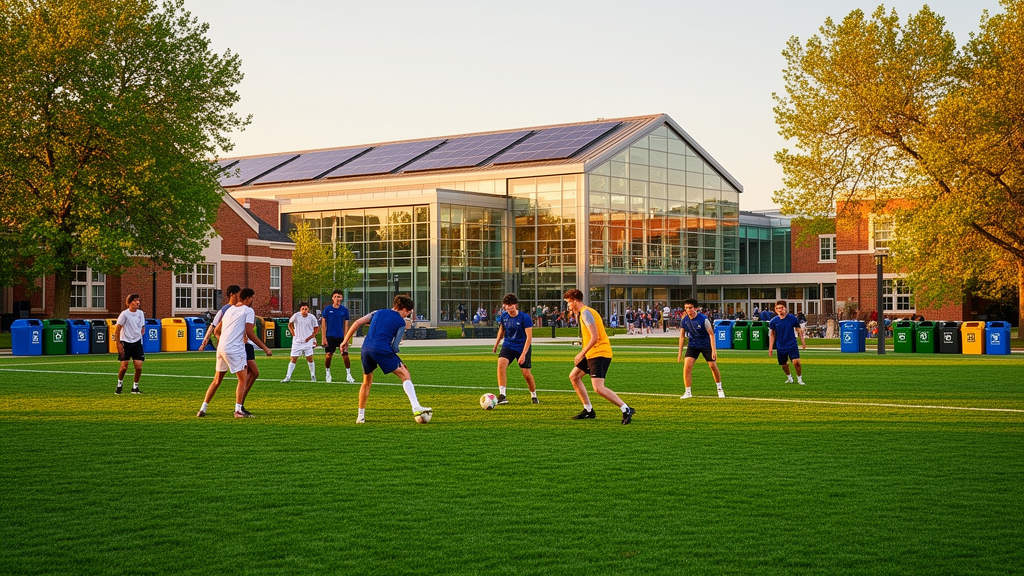
Universities have spent the past decade reinventing themselves as engines of sustainable transformation, embedding environmental thinking into research, teaching, campus operations, and governance. A new scoping review published in Heliyon argues that one corner of campus life has been quietly overlooked in this green overhaul: university sport. A team of Spanish researchers led by Guillermo Morán-Gámez used the PRISMA extension for scoping reviews to map the scientific literature on the intersection of sport, higher education, and environmental sustainability, and their findings reveal a field that is growing rapidly yet remains strikingly fragmented.
The researchers searched Web of Science, ScienceDirect, ProQuest, SciELO, and Latindex in July 2023, combining Boolean search strings built from terms such as physical activity, sport, sustainability, university, campus, and green campus. The initial trawl returned 1,468 articles, which was narrowed to 529 after applying filters for publication date, document type, and subject area. Title, abstract, and keyword screening retained 74 records, deduplication reduced these to 54, and full-text assessment ultimately left 29 studies published between 2015 and 2023. The protocol was registered on the Open Science Framework, and the authors screened records independently and manually to reduce selection bias.
Crucially, the review limited itself to environmental sustainability, deliberately excluding the social and economic dimensions of the familiar triple bottom line framework. The studies that survived screening had to explicitly address all three core domains: sport, universities, and environmental sustainability. Research touching only two of these domains, such as sustainability in professional sport facilities or green campus initiatives unrelated to athletics, was excluded. This strict delimitation is what makes the resulting map genuinely novel, since previous reviews of sport and sustainability had examined the Olympic movement, the Korean sport industry, or outdoor physical activity, but never the specific nexus of campus sport.
Once categorised, the 29 studies fell into five thematic clusters: environmental modules in sport science degrees, the environmental awareness and behaviour of sport science students, the environmental policy of athletics departments, sustainable university sporting events, and sustainable university sport facilities. Sporting events dominated the evidence base, accounting for 34.5 percent of the included studies, while curricular content, student outcomes, governance, and facilities each hovered between roughly 14 and 21 percent. The distribution itself tells a story: universities and researchers see big games as their most visible lever for environmental change, even as the quieter infrastructure of teaching and governance lags behind.
The curricular evidence is perhaps the most sobering. A survey of 366 faculty members across all 75 sport faculties in Türkiye found that while 97 percent considered themselves environmentally aware, only 10.3 percent included the Sustainable Development Goals in their lectures, and 96.7 percent were unaware of their country’s institutional environmental progress. In Spain, an analysis of sport management modules across 48 universities found that just 6.74 percent had any connection to sustainability, fewer than modules on entrepreneurship, technology, or tourism. An examination of 84 American graduate sport management programmes identified climate, environment, and sustainability as the second least addressed of seven core themes.
Yet where environmental content does appear, the results are encouraging. A training programme in Physical Activity and Sport in Natural Environments at the Autonomous University of Madrid significantly improved students’ environmental knowledge, attitudes, values, and behaviours, with students who spent more hours active in nature faring best. This echoes a broader pattern in the literature: physical activity in natural environments is consistently associated with stronger pro-environmental attitudes, confirming findings from earlier reviews that green space and green minds are linked. Studies of sport management students, meanwhile, show that values, beliefs, and norms correlate positively, but that sustainable values do not automatically translate into sustainable behaviour, a gap that graduate students in one study bridged better than undergraduates.
Governance emerges as a persistent weak point. Qualitative studies of athletics departments describe loose coupling between sustainability offices and athletic departments, with personal relationships between staff doing the work that formal coordination structures should perform. Cross-departmental green teams helped coordinate action and improve information flow, but a review of the Sustainability Tracking, Assessment and Rating System found that of 335 reporting institutions, 247 were NCAA-affiliated and only 50 attempted to earn points in the Green Athletics category, with just 21 succeeding. Even waste management at football tailgates suffered from poor communication between formal campus officials and informal recyclers such as canners, limiting systemic efficiency.
The event and facility literature is where the numbers get dramatic. A life cycle assessment of 23 varsity teams at the University of British Columbia found that spectator travel emitted 960 tonnes of carbon dioxide equivalent, and that the 4 percent of spectators who flew were responsible for 52 percent of those emissions; a 10 percent reduction in flights would cut 50 tonnes. Waste audits at a college football stadium found that 96 percent of pre-consumer waste was food, with 71.2 percent of it edible, suggesting demand forecasting and food sourcing as powerful levers. On the infrastructure side, replacing fuel oil with loquat seed biomass at a University of Almería swimming pool cut emissions by nearly 148,000 kilograms of carbon dioxide per year while reducing fuel costs by 72.8 percent and paying back the initial investment in just 1.3 years. A wastewater heat recovery system at a UK university sports pavilion saved over 1,700 kilograms of carbon dioxide equivalent across its lifetime with a payback period of about 1.33 years.
Fans, it turns out, are willing participants in this transition, provided the message comes from the right messenger. Surveys of college sport fans found that 72 percent expected environmental action from athletic departments, 73 percent were likely to engage in environmental initiatives during games, and more than 70 percent said environmental efforts influenced their affinity for the department. Crucially, the strongest predictor of receptivity to sustainability messaging was fans’ attachment to the team and the perceived fit between athletics and sustainability, meaning universities possess a form of social capital that corporations envy. One study even found that environmental predispositions mattered less than the norms of the event itself, underlining the power of making sustainable behaviour the default at the stadium. Political affiliation did shape perceptions among US fans, with Democratic supporters ascribing greater climate responsibility to athletic departments than independents or Republicans.
The review’s authors conclude that publications on sport and environmental sustainability at universities have risen steadily, with most included studies appearing in the final four years of their search window. But they also flag significant blind spots: most research treats sustainability as a matter of facilities management and event logistics rather than as a property of physical activity itself, the Global South is severely underrepresented, and the lack of standardised environmental metrics makes it nearly impossible to compare initiatives across institutions. Their practical recommendations are concrete: universities should incorporate sport events, facilities, and activities into institutional sustainability reporting, embed sustainability learning outcomes into core sport science modules, establish interdepartmental coordinating structures, and adopt standardised indicators such as waste per event, facility energy consumption, and fan mobility patterns. If campus sport can channel the passion of its fans into measurable environmental action, the review suggests, the playing field may become one of the university’s most powerful classrooms for the climate era.
Subject of Research: The role of sport in environmental sustainability on university campuses
Article Title: Sport in the context of sustainable change on university campuses: A PRISMA scoping review
Article References: Morán-Gámez, G., Fernández-Martínez, A., López-Flores, M., Nuviala, A., & Calvo-Lluch, Á. (2026). Sport in the context of sustainable change on university campuses: A PRISMA scoping review. Heliyon, 12(16), Article e45583. https://doi.org/10.1016/j.heliyon.2026.e45583
Image Credits: AI Generated
DOI: 10.1016/j.heliyon.2026.e45583
Keywords: sustainability, university sport, scoping review, PRISMA, higher education, athletics departments, carbon footprint, sport facilities, sporting events, environmental education, fan engagement, sport management
Cite Scienmag News
Sloane Callahan. (October 16, 2026). Green Play: Scoping Review Maps How Campus Sport Drives Sustainability. Scienmag. https://scienmag.com/green-play-scoping-review-maps-how-campus-sport-drives-sustainability/
Sloane Callahan. "Green Play: Scoping Review Maps How Campus Sport Drives Sustainability." Scienmag, 16 October 2026, https://scienmag.com/green-play-scoping-review-maps-how-campus-sport-drives-sustainability/. Accessed 16 October 2026.
Sloane Callahan. "Green Play: Scoping Review Maps How Campus Sport Drives Sustainability." Scienmag. October 16, 2026. https://scienmag.com/green-play-scoping-review-maps-how-campus-sport-drives-sustainability/


