


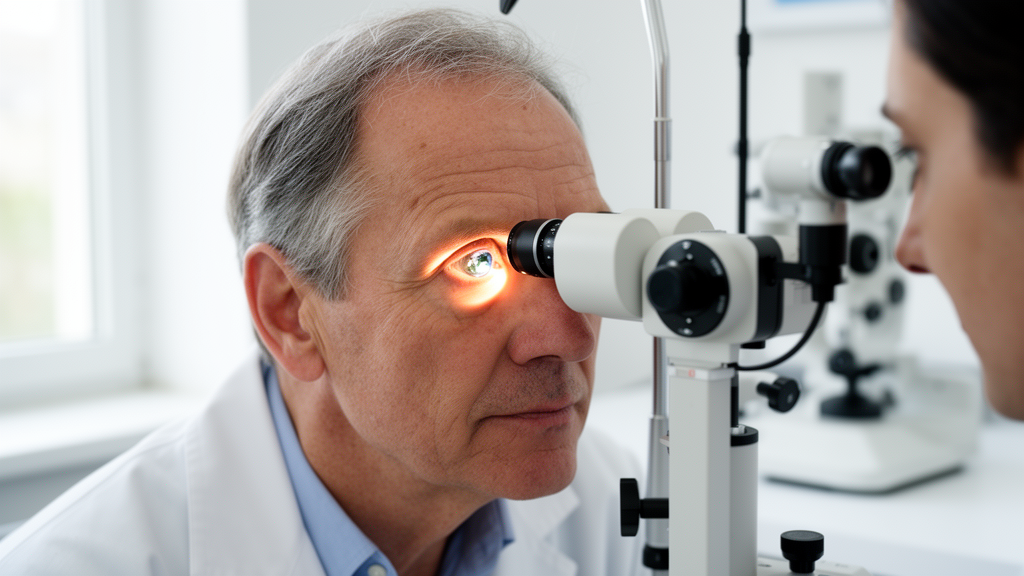
A routine eye scan that takes seconds and involves nothing more than a beam of light may one day help doctors predict who is about to have a heart attack or stroke. That is the tantalizing implication of a new study drawing on the UK Biobank, in which researchers found that the thickness of two thin layers of nerve tissue at the back of the eye is linked to the risk of suffering a major cardiovascular event years later. The work, published in the Journal of Neurology, analyzed optical coherence tomography (OCT) images from 51,293 British adults and followed them for a median of nearly 15 years, making it one of the largest investigations ever conducted into the connection between retinal structure and future heart and brain disease.
OCT is a workhorse of modern ophthalmology. The technique uses low-coherence light waves to build cross-sectional images of the retina, resolving its ten distinct layers with micrometer precision. Because the retina is embryologically and physiologically an outpost of the central nervous system, its delicate microvasculature offers what the researchers describe as a noninvasive, side-effect-free quick look into the brain. Ophthalmologists already rely on OCT to screen for glaucoma, diabetic retinopathy, and macular degeneration. What the new study adds is the suggestion that the same scan, already fast and comparatively cheap, might also carry a hidden cardiovascular report card.
The research team, led by Martin Hänsel, Julian Deseoe, and Susanne Wegener of the University Hospital Zurich, focused on two inner retinal layers: the retinal nerve fiber layer (RNFL), a thin sheet of axons funneling visual signals toward the optic nerve, and the ganglion cell-inner plexiform layer (GCIPL), which contains the cell bodies and synaptic connections of retinal neurons. Earlier studies had shown that patients who had already survived a stroke or heart attack tend to have thinner RNFL and GCIPL measurements. The open question was whether thinning could be detected before the event, in seemingly healthy people, and whether it carried information beyond conventional risk factors.
To answer it, the team mined the UK Biobank, a population-based cohort of more than half a million adults aged 40 to 69 recruited between 2006 and 2010. Roughly a tenth of participants underwent OCT imaging with a spectral-domain Topcon device using a standardized 6 by 6 millimeter macular raster scan of 128 B-scans. Custom segmentation software automatically delineated the retinal boundaries, and the investigators applied strict quality control, discarding the poorest 20 percent of images based on quality scores, excluding participants who reported eye disease, and requiring complete data on cardiovascular risk factors. After these filters, 51,293 participants remained, of whom 1,506, or 2.9 percent, had already experienced a stroke or myocardial infarction before their eye scan.
The first finding concerned the past rather than the future. Participants with prior cardiovascular disease had measurably thinner inner retinas than their event-free peers: the RNFL averaged 28.97 micrometers in the CVD group versus 29.70 micrometers in those without, the GCIPL 72.99 versus 74.21 micrometers, and a photoreceptor-related measure called ISOS.RPE also differed significantly. The other layers examined showed no such difference. The researchers then turned to the 49,787 participants with no prior cardiovascular events and asked a forward-looking question: did retinal thickness at baseline predict who would go on to suffer a major adverse cardiovascular event, a composite of stroke, myocardial infarction, and cardiovascular death, during follow-up?
The answer was yes. In cause-specific hazard models, which properly account for the competing risk of dying from non-cardiovascular causes, each standard deviation increase in RNFL thickness was associated with an 8 percent lower risk of a future event (adjusted hazard ratio 0.92, 95 percent confidence interval 0.89 to 0.96, p < 0.001), while each standard deviation of additional GCIPL thickness carried a 4 percent reduction (adjusted hazard ratio 0.96, 95 percent confidence interval 0.92 to 1.00, p = 0.04). Crucially, these associations survived adjustment for a wide range of traditional cardiovascular risk factors, including age, sex, blood pressure, diabetes, cholesterol, body mass index, smoking, and atrial fibrillation. The relationship was linear, with no evidence of nonlinear effects, and it did not differ between men and women.
The absolute differences were striking when participants were sorted into thin, medium, and thick groups. Over ten years, people with the thinnest RNFL had a cumulative incidence of major cardiovascular events of 5.19 percent, nearly double the 2.78 percent seen in those with the thickest RNFL. The same gradient appeared for the GCIPL: 4.76 percent of the thinnest group suffered an event within a decade, compared with 2.42 percent of the thickest group, roughly a halving of risk across the retinal spectrum.
Perhaps the most intriguing technical detail is a double dissociation between the two layers and the two event types. RNFL thickness was more strongly associated with myocardial infarction (adjusted hazard ratio 0.94, p = 0.02), while GCIPL thickness was more strongly linked to incident stroke (adjusted hazard ratio 0.90, p = 0.003), with the complementary layer showing weaker, non-significant associations in each case. The authors propose a microvascular explanation. The RNFL is fed primarily by the radial peripapillary capillary plexus, whose capillaries run parallel to the nerve fibers, whereas the GCIPL is supplied by the superficial vascular plexus with a lobular architecture. Because atherosclerosis is a systemic disease, subclinical narrowing of the central retinal artery and its branches would chronically starve these layers of oxygen, and the two distinct vascular bed architectures may respond differently to the risk factor profiles that predispose to coronary versus cerebral events. A recent Mendelian randomization study supports the idea of shared underlying causes between retinal layer thickness and cardiovascular disease.
How much does the eye scan actually add to prediction? The honest answer: modestly. Adding RNFL and GCIPL thickness to a simple model based on age and sex alone nudged the area under the receiver operating characteristic curve for 10-year event prediction from 0.708 to 0.710, a statistically significant but small improvement, with even smaller gains when the layers were added to fully adjusted models. The authors are candid about this gap between statistical significance and clinical relevance. They also emphasize that their cohort excluded people over 69, precisely the age group with the highest cardiovascular risk, as well as anyone with pre-existing eye disease, and that the observational design cannot establish causation. Whether RNFL and GCIPL thinning actually contributes to disease or merely mirrors it in the retinal microcirculation remains unresolved.
Still, the study offers practical building blocks for the future. The team generated age- and sex-specific normative values for RNFL and GCIPL thickness in healthy adults, giving clinicians a reference frame should retinal measurements ever be folded into risk screening, particularly for people with a family history of cardiovascular disease. The authors sketch a roadmap for improving performance: combining layer thickness with OCT angiography measures such as vessel density, tracking individual retinal trajectories over time rather than single snapshots, and disentangling ischemic from hemorrhagic stroke, which was not done here. Prospective validation studies will be needed before any ophthalmology practice doubles as a cardiac screening station. For now, the message is one of cautious excitement: the eye has long been called a window to the soul, but a growing body of evidence suggests it may also be a window to the heart, and the view is getting clearer with every scan.
Subject of Research: Retinal layer thickness measured by optical coherence tomography as a predictor of future major adverse cardiovascular events in the UK Biobank cohort
Article Title: Retinal layer thickness as a potential marker for future cardiovascular events – a UK Biobank cohort study using optical coherence tomography
Article References: Retinal layer thickness as a potential marker for future cardiovascular events – a UK Biobank cohort study using optical coherence tomography. (n.d.). https://doi.org/10.1007/s00415-026-14175-4
Image Credits: AI Generated
DOI: 10.1007/s00415-026-14175-4
Keywords: optical coherence tomography, retinal nerve fiber layer, ganglion cell-inner plexiform layer, cardiovascular risk prediction, UK Biobank, stroke, myocardial infarction, major adverse cardiovascular events, retinal microvasculature, risk screening, Journal of Neurology, population cohort study
Cite Scienmag News
Cassandra Pierce. (October 16, 2026). Eye Scan Could Warn of Heart Attacks and Strokes Years in Advance, Study of 51,000 Suggests. Scienmag. https://scienmag.com/eye-scan-could-warn-of-heart-attacks-and-strokes-years-in-advance-study-of-51000-suggests/
Cassandra Pierce. "Eye Scan Could Warn of Heart Attacks and Strokes Years in Advance, Study of 51,000 Suggests." Scienmag, 16 October 2026, https://scienmag.com/eye-scan-could-warn-of-heart-attacks-and-strokes-years-in-advance-study-of-51000-suggests/. Accessed 16 October 2026.
Cassandra Pierce. "Eye Scan Could Warn of Heart Attacks and Strokes Years in Advance, Study of 51,000 Suggests." Scienmag. October 16, 2026. https://scienmag.com/eye-scan-could-warn-of-heart-attacks-and-strokes-years-in-advance-study-of-51000-suggests/


