


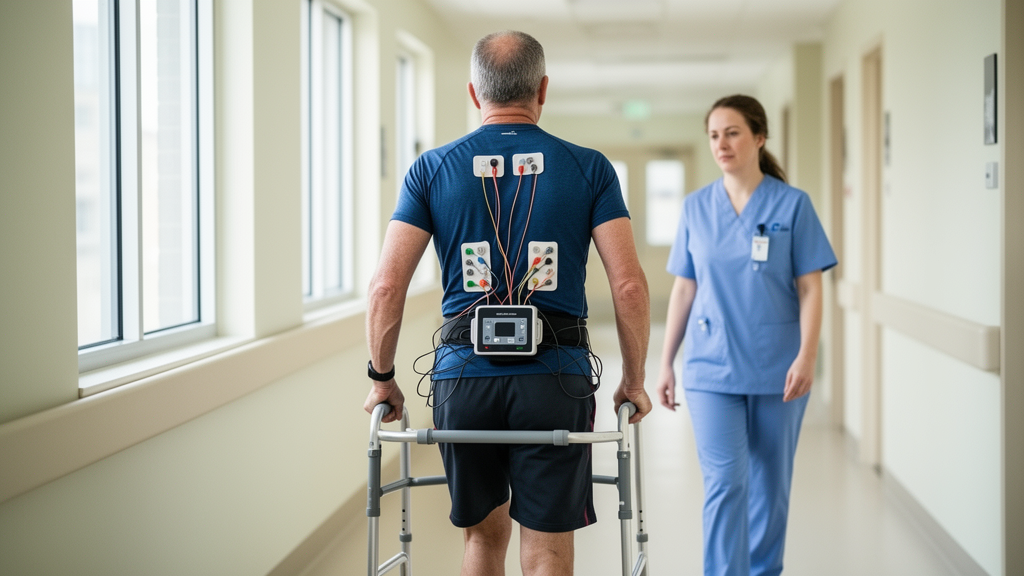
For a 23-year-old woman in Shanghai with a rare inherited movement disorder, the simplest acts of standing and walking had been slipping away since her early teens. A decade of progressive leg stiffness had taken her from a noticeably abnormal gait at age thirteen to a walker and twenty-meter walking limits by twenty-one. Now, in a report that is generating attention in rehabilitation circles, clinicians at Shanghai Eighth People’s Hospital describe how a carefully orchestrated combination of three therapies, delivered over just three months, transformed her spasticity, strength, balance, and even her mood.
The woman carries a genetic diagnosis of hereditary spastic paraplegia type 11, or SPG11, the most common autosomal recessive form of a group of neurodegenerative conditions defined by progressive degeneration of the corticospinal tracts, the long nerve fiber highways running from the brain’s motor cortex down the spinal cord. SPG11 mutations account for roughly twenty percent of all recessive hereditary spastic paraplegia cases, and because no disease-modifying treatment exists, care has long been limited to managing symptoms as the degeneration advances. Her case, documented by Haodong Zhang, Jie Shen, and Yanping Qu, was confirmed by genetic testing that revealed compound heterozygous mutations in the SPG11 gene, alongside brain MRI findings typical of the disease, including a markedly thinned corpus callosum and increased signal in the periventricular white matter.
The cornerstone of her treatment was intrathecal baclofen, a therapy in which a small pump is surgically implanted to deliver the muscle-relaxing drug baclofen directly into the spinal fluid. Because oral baclofen crosses the blood-brain barrier poorly, patients need high doses that cause drowsiness, dizziness, and generalized weakness. Direct spinal delivery achieves high drug concentrations where they matter with minimal systemic exposure, and it is an established treatment for severe refractory spasticity. But the drug has a fundamental limitation: it quiets overactive spinal reflexes without touching the cortical damage upstream. The result is what clinicians call a functional ceiling, a point at which reduced spasticity no longer translates into genuine gains in independent mobility.
That ceiling is precisely what the Shanghai team set out to break through. Their strategy layered two additional interventions on top of the baclofen pump. The first was intermittent theta-burst stimulation, or iTBS, a refined form of transcranial magnetic stimulation in which rapid bursts of magnetic pulses are applied to the scalp over the motor cortex. The protocol used 50 Hz intra-burst pulses repeated at 5 Hz, with 600 pulses delivered to each hemisphere per session in just three minutes and twenty seconds per side, at 67 percent of the patient’s resting motor threshold, five days a week for three months. The second was functional electrical stimulation, or FES, which uses surface electrodes over the quadriceps, tibialis anterior, and gluteus maximus muscles to deliver biphasic square-wave currents at 30 to 50 Hz, evoking visible, coordinated muscle contractions.
The logic of pairing these techniques is rooted in neuroplasticity science. iTBS induces long-term potentiation-like changes in the primary motor cortex, strengthening rather than dampening corticospinal output, which is the opposite of what continuous theta-burst stimulation would achieve. At the molecular level, excitatory stimulation engages NMDA receptor-dependent signaling, calcium-dependent plasticity mechanisms, and BDNF-TrkB pathways that promote synaptic remodeling. FES, meanwhile, activates alpha motor neurons and Ia afferent fibers, sending proprioceptive feedback up the spinal cord. When the two are timed together, the convergent cortical and peripheral signals may reinforce corticospinal synapses through spike-timing-dependent plasticity, a Hebbian learning rule in which neurons that fire together wire together. The combined approach forms a bidirectional framework: top-down corticospinal modulation meeting bottom-up sensory input.
Before any of that could work, however, the team had to solve a subtler problem: finding the right baclofen dose. At the initial 40 micrograms per day, spasticity remained severe. Raising the dose to 61.18 micrograms brought muscle tone down and strength and balance up. But pushing further to 70.36 micrograms produced a paradoxical decline, because too little tone left the patient without the residual stiffness that supports weight-bearing and postural stability. The optimum emerged at 62.82 micrograms per day, where spasticity was controlled enough to permit movement while residual tone still buttressed dynamic balance. The case underscores a principle increasingly emphasized in the field: intrathecal baclofen dosing should be titrated against functional outcomes rather than spasticity scores alone, demanding close coordination between neurosurgeons and rehabilitation teams.
The measured results were striking. Total Modified Ashworth Scale scores, which grade spasticity across the hip, knee, and ankle, fell from 12 per leg to 4, with knee flexors dropping from grade 2 to a completely normal 0. Manual muscle testing totals nearly tripled, rising from 8 on the right and 9 on the left to 22 on each side. The Berg Balance Scale, a fourteen-task measure of static and dynamic balance, climbed from 19 to 26 out of 56, while the trajectory length of the center of pressure during quiet standing, a biomechanical index of postural sway, shortened from 25.3 to 22.9 centimeters, indicating improved stability. Perhaps most importantly, the patient regained the ability to walk indoors using a walker.
The psychological gains were just as notable. Her Hamilton Anxiety Scale score fell from 10 to 5 and her Hamilton Depression Scale score from 10 to 6, alongside a documented baseline of mild anxiety and depression. The pattern matters because epidemiological data show that up to sixty percent of people with hereditary spastic paraplegia develop clinically significant mood disorders tied to chronic spasticity and progressive loss of autonomy. The authors suggest the multimodal intervention interrupted a spasticity-anxiety feedback loop: relieving persistent muscular discomfort and restoring the capacity to ambulate boosted self-efficacy, which in turn supports rehabilitation adherence in a self-reinforcing cycle. Throughout the three-month program, no adverse events were reported for either stimulation modality, and the patient tolerated both well under structured monitoring for headaches, scalp discomfort, dizziness, and other known stimulation side effects.
The report carries real significance as the first documented use of combined intrathecal baclofen, iTBS, and FES in a genetically confirmed SPG11 patient, building on earlier evidence that the stimulation pairing improves hand function after stroke and gait after spinal cord injury. But the authors are candid about the limits. A single-patient design cannot establish efficacy or a dose-response relationship, the three-month follow-up is too short to judge durability in a progressive disease, and rating scales like the Ashworth scale involve subjective judgment. Because baclofen titration happened concurrently with the stimulation therapies, the individual contributions of each component cannot be disentangled. The team also notes a technical caveat: the resting motor threshold was measured from a hand muscle even though stimulation targeted the leg cortex, which sits deeper and more medially and may require different intensities; future work should calibrate from lower-limb muscles directly.
Still, the case offers a provocative template for tackling progressive neuromuscular disease. Rather than treating spasticity in isolation, the regimen treated the whole motor network, using the drug to open what the authors call a permissive neuroplastic window at the spinal level, magnetic stimulation to strengthen descending drive from above, and electrical stimulation to feed coordinated sensory information back from below. If larger controlled trials confirm the approach, the idea that inherited corticospinal degeneration can be functionally circumvented, at least in part, would represent a meaningful shift in the rehabilitation of hereditary spastic paraplegia, a condition long managed with resignation. For now, one young woman who could not stand unassisted is walking indoors with a walker, and the field is watching closely to see whether the recipe can be repeated.
Subject of Research: Combined neuromodulation and intrathecal baclofen therapy for hereditary spastic paraplegia type 11
Article Title: Combined intermittent theta-burst stimulation and functional electrical stimulation as adjuncts to intrathecal baclofen in hereditary spastic paraplegia type 11: a case report
Article References: Zhang, H., Shen, J., & Qu, Y. (2026). Combined intermittent theta-burst stimulation and functional electrical stimulation as adjuncts to intrathecal baclofen in hereditary spastic paraplegia type 11: a case report. Frontiers in Rehabilitation Sciences, 7, Article 1942850. https://doi.org/10.3389/fresc.2026.1942850
Image Credits: AI Generated
DOI: 10.3389/fresc.2026.1942850
Keywords: hereditary spastic paraplegia, SPG11, intrathecal baclofen, intermittent theta-burst stimulation, functional electrical stimulation, neuroplasticity, spasticity, rehabilitation, transcranial magnetic stimulation, case report, motor cortex, balance
Cite Scienmag News
Cassandra Pierce. (October 16, 2026). Brain Stimulation Plus Electrical Pulses Help Patient With Rare Paralysis Gene Walk Again. Scienmag. https://scienmag.com/brain-stimulation-plus-electrical-pulses-help-patient-with-rare-paralysis-gene-walk-again/
Cassandra Pierce. "Brain Stimulation Plus Electrical Pulses Help Patient With Rare Paralysis Gene Walk Again." Scienmag, 16 October 2026, https://scienmag.com/brain-stimulation-plus-electrical-pulses-help-patient-with-rare-paralysis-gene-walk-again/. Accessed 16 October 2026.
Cassandra Pierce. "Brain Stimulation Plus Electrical Pulses Help Patient With Rare Paralysis Gene Walk Again." Scienmag. October 16, 2026. https://scienmag.com/brain-stimulation-plus-electrical-pulses-help-patient-with-rare-paralysis-gene-walk-again/


